DeepSeek from Beginner to Expert: A Full Breakdown of V3 and R1 Models with Practical Tips to Avoid Pitfalls
DeepSeek rises on open source, free access, and high performance—switch between V3 and R1 based on the scenario.
This article systematically breaks down DeepSeek's five keywords—AI, domestic, free, open source, and powerful—pointing out that open source and free commercial use are its core advantages over closed-source models. It distinguishes the division of labor between the V3 general model and the R1 reasoning model: V3 suits everyday tasks, while R1 excels at logic-intensive scenarios like math and coding—a difference in scenarios, not a version replacement. R1's performance rivals OpenAI O1, yet its API price is orders of magnitude lower and it's fully open source. In practice, R1's coding experience is on par with Claude and Copilot. The article also reminds beginners to avoid leaving R1 on all the time for simple tasks and to switch models based on the scenario.
DeepSeek's explosive rise has given many non-technical users their first real experience with a top-tier large model. But beyond the fragmented information from short videos and news feeds, its technical lineage, model differences, and usage logic deserve a systematic breakdown. This article is based on a step-by-step tutorial from a Bilibili creator, combined with consensus from creators across multiple platforms, to help you understand what DeepSeek actually is, how to use it, and why it deserves to become a mainstay tool in your daily work.
DeepSeek's Five Keywords: AI, Domestic, Free, Open Source, Powerful
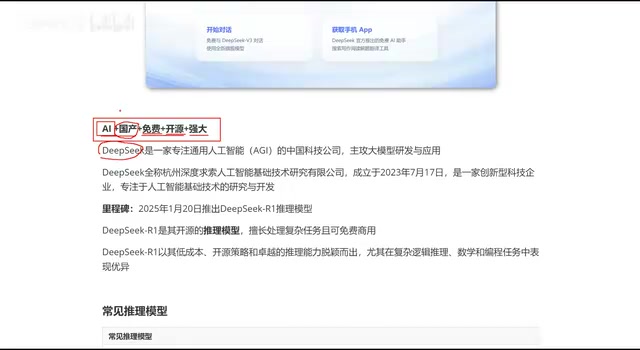
According to the Bilibili creator's breakdown in the tutorial, understanding DeepSeekAd can start with five keywords: AI, domestic, free, open source, and powerful. These five words aren't just a pile of labels—they form the underlying logic of why it can be widely used in China.
When ChatGPT burst onto the scene, it genuinely shocked the world, but most domestic users didn't get to experience its capabilities right away due to network restrictions. The various large models subsequently launched by major Chinese tech companies, while numerous, still had obvious gaps compared to the GPT series and failed to generate a similar level of excitement. What sets DeepSeek apart is that it's a Chinese company capable of matching OpenAI, and because it's "domestic" and "free," ordinary users can experience it directly by downloading the app or visiting the website.
"Open source" is another key dividing line. According to cross-analysis from the Bilibili creator and YouTube tech channels, OpenAI's O1 reasoning model is closed-source, while DeepSeek R1 rivals O1 yet is fully open source. Open source means a longer technical lifecycle and broader commercial reuse potential—the official team explicitly supports free commercial use, and enterprises can adopt it directly.
Open-source large models refer to models whose weights, architecture, and even training details are made public, allowing anyone to download, modify, and redistribute them. Unlike closed-source models (such as OpenAI's GPT-4 and O1), which can only be accessed via API calls, open-source models can be privately deployed by enterprises, keeping data on-premises and making it easy to fine-tune for specific domains. DeepSeek R1 uses the MIT license, explicitly permitting free commercial use—extremely rare among top-tier reasoning models. Open source also means the community can audit model behavior, reproduce results, and build derivative tools on top, thereby accelerating technical iteration and ecosystem prosperity.
The Division of Labor Between the Two Models: V3 General Model and R1 Reasoning Model
DeepSeek has two core models: the V3 general model and the R1 reasoning model. Many beginners easily misunderstand them as a "who's more advanced" relationship, but as the creator emphasized, this is a difference in application scenarios, not a hierarchical replacement.
V3 is designed for everyday task processing—making a spreadsheet, asking basic common-sense questions, organizing materials—tasks without complex logic chains that can be handled by direct input. R1 excels at scenarios requiring multi-step reasoning, such as math problems, coding, and logical analysis. In the web version, users need to manually toggle on the "Deep Think R1" switch to invoke the reasoning model.
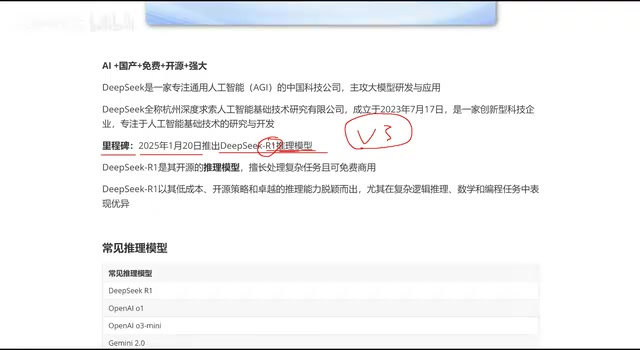
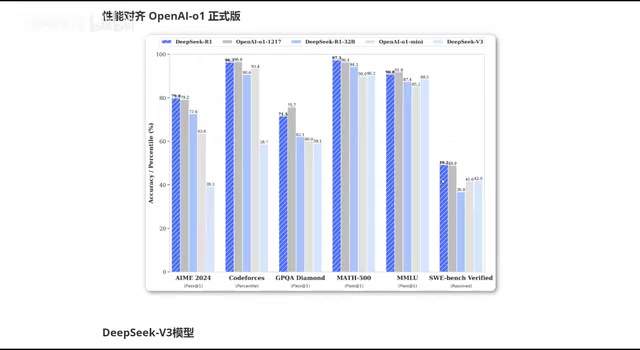
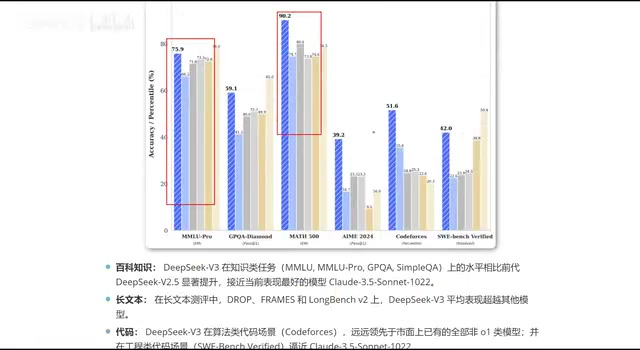
According to the officially released performance comparison charts, R1 and OpenAI O1 are essentially on par across various benchmarks. In comparisons between V3 and GPT-4o and Claude 3.5, V3 is close to Claude on encyclopedic knowledge, surpasses other models in long-text processing, approaches Claude in coding ability, and significantly leads all open-source and closed-source models of the time in mathematics. The creator also candidly noted that V3 still has a gap compared to the best-performing models in Chinese language ability, and the official team doesn't shy away from this—such candor is itself a reflection of technical confidence.
The core difference between reasoning models (like DeepSeek R1 and OpenAI O1) and general models (like V3 and GPT-4o) is whether they perform explicit multi-step thinking before outputting an answer. Reasoning models generate longer internal reasoning chains (chains of thought), progressively decomposing problems, verifying hypotheses, and then giving the final answer, making them better suited for mathematical proofs, complex code debugging, and logic puzzles. The cost is slower response times and higher token consumption. General models generate answers directly, suitable for lightweight tasks like factual Q&A and text organization. In the DeepSeek web version, toggling on "Deep Think R1" invokes the reasoning model, while toggling it off uses V3, allowing users to switch flexibly based on task complexity.
Hands-On Experience: Coding on Par with Claude, at a Fraction of the Price
According to the creator's own account, he had extensively used Claude to assist with coding over the past year or two, and also used the integrated Copilot in VS Code—both experiences were excellent. But after switching to DeepSeek, he felt no noticeable drop-off, and it even began to fully replace his previous tools for daily searches and code writing. This experience aligns with feedback from multiple developers in the community: R1's feedback quality on coding tasks is outstanding.
Cost is another decisive factor. The product pricing on the official API open platform shows that the price gap between R1 and O1 is many times over. The official news page also discloses the timeline of each version: V2 was released in October 2024 (original text says "24年19月"—likely a typo), R1 was released in November 2024, V3's official version was released in December 2024, and the R1 official version was released on January 12, 2025—it was this January version that truly set the market ablaze.
The creator also mentioned a widely discussed figure: R1's training cost was reportedly only $5.7 million at the time. This number itself has different interpretations in the technical community, but the signal it sends is clear—the combination of low cost, high performance, and open source is changing the competitive landscape of large models.
API (Application Programming Interface) is how developers integrate model capabilities into their own applications, billed by usage (number of tokens). DeepSeek's open platform API pricing is far lower than comparable OpenAI models—R1's input/output prices are roughly a few dozen times cheaper than O1's—dramatically reducing costs for scenarios like batch processing and automated workflows. For enterprises, the API also supports private data integration and customized development, whereas the web version is only for individual interaction. Understanding the capability boundaries between the API and the web version helps you choose the right access method when you need to process at scale.
The Shift in Usage Scenarios: From Search Engines to AI Conversations
One observation in the tutorial is worth noting: in the past, when encountering a question you didn't understand, you'd ask Baidu or Bing; now the mindset has completely shifted—you directly open the DeepSeek or ChatGPT app or website and ask. This habit migration is not an isolated case. The creator mentioned that many companies and even government agencies are requiring employees to use AI products to improve work efficiency, because output pressure in the market environment continues to increase.
This also explains why "knowing how to use AI" is shifting from a bonus skill to a baseline requirement. DeepSeek's free strategy lowers the barrier to entry, but what truly separates people is the ability to correctly choose V3 or R1 based on task type—use V3 for everyday chores when speed matters, and toggle on R1 for logic-intensive tasks when accuracy matters. This simple switching action is the pitfall most easily overlooked by beginners.
Common Misconceptions and Pitfall Avoidance Tips
According to multi-source analysis, the three most common misconceptions among beginners are: treating R1 as the default model and leaving it on all the time, causing slower responses on simple tasks; misunderstanding V3 and R1 as an old-versus-new version relationship, missing out on the efficiency advantages of the general model for lightweight tasks; and ignoring the capability boundary differences between the API and the web version, still operating manually when batch processing is needed. Clarifying the division of labor between models and switching based on scenarios is more practical than blindly chasing the "strongest model."
DeepSeek's rise is not a single-point breakthrough but a combined result of open-source strategy, cost structure, and model capability. For ordinary users, understanding this logic has more long-term value than memorizing a few prompt tricks.
Chain of Thought is the step-by-step reasoning process that reasoning models generate internally; users typically only see the final answer, though some platforms allow viewing intermediate steps. The longer the chain of thought, the more tokens the model consumes and the longer the response time. For simple queries (like "what's the weather today"), forcing the reasoning model on causes unnecessary latency and compute waste. Therefore, dynamically switching models based on task complexity is a key technique for using DeepSeek efficiently.
One-line Summary
DeepSeek rises on open source, free access, and high performance—switch between V3 and R1 based on the scenario.
Paragraph Summary
This article systematically breaks down DeepSeek's five keywords—AI, domestic, free, open source, and powerful—pointing out that open source and free commercial use are its core advantages over closed-source models. It distinguishes the division of labor between the V3 general model and the R1 reasoning model: V3 suits everyday tasks, while R1 excels at logic-intensive scenarios like math and coding—a difference in scenarios, not a version replacement. R1's performance rivals OpenAI O1, yet its API price is orders of magnitude lower and it's fully open source. In practice, R1's coding experience is on par with Claude and Copilot. The article also reminds beginners to avoid leaving R1 on all the time for simple tasks and to switch models based on the scenario.
Related articles

Gemini 4 Hydrogen Released: A 2.5x Faster Everyday AI Model
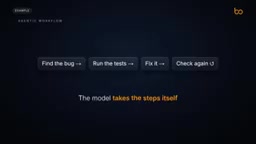
Google releases Gemini 4 Hydrogen, claiming 2.5x the speed of Gemini 3.8 Flash, with four-tier thinking control, a million-token context, and Orchestrator multi-model collaboration. API pricing is $1.50 per million input tokens.
Gemini 4 Hydrogen Hands-On: Google's Fastest and Cheapest AI Model
Hands-on with Gemini 4 Hydrogen: the fastest, cheapest model in the Gemini 4 family. We break down the Carbon/Argon/Hydrogen split, API pricing traps, free-tier limits, and the cost trade-offs of four thinking levels—with a real bug-debugging demo.
Gemini 4 Hydrogen vs Sonnet Comparison Test: Uses Only 1% of Weekly Quota, Performance on Par
Hands-on test: Gemini 4 Hydrogen vs Sonnet on the same CRUD task—Hydrogen used only 1% weekly quota with comparable performance and better UI details, while Anthropic's model used 7%. Developer says daily tasks don't require expensive models.