DeepSeek Harness Architecture Explained: The "Everything is a Plugin" AI Agent Engineering System

DeepSeek Harness reveals why engineering systems, not models alone, determine AI agent performance.
DeepSeek Harness introduces an 'Everything is a Plugin' architecture that explains why the same AI model performs differently across tools. The framework comprises seven engineering modules — tool invocation, file system, sandbox, context management, memory, orchestration, and feedback loops — establishing that while models set the performance floor, the Harness engineering layer sets the ceiling.
The Release of DeepSeek Harness: Everything is a Plugin
DeepSeekAd recently released a developer preview of Harness, summarizing its core philosophy in one phrase — Everything is a Plugin. This release quickly caught the attention of the AI developer community, not just as a product, but as a representation of an architectural paradigm that is becoming an industry consensus.
For developers, the onboarding cost is minimal. As long as you have Node.js installed locally, a single command completes the installation:
npx @deepseek-ai/dsh web
The npx used here is a command execution tool built into npm since version 5.2 of Node.js's package manager. It allows developers to execute commands from a package without installing it globally. This design philosophy reduces toolchain pollution and enables tools like DeepSeek Harness to achieve a "one command to run" experience. The Node.js ecosystem has become one of the preferred runtimes for AI development tools because its event-driven, non-blocking I/O model is naturally suited for handling asynchronous calls in AI inference, combined with the vast npm ecosystem providing rich middleware support.
If you want to dive deeper into the source code at this stage, you can also clone the project directly from GitHub for study. It's worth noting that the official introduction page provided by DeepSeek is accessible without a VPN, lowering the barrier for developers in China.
But what truly deserves our time to discuss isn't the installation steps — it's the architectural thinking behind Harness.
What is Harness: Not Just a Product, But an Architectural Paradigm
The English word "Harness" originally means the equipment placed on a horse to control and direct it. This naming perfectly captures its essence.
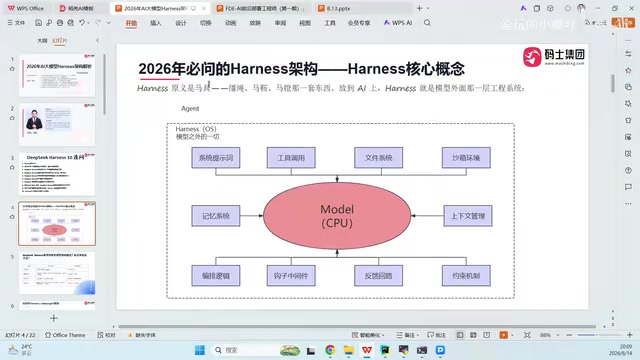
From "Wild Horse" to a Controllable AI Model
Today's large models are incredibly powerful — like a horse brimming with strength. The problem is, it's more like a wild horse — impressive in capability, but when you need to deploy it in an enterprise environment for actual tool invocation or agent applications, it struggles to reliably complete complex tasks without external "harness" to constrain and guide it.
The AI Agent mentioned here refers to an autonomous system capable of perceiving its environment, making decisions, and taking actions to achieve goals. Unlike simple chatbots, agents possess capabilities like tool invocation, multi-step reasoning, and environment interaction. From the AutoGPT-driven Agent hype in 2023 to the production deployment of products like OpenAI Codex and Anthropic Claude Code in 2024, agent architecture has rapidly evolved from proof-of-concept to engineering-grade implementation. The current industry consensus is clear: model inference capability alone is insufficient to constitute a usable agent product — it must be paired with a complete engineering framework for reliable operation.
Harness is precisely that engineering system layered on top of the model. It's responsible for connecting the model to the real world: linking to file systems, terminals, browsers, web coding environments, and more.
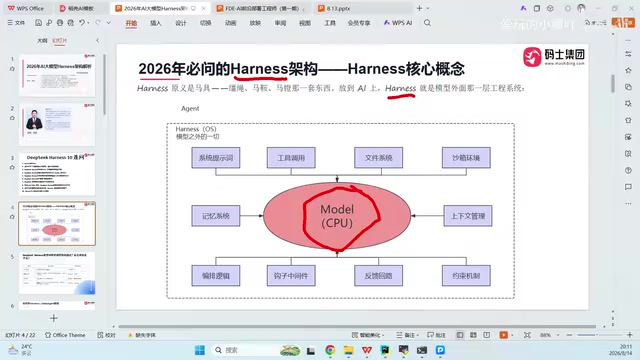
Two Levels of Understanding Harness Architecture
If asked "What is Harness?" in an interview or technical discussion, there are two levels worth mastering:
Broad level: It's an architecture. This architecture has long been widely applied in mainstream AI tools and frameworks like Claude Code and Codex. DeepSeek Harness simply gave this architecture an explicit name and presented it as an official product.
Narrow level: It's an agent product created by DeepSeek that highly conforms to the Harness architecture. You can absolutely build your own agent based on the Harness architecture — for example, branding it and making it available to users as an agent application.
The Core Pain Point: Why the Same Model Seems Dumber in a Different Tool
This is the key pain point that Harness architecture aims to solve, and a phenomenon many developers have experienced firsthand: The same model performs excellently in Tool A but appears stupid in Tool B.
For example, why does the same DeepSeek model work great for some people but poorly for others?
The Model Sets the Floor, Harness Sets the Ceiling
The answer usually doesn't lie in the model itself. Suppose Agent A and Agent B use the same underlying model:
- Agent A: Has good memory sets, excellent tool invocation, comprehensive context management, constraint mechanisms when errors occur, and can safely execute in a sandbox environment — it appears very intelligent.
- Agent B: These engineering capabilities are poorly implemented or missing entirely, with no feedback or fallback handling when errors occur — it appears stupid.
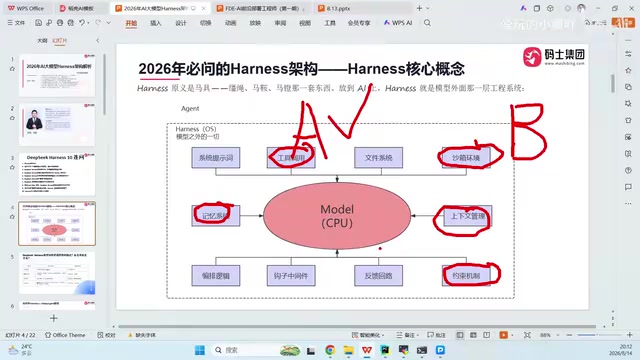
The conclusion is clear and profound: The model only determines an agent's floor, while the Harness engineering layer determines its ceiling.
To use an analogy: the model is like a CPU, responsible for judgment and computation; Harness handles everything else — the entire engineering system beyond the model. Just as a computer with a top-tier CPU but lacking memory, storage, and an operating system cannot accomplish real tasks, large models also need a complete engineering system to realize their true potential.
The Seven Core Modules of Harness Architecture
The early DeepAgents framework was actually a complete Harness architecture implementation, built around approximately seven engineering modules:
Detailed Breakdown of the Seven Engineering Layers
-
Tool Invocation: Enabling the model to call external tools to execute specific tasks. Since 2024, Anthropic's MCP (Model Context Protocol) is becoming the industry standard for tool invocation — it defines a unified interface specification for model-to-tool interaction, allowing different tool providers to connect to agent systems through a standardized protocol. DeepSeek Harness's "Everything is a Plugin" philosophy is highly aligned with MCP's design philosophy: abstracting all external capabilities into standardized plugin interfaces, enabling agents to flexibly combine various tools without writing custom adapter code for each one.
-
File System: Providing the model with persistent file read/write capabilities, enabling it to create, modify, and manage project files — a foundational capability for code generation agents.
-
Sandbox Environment: Safely executing code in isolated environments. A sandbox is a security mechanism that restricts program execution to a controlled environment, preventing code execution from damaging the host system. In AI agent scenarios, sandboxing is particularly critical — because model-generated code may contain dangerous operations (such as file deletion, network attacks, etc.). Common sandbox implementations include containerization technology (such as Docker), virtual machine isolation, WebAssembly runtimes (such as Wasmer), and OS-level process isolation (such as Linux's seccomp and namespaces). Different approaches offer varying tradeoffs between performance and security.
-
Context Management: Managing conversation and task context information. This is one of the most technically challenging modules in Harness architecture. Although large model context windows are continuously expanding (from the initial 4K tokens to today's 128K or even longer), three core problems remain: first, longer contexts mean higher inference costs, requiring intelligent trimming strategies; second, the "attention dilution" phenomenon — the model's attention to the middle portions of long contexts significantly decreases (the "Lost in the Middle" problem); third, information redundancy accumulation in multi-turn conversations. Therefore, the Harness layer needs to implement context compression, summarization, retrieval augmentation, and other strategies to ensure the information passed to the model is both concise and complete.
-
Memory System: Compensating for the inherent "lack of memory" in large models.
-
Logic Orchestration and Middleware: Coordinating the execution flow of multiple components, similar to the middleware mechanism in Express/Koa in web development, allowing custom logic to be inserted at different stages of request processing.
-
Feedback Loops and Constraint Mechanisms: Defining the model's boundaries and handling fallbacks when errors occur — whether to auto-retry or hand off to a human. Feedback loops borrow from the closed-loop control concept in cybernetics: system output is fed back into the decision process to correct subsequent behavior. In agent engineering, this manifests as the system checking whether execution results meet expectations after the model makes tool calls, triggering retry, degradation, or human intervention strategies if errors occur. Constraint mechanisms are similar to "Guardrails," including output format validation, permission control, cost caps, execution timeouts, etc. The sophistication of these mechanisms directly determines the agent's reliability in production environments.
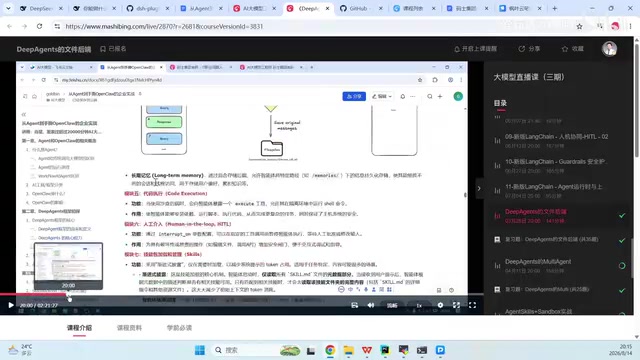
Why the Memory System is a Critical Component
The memory system deserves special emphasis here. Large models are inherently stateless and memoryless — what you asked in the previous message might be "forgotten" in the next. This is determined by the Transformer architecture's inference mechanism: every time the model generates a response, it recalculates attention based on the complete token sequence of the current input, rather than maintaining a persistent internal state. Therefore, Harness must build a memory system that records the series of operations the agent performs with the model, giving the entire interaction continuity.
Memory systems are typically divided into short-term memory (context cache for the current session) and long-term memory (knowledge persistence across sessions). Short-term memory can be managed through sliding windows, summary compression, and similar methods; long-term memory often relies on vector databases (such as Pinecone, Milvus, etc.) for semantic retrieval, or uses structured storage to record user preferences and historical decisions. This is also a crucial factor in determining whether an agent appears "intelligent."
Why AI Developers Must Master Harness Architecture
This architecture is becoming a core competency requirement in the AI engineering field. More and more interviewers are focusing on whether candidates understand the "engineering system beyond the model."
The divergence in technical paths is becoming increasingly clear:
- If you pursue the model itself direction, that's the algorithm and model training track — involving pre-training, fine-tuning, RLHF (Reinforcement Learning from Human Feedback), data engineering, and other deep research work;
- If you pursue the AI development direction, you'll almost inevitably move toward Harness architecture — focusing on how to transform existing model capabilities into reliable products and services.
This divergence is similar to the division between "chip design" and "system development" in the traditional software industry. Most developers don't need to manufacture CPUs themselves, but they must be proficient in building complete software systems on top of CPUs. Similarly, most AI developers don't need to train foundation models, but must master how to build engineered agent systems on top of models.
Companies and interviewers tend to favor those who embrace new technologies. Whoever masters new tech faster gains an advantage in job hunting, interviews, and even taking on project leadership roles. The release of DeepSeek Harness provides developers with an official vehicle for learning and practicing this architecture.
Summary: Harness Architecture is the Core Competitive Advantage of AI Agents
The value of DeepSeek Harness isn't that it's yet another AI tool to install and play with. Its value lies in clearly presenting "Harness Architecture" — an engineering paradigm becoming industry consensus — in the form of an official product.
Understanding Harness essentially means understanding one truth: In an era where large model capabilities are converging, what truly differentiates agents is the solid engineering system beyond the model. For developers looking to go deep in AI development, mastering Harness architecture is one of the most worthwhile knowledge investments right now.
From a broader industry perspective, the standardization of Harness architecture means AI development is transitioning from a "craft workshop" era to an "industrial" era. Just as web development evolved from early CGI scripts to MVC frameworks to microservice architectures, AI development is undergoing a similar engineering maturation process. Developers who grasp this paradigm shift will gain an early advantage in the coming explosion of AI applications.
Key Takeaways
Related articles

macOS Is No Longer UNIX: Apple Didn't Renew Certification, But the Technology Is Unchanged
Apple did not renew macOS's UNIX certification, and the Open Group has removed Apple's entry. This article analyzes the technical reality behind the expiration, Apple's possible intentions, and the practical impact on developers.

Building Stateful Multi-Agent Systems with Azure Cosmos DB
Based on the official Azure Cosmos DB tutorial, this article explains how to use the Agent Memory Toolkit to add shared persistent memory to a multi-agent travel planner, covering short-term, long-term, episodic, and semantic memory plus cross-session state continuity.

Production AI Agent Operations: A Three-Step Framework for Observing, Evaluating, and Optimizing
Azure Cosmos DB team proposes a three-step framework for production AI Agent operations: observe trace tracking, evaluate with LLM as a judge and regression testing, optimize cost across RU, retrieval, memory, and LLM layers.