DeepSeek Harness Desktop App Officially Launches: Open Source, Cross-Platform, Free ¥6 Credit on Sign-In

DeepSeek's official Harness desktop app launches on Windows & macOS, open source, with a limited-time ¥6 sign-in credit.
DeepSeek's official desktop client Harness has launched on both Windows and macOS as an open-source release, replacing the need for third-party wrapper apps. Users who download and log in can claim ¥6 in credits before October 6 — logging out and back in resolves any credit delays. Meanwhile, rumors of a simultaneous V4.1 Pro model release have been explicitly debunked by Cui Tianyi; the two are independent events.
DeepSeek Harness Desktop App Launches on Windows and macOS
DeepSeekAd's official desktop client, Harness, has officially launched with day-one support for both Windows and macOS — ready to use right out of the box. For users who have long relied on the web version or third-party wrapper apps, this marks the arrival of an officially maintained, more stable experience.
What makes this launch even more noteworthy is that Harness is open source from day one. Open sourcing has always been a defining characteristic that sets DeepSeek apart from some closed-source competitors — from releasing model weights to continuously opening up its toolchain, allowing the community to audit, extend, and customize. An open-source desktop client also gives developers far more room to integrate Harness into local workflows.
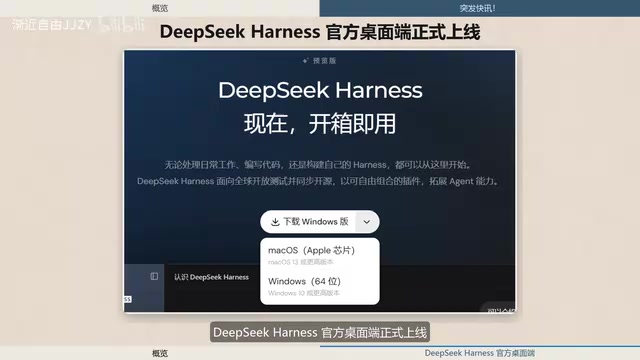
A "wrapper app" refers to a product built by third-party developers that packages DeepSeek's API or web interface into a standalone desktop application — essentially a re-wrap of the official service. While these tools can improve convenience, they come with clear limitations: updates lag behind the official release, data transmission security cannot be guaranteed, feature support is incomplete, and any change to the official API can break them entirely. As the official client, Harness integrates directly with backend services, gains priority access to new features, offers more stable connections, and provides stronger security and privacy guarantees. "Open source" means Harness's source code will be publicly released (typically hosted on platforms like GitHub), allowing anyone to review the code logic, identify potential security vulnerabilities, submit fixes, or build customized versions tailored to specific workflows — particularly valuable for enterprise private deployment scenarios.
Download and Log In to Claim ¥6 Credit — Expires October 6
The most immediately tangible perk of this launch is a ¥6 credit awarded simply for downloading and logging into the desktop app. This type of credit can typically be applied toward API calls or model usage fees, making it a genuine subsidy for frequent DeepSeek users and lightweight developers.
Note that the credit comes with a hard expiration date — October 6. Users who want to take advantage of this should act quickly, as the benefit will expire after that date. Given the timing, this looks like a new-user acquisition and activation strategy tied to the desktop launch, using a time-limited incentive to onboard the first wave of seed users.

What to Do If Your Credit Doesn't Arrive
Some users have reported that the credit didn't show up immediately after signing in. The current workaround is simple: log out and log back in, which typically triggers the credit to appear. This kind of issue is usually caused by server-side sync delays during a new client's initial rollout — a common occurrence at launch — and will likely be ironed out over time.

Will V4.1 Pro Launch Alongside the Desktop App? Officials Debunk the Rumor
Before the desktop app launched, a rumor circulated in the community claiming that DeepSeek V4.1 Pro would be unveiled alongside the official Harness desktop client. This speculation generated considerable excitement among users.
However, Cui Tianyi has since addressed this in the comments, clearly stating that there is no such plan for a "V4.1 Pro and desktop app simultaneous release." In other words, the launch of Harness and the release of the next-generation model are entirely independent events and should not be conflated.
Whether V4.1 Pro will arrive before the National Day holiday remains unknown. For users following DeepSeek's model roadmap, it's far better to rely on official announcements than unverified community speculation.

DeepSeek V4.1 Pro refers to an anticipated next-generation flagship language model from DeepSeek. The previously released V3 and R1 series attracted widespread attention for performance on multiple benchmarks that rivaled or surpassed mainstream closed-source models, fueling high community expectations for a "V4.1 Pro" successor. It's worth noting that a client tool (like Harness) and a model itself are entirely different product lines: the former is the "interface" through which users interact with the model, while the latter is the "engine" that provides the intelligence. Their development and release timelines are typically independent of each other, and conflating a desktop app launch with a new model release is a common misreading pattern in community discourse.
Wrap-Up
The launch of the DeepSeek Harness desktop app fills a long-missing piece of the puzzle — an official client — and the combination of open source and cross-platform support is a positive signal for both everyday users and developers. The time-limited ¥6 credit is a great opportunity to try it out, but keep an eye on the expiration date. As for rumors about V4.1 Pro, officials have clearly denied them — stay grounded and wait for the official word.
Related articles

5 Practical Ways Real Estate Agents Can Use AI to Boost Efficiency (2026 Edition)
How can real estate agents use AI to boost efficiency? Based on a YouTube walkthrough, this breaks down five methods — ChatGPT for listing descriptions, Canva for marketing materials, forms for open house leads, Zapier for automated follow-up, and seller meeting prep — and flags risk boundaries like fair housing laws, photo authenticity, and price verification.

Grok Bot vs ChatGPT Agent: Which AI Agent Is More Powerful?
How does Grok Bot differ from ChatGPT Agent? This comparison examines how they work: Grok Bot has a cloud computer and runs persistently inside tools to execute multi-step tasks automatically; ChatGPT Agent operates web pages in a browser and is more mature at general tasks. Includes selection advice.

Walmart Agent Gateway: AI Shops for You Automatically—Why Is Amazon Going the Opposite Way?
Walmart's Agent Gateway lets ChatGPT, Gemini and other AI assistants access its product catalog to search, compare and add to cart, with spending limits and per-purchase approval. Amazon blocks external AI agents—two retail giants, opposite paths. Currently US-only, India may follow.