DeepSeek Harness Hands-On Review: Core Advantages of a Plugin-Based Agent Framework

DeepSeek Harness delivers a plugin-based open-source Agent framework combining Claude Code's power with enterprise flexibility.
DeepSeek Harness is an open-source Agent development framework whose core advantage lies in its thoroughly plugin-based architecture. Unlike closed-source alternatives like Claude Code, everything in Harness — models, tools, sandboxes, memory, and UI — is a replaceable plugin. It offers strong coding capabilities via DeepSeek V4 Pro with high cache hit rates for minimal cost, web-based interaction, and supports both local and distributed deployment, making it ideal for teams building custom Agent applications.
Recently, DeepSeek Harness exploded in popularity on GitHub overnight, with developers rushing to star the project. Many people's first reaction was to dismiss it as "yet another Claude Code," but after diving deeper, you'll discover that its real killer feature is a thoroughly plugin-based Agent architecture — this is what truly sets it apart from other tools on the market. This article takes you through the complete experience of this open-source framework, from installation and usage to architectural design.
What Is DeepSeek Harness: A Foundation for Agent Development
To understand Harness, you first need to understand what constitutes an Agent application. Beyond the large language model itself, an Agent application requires extensive infrastructure: file I/O, shell execution, context compression, long-term memory, sandbox environments, permission management, logging systems, and more. If developers had to build all of this from scratch, the workload would be enormous.
Each piece of infrastructure has its own technical depth: Context Compression refers to techniques for maintaining key information through summarization or selective forgetting when conversation history exceeds the model's context window; Long-term Memory typically leverages vector databases (such as Chroma or Pinecone) to embed historical interactions as vectors and persist them for later retrieval-augmented generation; Sandbox environments execute Agent-generated code in isolated containers or virtual machines to prevent malicious or erroneous code from affecting the host system. Integrating these capabilities is far more complex than a single API call and often requires weeks or even months of engineering effort.
The core philosophy of Harness is to build all these underlying capabilities ready-made, essentially providing an Agent scaffold that developers can use out of the box. In one sentence: "Everything except the LLM itself — that's Harness."
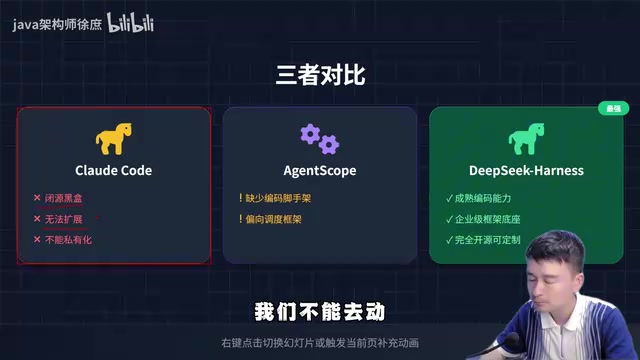
From hands-on experience, DeepSeekAd Harness is essentially a fusion of "Claude Code + AgentScope." It combines Claude Code's powerful install-and-use coding capabilities with the flexibility and extensibility of enterprise-grade distributed frameworks like AgentScope. AgentScope, mentioned here, is an open-source multi-Agent collaboration framework from Alibaba DAMO Academy, designed for building distributed multi-agent systems with support for message passing mechanisms, inter-Agent coordination and scheduling, fault recovery, and cross-node deployment — suitable for complex multi-Agent collaboration scenarios in enterprise production environments. The comparison with AgentScope emphasizes that Harness is not merely a terminal tool but possesses framework-level architectural flexibility.
Installation and Interaction Methods Explained
Unlike Claude Code's terminal-based interaction, DeepSeek Harness uses a web-based interaction approach. It's worth noting that while it's web-based, it can run locally as a client or be deployed as a distributed server-side service, making it applicable to a much wider range of scenarios.
Environment Preparation and Installation Steps
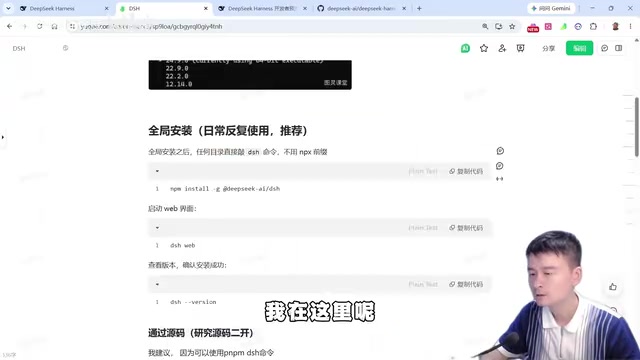
Before installation, you'll need a Node.js environment with specific version requirements (Node.js 24 was used in testing). It's recommended to use NVM to manage multiple Node.js versions and avoid conflicts. NVM (Node Version Manager) is a widely-used version management tool in the Node.js community that allows developers to install and switch between multiple Node.js versions on the same machine. Node.js 24 is a newer version line that includes the latest V8 engine optimizations and improved ES module support, which explains why Harness chose TypeScript as its development language — to fully leverage the performance advantages of modern JavaScript runtimes.
For most regular users, the simplest approach is a global installation via NPM with a single command. After installation, run deepseek-harness web to launch and open the interface in your browser. If you're interested in the source code or want to do secondary development, you can also clone the GitHub repository directly — the project is written in TypeScript for easy extension.
Model Configuration and Reasoning Levels
After first launch, you'll need to configure your DeepSeek API Key, though you can also connect other models. DeepSeek's internal models offer 4 reasoning levels — higher levels provide stronger reasoning capabilities but consume more tokens. Users can flexibly choose based on task complexity.
The technical principle behind this mechanism involves controlling the model's Chain-of-Thought depth to balance reasoning quality against cost. Higher reasoning levels allow the model to perform more rounds of internal reasoning steps (similar to OpenAI's o1 series extended thinking mechanism), generating large amounts of intermediate reasoning tokens but producing higher-quality output. Lower levels skip deep reasoning and provide answers directly, suitable for simple code completion or file operation tasks. Tokens are the basic billing unit for LLMs — Chinese text maps approximately 1.5-2 characters per token, and reasoning tokens are typically priced higher than regular input/output tokens, so level selection directly impacts usage costs.
Coding Capability Test: Cost-Effectiveness and Quality Combined
In practical coding tests using the DeepSeek V4 Pro model, multiple tasks were completed. One involved developing a "body-sensing fruit-slicing game," with the entire generation process taking about 19 minutes, achieving a 99% cache hit rate, and ultimately consuming only about two yuan in token costs.
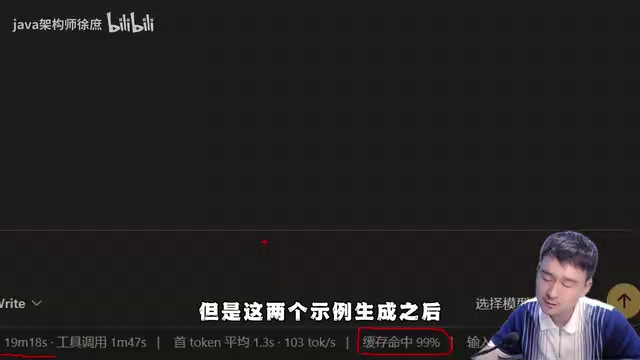
The cache hit rate here refers to the KV Cache (Key-Value Cache) or Prompt Cache mechanism. When multiple user requests contain identical prefix content (such as system prompts or existing conversation history), the model server can reuse previously computed Keys and Values from the attention matrix without recalculation. DeepSeek's API charges cached tokens at a significant discount (typically 1/10 of the original price or less), meaning a 99% hit rate indicates that the vast majority of input tokens don't need to be re-billed — this is the technical reason behind the extremely low costs. For Agent-type applications with high-frequency iteration and long-context interaction patterns, the cost advantages of caching are particularly significant.
Although the V4 Pro model has seen recent price increases, from a cost-effectiveness perspective, it still holds clear advantages over Claude, OpenAI, and other models. High cache hit rates are a key factor in keeping costs down — in high-frequency usage scenarios, actual costs often amount to just two or three yuan.
Harness's UI interaction is another highlight. Users can clearly see input parameters, the LLM's token consumption, and Source response content. This level of transparency is remarkably developer-friendly among current Agent applications, making it easy to understand and debug each step of the execution process.
Plugin Architecture: DeepSeek Harness's Core Competitive Advantage
If coding capability is just the baseline, then the plugin architecture is DeepSeek Harness's true moat.
Why Plugin-Based Design Matters So Much
By comparison, while Claude Code is excellent, it's closed-source. From late 2024 to early 2025, Claude Code's obfuscated source code was reverse-engineered by the community, revealing its internal system prompts, tool-calling logic, and permission management mechanisms. While this allowed developers to glimpse its implementation principles, the closed-source license means any secondary development based on leaked code carries legal risk and cannot follow official updates. This incident actually highlighted the value of open-source Agent frameworks — developers can freely audit, modify, and deploy within compliance. Even after source code leaks, developers cannot extend its kernel, cannot deploy it privately, and connecting models other than Claude is quite difficult.
DeepSeek Harness's core characteristic is: everything is a plugin. Its kernel Harness capabilities — including models, tools, skills, sessions, sandboxes, long-term memory, loops, and even the UI — are all plugins that can be freely replaced, flexibly recombined, and users can create custom plugins.
This design draws from Microkernel architecture philosophy. In the operating system domain, microkernels move traditionally kernel-level functions like file systems and network stacks to user space as plugins, retaining only minimal core scheduling capabilities. Similarly, Harness's kernel is only responsible for plugin loading, lifecycle management, and message routing, while specific functions like model calls, tool execution, and UI rendering are all implemented by plugins. The advantage of this architecture is that a single plugin's failure won't crash the entire system, and any component can be independently replaced or upgraded, greatly reducing system coupling and maintenance costs.
This means it simultaneously captures the advantages of two extremes:
- Like Claude Code: The foundational capabilities are already built — install and immediately get powerful coding abilities without writing code from scratch;
- Like AgentScope: Possesses enterprise-grade distributed framework flexibility for deep customization and extension.
Two Ways to Obtain Plugins
First: Develop plugins yourself. This requires some coding ability, but you can also have DeepSeek Harness write them for you. Simply switch from "Standard Mode" to "Creation Mode," and it gains the ability to create plugins.
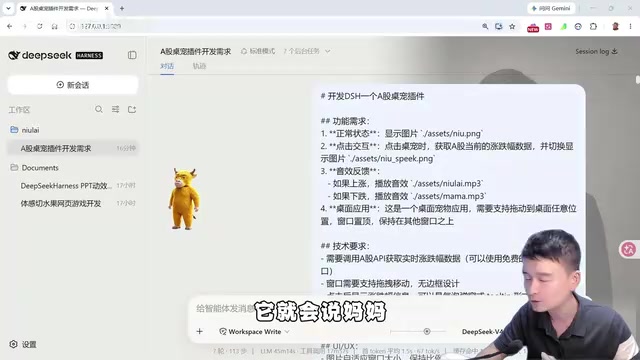
In testing, a prompt was used to have it develop an "A-Share Bull Market Desktop Pet" — when indices are in the green (rising), it shouts "The bull is here!" and reports the index; when indices are in the red (falling), it "wails" — quite entertaining. This plugin achieved a 100% cache hit rate with minimal cost, and the author has uploaded it to GitHub for public use.
Second: Use community plugins. DeepSeek Harness plugins are commonly tagged with bsh-plugin, and various ready-made plugins are available in the community. Installation is also flexible: you can have it automatically install from GitHub through conversation, or manually install via DSH commands — the entire process is very straightforward.
Conclusion: A New Open-Source, Extensible Choice for Agent Development
The significance of DeepSeek Harness isn't that it's yet another Agent tool that can write code — it's that it provides an open-source, extensible, privately-deployable Agent development foundation. It merges Claude Code's ease of use with AgentScope's flexibility, letting developers both use it out of the box and customize it deeply.
Combined with DeepSeek V4 Pro's excellent coding capabilities and cost-effectiveness, this combination is definitely worth attention. For teams looking to build their own Agent applications without building infrastructure from scratch, Harness offers an extremely attractive option.
Advanced topics including custom plugin development, kernel Harness reset, and enterprise-grade distributed deployment are worth following up on in the future.
Related articles

CSS Anchor Positioning: A New UI Positioning Approach Without JavaScript
A deep dive into CSS Anchor Positioning: from anchor-name and position-anchor to the anchor() function, position-area shorthand, position-try-fallbacks, anchor-size, and upcoming anchor queries.

New AI Chart Interaction: Continuous Follow-up Questions and Visualization in Conversation
Explore a new AI interaction method for continuously generating charts in conversation. Use the /visualize command to ask follow-up questions and visualize answers in the same chat window, improving data analysis efficiency.

Cursor Merges Into X Subscription: Paid Plans Share Unified Usage Pool, Grok Model Coding Usage Doubled
Cursor joins The X Subscription with a unified usage pool and doubled Grok coding quota. Third-party models shift to API pricing. Existing users can keep or migrate plans.