DeepSeek Harness in Enterprise: A Complete Guide to Agent Development

A zero-base breakdown of Agent fundamentals, native LLM weaknesses, and enterprise implementation paths for DeepSeek Harness.
Based on a hands-on livestream for zero-base learners, the article explains the engineering essence of AI Agents as the bridge between users and native large models, taking on four roles: Translator, Tool Expert, Memory Butler, and Task Butler. It identifies four structural weaknesses of native large models—no persistent memory, knowledge cutoff, no internet access, and no access to local tools—as the fundamental reason Agents exist, and illustrates that Agents have entered daily life through Doubao, DeepSeek, and AI coding tools. It then distills four practical directions for DeepSeek Harness: automated development of LMVK and a RAG workbench, automated Skill development, short video and UI anime content production, and enterprise intelligent customer service and e-commerce Agents. Finally, it outlines the three technological leaps of Agents—from tool invocation to programming orchestration to the engineering foundation—and advises beginners to first build a four-layer capability framework and then fill it in through concrete projects.
AI Agents are becoming the core form of LLM deployment, and DeepSeek Harness, an Agent development framework built for enterprise scenarios, is attracting attention from more and more technical teams. This article is based on a hands-on livestream aimed at beginners with zero experience, and systematically walks through the essence of Agents, the shortcomings of native large models, and the typical implementation paths for DeepSeek Harness in enterprise projects.
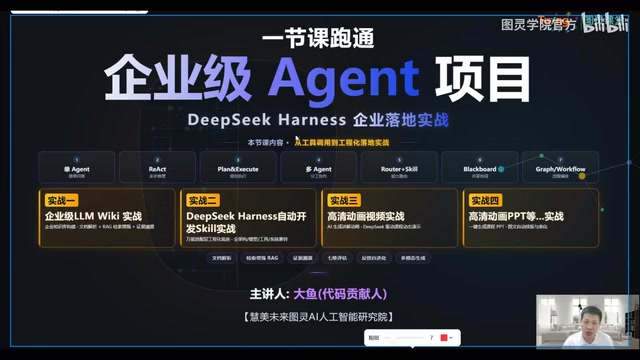
What Exactly Is an Agent: The "Translator" and "Butler" of the LLM Era
Many beginners think of an Agent as simply "a smarter chatbot," but the definition given in the livestream is closer to the engineering reality: an Agent is the bridge between users and native large models. Users have only two ways to call a native large model directly—write code or call an API—and either way, the model's own knowledge limitations will surface. The Agent's job is to understand user needs, invoke various tools, summarize the results, and return them to the user.
This positioning can be understood through an analogy: when a Chinese speaker communicates with an American, a translator is needed in between. The Agent is the translator of the LLM era—it translates the user's natural-language needs into instructions the model can understand, then converts the model's output into results the user can comprehend.
The Four Fatal Weaknesses of Native Large Models
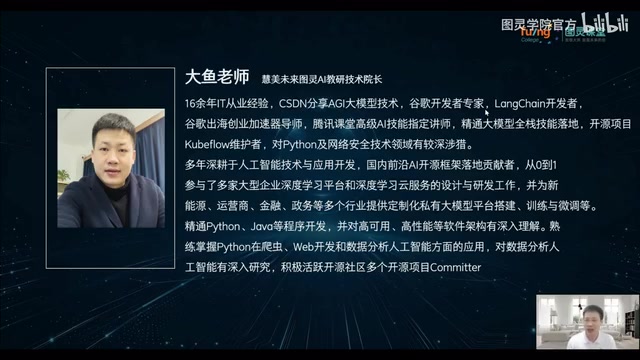
Why are Agents necessary? The livestream starts from the flaws of native large models and offers a clear explanation. The mainstream native large models on the market, whether domestic or foreign, are trained by large companies at enormous cost, and ordinary developers cannot reproduce them from scratch. But these models have several structural weaknesses:
- No persistent memory: After ten rounds of conversation, the model may forget what was said earlier—every conversation feels like starting over.
- Knowledge has a cutoff date: The model only learns content up to a certain point in time. Ask it about newer knowledge, and it will confidently make things up.
- No internet access: Ask it about tomorrow's weather or the latest stock quotes, and the model cannot give a real answer.
- No access to local tools: It cannot touch the files, databases, or software on your computer.
These weaknesses cannot be solved by "switching to a stronger model"—they require adding a layer of engineering capability on top of the model. This is precisely why Agents exist.
The Four Core Problems Agents Solve
The livestream distills the value of Agents into four roles, a breakdown that is very helpful for understanding enterprise Agent architecture:
Translator—translates the user's self-directed needs into instructions the large model can understand, then converts the model's output back into results the user can comprehend.
Tool Expert—helps the large model invoke various tools and APIs, enabling internet access and data lookup, turning the model from "able to talk" into "able to act."
Memory Butler—remembers context, user preferences, and conversation history, keeping multi-turn dialogues coherent and preventing the model from losing its memory.
Task Butler—breaks a user's big problem into smaller sub-problems, plans the execution flow, and proactively tries different approaches when exceptions occur.
These four roles actually correspond to four types of infrastructure in Agent engineering: the instruction adaptation layer, the tool invocation layer, the memory management layer, and the task planning layer. Once you understand these four layers, reading the documentation of any Agent framework becomes much easier to map out.
Agents in Everyday Life: From Doubao to AI Coding Tools
Agents are not remote. The livestream notes that products ordinary people use daily, such as Doubao and DeepSeekAd, are essentially Agent forms—users' questions are not sent directly to the underlying large model but first pass through the Agent layer, which calls the large model, processes the output, and returns the most accurate result to the user.

AI coding tools work the same way. Whichever code assistant it is, they can remember the entire project structure, invoke multiple approaches, debug code, and repeatedly verify results—this workflow relies precisely on the Agent's "Tool Expert" and "Task Butler" capabilities. In other words, AI coding tools are one of the most intuitive real-world applications of Agent capabilities.
Enterprise Implementation Paths for DeepSeek Harness
The livestream arranges multiple layers of hands-on practice, from simple to intermediate to enterprise-level logic, covering several project directions. From the description, several typical implementation paths can be distilled:
Automated development of LMVK and a RAG workbench—using DeepSeek Harness-related technology to automate the development of LMVK, along with enterprise management knowledge bases, image knowledge graphs, and various evaluation capabilities. This path contrasts with traditional RAG solutions, with the key being the automation of the development process itself.
Automated Skill development—many developers following the LLM field write a large number of Skills in their daily work, and automating Skill development through DeepSeek Harness can significantly boost efficiency. This is a typical approach to applying Agent capabilities to developers' own workflows.
Short video and UI anime content production—the traditional approach relies on multiple UI anime tools, whereas with large model involvement and the DeepSeek Harness approach, content development may be accomplished simply by conversing with the model and plugging in purpose-built Skills and plugins.
Enterprise intelligent customer service and e-commerce Agents—covering multimodal RAG retrieval, high-concurrency optimization, multi-Agent and Skill collaboration, and model fine-tuning—technologies aimed at real business scenarios.
RAG (Retrieval-Augmented Generation) is a prerequisite concept for understanding "enterprise management knowledge bases" and "multimodal RAG retrieval." Its basic idea: before the model generates an answer, relevant document fragments are retrieved from an external knowledge base and fed to the model as context, so the model answers based on real materials rather than parameter memory alone. This alleviates the problems of knowledge cutoff and easy fabrication in large models, and also allows enterprise private data to be used without entering model training. The RAG engineering pipeline typically includes document splitting, vectorization (embedding), vector store retrieval, reranking, and answer generation. Multimodal RAG further brings non-text content such as images and tables into the retrieval scope—this is the background behind the "image knowledge graph" direction in the livestream.
Skill in the Agent context usually refers to an encapsulated capability unit that the model can invoke on demand—it can be a prompt template, a function, an external API, or a fixed set of operational procedures. Compared with low-level generic tool invocation, Skills are more business-semantic, packaging specific tasks like "check order" or "generate storyboard script" into reusable modules that the Agent decides when to call during the planning phase. Therefore, "automated Skill development" is effectively applying Agents to developers' own workflows: letting the model assist in generating, testing, and maintaining these capability units to boost Skill output efficiency.
The Three Technological Leaps of Agents
At the end of the livestream, it was mentioned that Agents have gone through three technological leaps: from tool invocation, to programming and orchestration, to the engineering foundation. This evolutionary thread deserves separate consideration. Early Agent capabilities were mainly reflected in single-point tool invocation; then came the orchestration stage, where developers began chaining multiple tools and steps into workflows with code; and now the competitive focus for enterprise Agents has shifted to the engineering foundation—memory management, task planning, multi-Agent collaboration, and evaluation systems—the infrastructure that supports long-term stable operation.
For developers who want to enter this field, this means the learning focus cannot stop at "knowing how to call APIs"; it must include understanding the engineering implementation of the Agent's four-layer capabilities. The livestream repeatedly emphasized "focus on the ideas," which points to the same thing: project source code can be obtained, but only by thoroughly grasping the logic and ideas can you transfer them to your own business scenarios.
Multi-Agent collaboration refers to multiple Agents with different responsibilities (for example, one for planning, one for retrieval, one for validation) collaborating through message passing or shared state to complete complex tasks, rather than a single Agent handling all steps sequentially. Its value lies in splitting complex processes into clearly bounded roles that can be debugged and evaluated separately; the cost is the introduction of new problems such as communication overhead, state consistency, and error propagation—which is why enterprise scenarios place greater emphasis on the engineering foundation. Complementing this, model fine-tuning refers to continuing to train a general large model with the enterprise's own data so that the model better fits domain-specific terminology and output formats. Fine-tuning and RAG are often used together: fine-tuning changes the model's "expression habits," while RAG supplements the model's "source of facts"—the problems they solve do not overlap.
A Few Judgments for Zero-Base Learners
One point from the livestream is worth noting: the current LLM application track has "more positions than people," unlike the competitive landscape of traditional jobs. Whether this judgment holds requires individuals to verify against their own circumstances, but it points to a fact—enterprises are using large models for digital transformation, and people who can truly put Agents into business operations remain scarce.
Another reminder concerns the learning approach. Online materials update extremely fast; following videos and only being able to write "one, two, three" but not "three, two, one" in reverse is a common dilemma in self-study. For engineering-heavy technologies like Agents, a more effective approach is to first build a framework understanding of the four-layer capabilities, then fill in the framework through concrete projects.
One-line Summary
A zero-base perspective on the essence of Agents, the weaknesses of native large models, and enterprise implementation paths for DeepSeek Harness.
Paragraph Summary
Based on a hands-on livestream for zero-base learners, the article systematically explains the engineering essence of AI Agents: they are the bridge between users and native large models, taking on four roles—Translator, Tool Expert, Memory Butler, and Task Butler. It points out four structural weaknesses of native large models—no persistent memory, knowledge cutoff, no internet access, and no access to local tools—which are the fundamental reason Agents exist, and uses Doubao, DeepSeek, and AI coding tools to show that Agents have entered daily life. At the implementation level, it distills four practical directions for DeepSeek Harness: automated development of LMVK and a RAG workbench, automated Skill development, short video and UI anime content production, and enterprise intelligent customer service and e-commerce Agents. Finally, it presents the three technological leaps of Agents—from tool invocation to programming orchestration to the engineering foundation—and advises zero-base learners to first build a four-layer capability framework, then fill it in.
Related articles
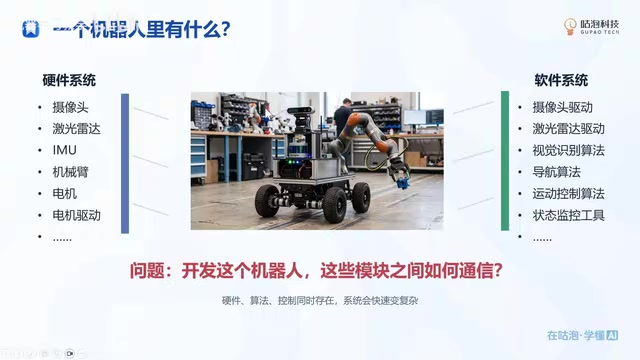
Getting Started with ROS2 Robot Development: Core Concepts and Environment Setup
This article introduces the core concepts and environment setup of ROS2 robot development, explains why ROS2 unifies module communication and facilitates collaborative work, and outlines the Turtlesim simulation experiment to help beginners get started quickly.

SLAM Mapping and Navigation Tutorial: A Complete Learning Path from Theory to Practice
This Bilibili SLAM mapping and navigation tutorial starts with a navigation overview, covering architecture, installation commands, and practical prerequisites, then connects to the Fourteen Lectures on Visual SLAM, slam_toolbox, and Cartographer—a complete learning path from theory to practice.

LangChain Beginner's Guide: Core Concepts and Hands-On Tools
What is LangChain? This guide covers its core positioning—Agent = Model + Harness—and the three key problems it solves: training time limits, external data connections, and multi-turn conversation context.