DeepSeek Harness in Full: A Practical Guide to Agent Engineering

Tracing Agents' evolution from tool calling to engineering foundation, arguing DeepSeek Harness is key to enterprise deployment.
The article starts from the essence of Agents, identifying them as a capability proxy layer that solves the four major shortcomings of native LLMs: no memory, knowledge cutoff, no internet access, and inability to call tools, summarized through four roles: translator, tool whiz, memory keeper, and task manager. It then traces three leaps in Agent technology: the single-step Function Calling era, the multi-step autonomous orchestration era of ReAct and frameworks, and the engineering foundation era of DeepSeek Harness. Using sealed-truck, sedan, and modified-car analogies, the author illustrates existing tools' limits and showcases Harness through four progressive projects: the LMVK workbench, automated Skill generation, conversational UI animation, and enterprise customer service and e-commerce Agents. The conclusion stresses that enterprises need a maintainable, extensible, auditable foundation rather than a demo-level framework, suggesting a learning path of cognition first, then projects, then business adaptation.
Agent development is one of the hottest topics in tech right now, but most tutorials stop at conceptual overviews or simple demos. Genuine engineering implementation—from environment setup and task orchestration to enterprise-grade project work—is rarely covered systematically. This article draws on a complete tutorial from a frontline developer to break down the full path of Agent development, with a focus on how DeepSeek Harness becomes the key foundation for Agent engineering.
What Exactly Is an Agent: From Translator to Task Manager
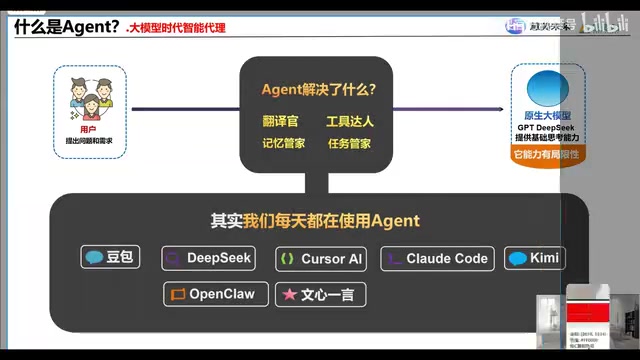
Many people conflate Agents with ordinary chatbots the first time they encounter them. In reality, an Agent is essentially a "proxy layer" for large-model capabilities. Native LLMs have several fatal shortcomings: no memory, so every conversation starts from scratch; a knowledge cutoff date, so asking about tomorrow's events yields confidently fabricated nonsense; no internet access, so it can't check real-time weather or stock prices; and no ability to call tools on your computer.
An Agent solves precisely these four problems. It acts as a "translator," converting the user's natural-language requests into instructions the model can understand and turning the output back into human-readable form; it acts as a "tool whiz," letting the model call APIs and fetch data online, turning it from something that can talk into something that can act; it acts as a "memory keeper," remembering context and user preferences to keep multi-turn conversations coherent; and it acts as a "task manager," breaking complex problems into subtasks, planning the execution flow, and proactively resolving them.
The Doubao and DeepSeekAd chat products you use daily are all powered by an Agent orchestrating the large model behind the scenes, rather than calling it directly. AI coding tools work the same way—remembering project structure, calling solutions, and debugging code are themselves manifestations of an Agent's tool-whiz and memory-keeper capabilities.
The Three Leaps of Agent Technology
Only by understanding the arc of Agent evolution can you see where DeepSeek Harness fits. The industry generally divides Agent technology into three stages.
Generation 1: The Tool-Calling Era (Function Calling)
The core of this generation was "giving the large model hands and feet." When a user asks "check this year's sales figures," a native model can't answer because of its knowledge cutoff and permission limits, but through the Function Calling mechanism, an Agent can call an internal database or weather API to retrieve real data. Agents at this stage are like interns—you nudge them and they move, executing one step at a time with no autonomous planning ability.
The Function Calling mechanism: This is a structured-output capability that LLM providers introduced at the API layer. Developers pre-declare a set of available functions (name, description, parameter JSON Schema), and when the model determines during a conversation that it needs to call a function, it doesn't return natural language directly but rather a function name and parameters conforming to the Schema. The outer program parses this structured output, actually executes the function, then passes the return value back to the model as a new message, and the model integrates it into the final answer. Its significance lies in decoupling the model's "language ability" from the external system's "execution ability": the model only decides which tool to call and what parameters to pass, while the actual data reads and writes and side effects are carried out controllably by the host program. This is the technical starting point for Agents moving from "can talk" to "can do," and the later ReAct and multi-step orchestration all build on the same loop of "the model outputs intent, the runtime executes."
Generation 2: The Autonomous Orchestration Era
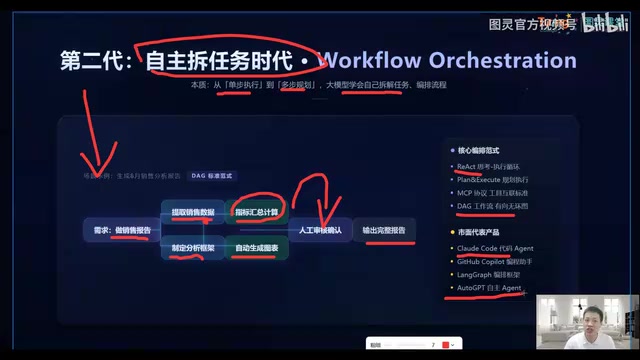
The evolution from single-step execution to multi-step planning. When a user says "make a sales report," the Agent can autonomously break down the task: first do intent recognition, then branch into two parallel paths—one extracting internal sales data, one determining the analysis framework—then have the large model generate the report, and finally deliver it after human confirmation. The ReAct architecture and various Agent frameworks common on the market all rest on this generation's underlying logic.
But in enterprise deployment, Generation 2's problems began to surface: uncontrollable processes, poor scalability, and difficulty auditing. Hence the third generation.
The ReAct architecture: ReAct stands for Reasoning + Acting, a prompting and execution paradigm that has the model alternate between "reasoning" and "acting." In each round, the model first outputs a thought (judging whether current information is sufficient and what to do next), then outputs an action (calling a tool or retrieving), the runtime executes it and appends the observation back to the context, and the model continues to the next round of reasoning on that basis. This loops until the model judges the task complete and gives an answer. Compared with a single Function Calling, ReAct turns "one decision" into "a sustainable multi-round decision loop," and thus can handle tasks requiring multi-step information gathering. The cost is that more rounds mean longer context, higher latency, and higher expense, and intermediate steps may drift or loop—which is precisely why enterprise scenarios need stronger process control and observability.
Generation 3: The Engineering Foundation Era
This is the stage DeepSeek Harness occupies. It's no longer just an Agent framework but provides an engineering foundation—configurable, extensible, and controllable. The original uses a vivid analogy to distinguish three kinds of tools: closed-source AI coding tools are like a "sealed truck," ready to drive off the lot but with a cabin you can't modify; platform-style Agents are like a "sedan," whose exterior you can change but whose engine you can't touch; and open-source Agent projects on GitHub are like "traditional modified cars," where you can swap parts but changing one bit of UI may affect the whole vehicle. Harness's positioning is to let developers flexibly assemble and extend on a controllable engineering foundation according to enterprise needs.
Breaking Down DeepSeek Harness Hands-On Projects
The tutorial presents several progressive hands-on projects, covering the full range of scenarios from simple to enterprise-grade.
Automated Development of the LMVK Workbench
The first project uses Harness technology to automate the development of an LMVK-related workbench, covering an enterprise management knowledge base, an image knowledge graph, and various evaluation modules. Compared with traditional development methods, Harness can greatly compress repetitive engineering work.
Automated Skill Generation
A large number of developers are currently writing Skills, but manual authoring has limited efficiency. The tutorial demonstrates how to use Harness to automate Skill development, significantly boosting output efficiency.
Conversational UI and Animation Development
Traditional UI animation development relies on toolchains like Civitai and ComfyUI, whereas with Harness plus external dedicated Skills and plugins, an animation project can be generated purely through conversation with the large model. This shows Harness's extensibility in creative development scenarios.
Enterprise-Grade Intelligent Customer Service and E-Commerce Agents
The final enterprise-grade projects include multimodal RAG retrieval, high-concurrency optimization, an e-commerce domain Agent with multi-Agent collaboration, and model fine-tuning based on dependent scenarios. These projects correspond to the real business logic of major companies and are the touchstone for testing Harness's engineering capabilities.
The division of labor between multimodal RAG and model fine-tuning: RAG (Retrieval-Augmented Generation) means retrieving relevant snippets from an external knowledge base before generation, splicing them into the context, and then letting the model answer; its advantages are that knowledge can be updated in real time and answers can be traced, making it suitable for frequently changing factual content such as product information and policy terms. Multimodal RAG further extends the retrieval objects to non-text data such as images, tables, and audio; common enterprise customer-service retrieval of product images and manual screenshots falls into this category. Model fine-tuning, by contrast, adjusts model parameters through domain data, changing the model's expressive style, output format, and task patterns rather than injecting volatile facts. The two are usually complementary: use fine-tuning to make the model reliably follow business phrasing and structured output specifications, and use RAG to ensure factual accuracy and timeliness. The engineering difficulty of enterprise-grade Agents often lies not in choosing individual components but in retrieval quality, latency control under concurrency, and defining the boundaries of responsibility among multiple Agents.
Why an Engineering Foundation Matters More Than a Framework
You can find plenty of open-source Agent projects on GitHub, but the vast majority are just demos, far from enterprise-ready. What enterprises really need is a maintainable, extensible, auditable engineering foundation, not a sample that merely runs.
The value of DeepSeek Harness lies in moving Agent development from "handicraft workshop" to "assembly line." It provides standardized task orchestration, tool integration, and process control, so developers don't have to reinvent the wheel and can focus their energy on business logic and scenario adaptation. For teams wanting to move from demo to production, this engineering foundation matters far more than the framework's API design itself.
Suggested Learning Path
The Agent development knowledge system updates extremely fast, and fragmented learning easily leaves you spinning in place. An effective path is: first thoroughly grasp the essence of Agents and the logic of the three technological leaps to build a complete cognitive framework; then work through progressive hands-on projects, moving gradually from simple scenarios to enterprise-grade complexity; finally adapt and transform them for your own business scenarios. Once the thinking is clear, tools and code have somewhere to land.
One-line Summary
Breaking down the evolution of Agents from tool calling to engineering foundation, and arguing that DeepSeek Harness is the key to enterprise-grade implementation.
Paragraph Summary
The article begins with the essence of Agents, pointing out that they are a capability proxy layer solving the four major shortcomings of native LLMs—no memory, knowledge cutoff, no internet access, and inability to call tools—and summarizes their functions through four roles: translator, tool whiz, memory keeper, and task manager. It then traces the three leaps of Agent technology: the single-step tool-calling era represented by Function Calling, the multi-step autonomous orchestration era represented by ReAct and various frameworks, and the engineering foundation era represented by DeepSeek Harness. The author uses the analogies of a sealed truck, a sedan, and a modified car to illustrate the limitations of existing tools, and through four progressive projects—the LMVK workbench, automated Skill generation, conversational UI animation development, and enterprise-grade customer service and e-commerce Agents—demonstrates Harness's engineering capabilities. The conclusion emphasizes that enterprises really need a maintainable, extensible, auditable foundation rather than a demo-level framework, and offers a learning path of first building cognition, then hands-on projects, then business adaptation.
Related articles
11 Tested Rules to Slash Claude Token Costs to the Bare Minimum
Claude Token costs too high? Creator Doobie rewrote 11 token-saving rules after 30 days of logs: keep effort at medium, use /clear when switching tasks, don't let cache expire, downgrade auxiliary agents to Haiku—with official Anthropic data and cost comparisons.
Build Your First AI Agent with Zero Code: A Claude Code Practical Guide
Build an AI agent in Claude Code with zero code. Learn the full workflow: folder setup, claude.md rulebook, plan-mode briefs, skills, and independent review.
Claude Code Advisor Mode Explained: How Fable 5.2 and Sonnet 5.5 Collaborate on Code
A deep dive into Claude Code's experimental Advisor mode: how Fable 5.2 and Sonnet 5.5 split the work, access requirements, version thresholds, three ways to enable it, Fable's special billing rules, and a fact-check of the "3.4x cost reduction" claim against official docs.