DeepSeek Harness in the Enterprise: From Agent Fundamentals to Project Development

A Bilibili livestream detailing DeepSeek Harness enterprise Agent deployment paths and hands-on projects.
Based on Bilibili UP host Teacher Dayu's livestream, this article outlines DeepSeek Harness in enterprise scenarios. It explains why Agents are key to deploying large models—native models lack memory, have knowledge cutoffs, and can't go online, while Agents fill these gaps. It then covers hands-on projects from automated development of LMVK, Skills, UI effects, and PPTs to enterprise applications like intelligent customer service and multi-Agent e-commerce, plus Agent technology's evolution and beginner learning advice.
AI large models are rapidly penetrating enterprise scenarios, but how to truly turn them into usable engineering capabilities remains a challenge for many teams. In a livestream on Bilibili, UP host Teacher Dayu focused on enterprise-grade applications of DeepSeek Harness, starting from Agent fundamentals and gradually working into multiple hands-on projects, offering developers a learning path from beginner to project deployment.
Why Agents Are the Key to Deploying Large Models
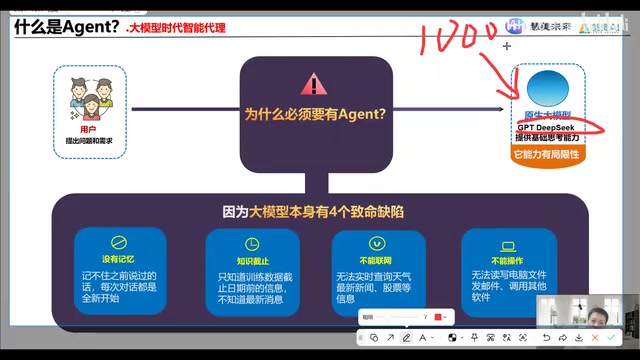
Many developers still understand the concept of an Agent only at the literal level of "intelligent agent." Teacher Dayu used a vivid analogy: an Agent is like a translator between a Chinese speaker and an American—it connects the user and the large model, understands requirements, invokes tools, summarizes results, and finally returns the answer to the user.
Native large models have several fatal shortcomings: no memory, so every conversation starts over; knowledge has a cutoff date, so they cannot answer real-time questions; no ability to go online; and no direct access to tools on the computer. These limitations make it hard for large models to stand alone in real business. Agents emerged precisely to solve these problems—acting as a "translator" that converts user needs into instructions the large model can understand; as a "tool expert" that lets the model call APIs and look up data online; as a "memory steward" that remembers context and user preferences to maintain coherence across multi-turn conversations; and as a "task manager" that breaks complex problems into small steps, plans execution flow, and proactively solves them.
According to Teacher Dayu's analysis in the livestream, common products on the market such as Doubao and DeepSeekAd are essentially Agents operating behind the scenes: the user's question is first sent to the Agent, which then calls the large model to process it, and finally returns precise results. Web coding tools like Claude Code are likewise built on Agent capabilities, able to remember project structure, invoke solutions, and debug code.
The core capability composition of an Agent typically includes four modules: Planning, Memory, Tool Use, and Action. The planning module is responsible for breaking complex tasks into executable sub-steps, with common methods including ReAct (reasoning-action loop) and Chain-of-Thought; the memory module is divided into short-term memory (current conversation context) and long-term memory (vector databases or external storage), used to maintain coherence across multi-turn interactions; the tool use module enables the Agent to call external APIs, search engines, code interpreters, and more, breaking through the boundaries of the large model's own capabilities; and the action module is responsible for carrying out actual actions and feeding back results. Understanding how these four modules collaborate is the key foundation for mastering Agent engineering design.
Overview of DeepSeek Harness Hands-On Projects
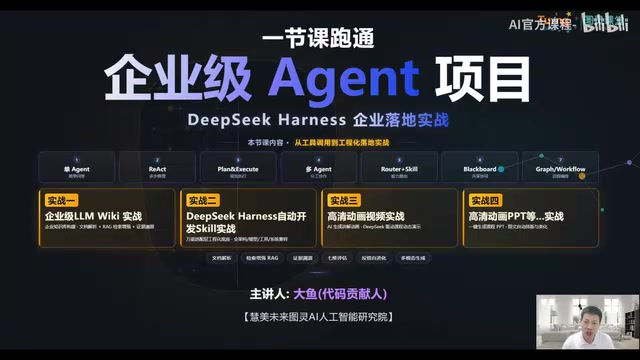
The core of the course is multiple hands-on projects, covering the complete chain from automated development to enterprise-grade applications. Teacher Dayu presented four foundational projects: automated development of LMVK via DeepSeek Harness (compared with traditional Workflow, involving workbenches, enterprise management knowledge bases, image knowledge graphs, and evaluation technologies); automated development of Skills, greatly improving development efficiency; automatically developing UI motion effects through conversation and external Skills/plugins, replacing the traditional toolchain; and using DeepSeek Harness to complete PPTs and project production.
Enterprise-grade projects are closer to the real logic of big tech, including intelligent customer service systems (involving multimodal RAG retrieval and high-concurrency optimization), multi-Agent-based e-commerce applications (combining Skills, Harness, and other technologies), and the practice of model fine-tuning in dependency scenarios. There are seven or eight of these projects in total, and Teacher Dayu said he would explain the enterprise-grade logic portion at the end of the course.

RAG (Retrieval-Augmented Generation) is one of the most commonly used technical architectures in current enterprise-grade Agent applications. Its core idea is: after the user asks a question, the system first retrieves the document fragments most relevant to the question from the enterprise knowledge base, then feeds these fragments as context into the large model to generate an answer. The benefit is that the model's answers are grounded in the enterprise's private data, avoiding hallucinations, while keeping knowledge up to date in real time without fine-tuning the model. A typical RAG pipeline includes document chunking, embedding, vector search, and reranking. The "multimodal RAG" mentioned in the article further extends the retrieval scope from plain text to images, tables, audio, and other modalities, placing higher demands on embedding models and retrieval strategies.
How Beginners Can Keep Up
This livestream was positioned as "completely non-technical teaching," and Teacher Dayu repeatedly emphasized ensuring all students could understand. For beginners, he suggested focusing on the ideas, understanding the logic, and then applying it to their own scenarios in combination with the project source code. The course runs about an hour and a half with strong continuity, and dropping out midway can easily create knowledge gaps.
Teacher Dayu himself has nearly 40 years of industry experience (note: in the livestream he called himself an "old bird approaching 40," which in context should mean many years in the industry). He served as a project manager at a listed company for eight years and is currently working on enterprise-grade projects based on e-commerce, multimodal RAG, and high-concurrency microservices. He mentioned that the large model application track currently has many positions and few people—it is an era of competing on technology and projects rather than on academic credentials. Traditional Java, Python, big data, and other positions face layoff pressure, while the AI large model field offers a historic opportunity.
The Technical Leap of Agents and Learning Advice
At the end of the livestream, three leaps in Agent technology were mentioned: from tool calling to programming orchestration, and then to the engineering foundation. This reflects how Agent capabilities are evolving from simple API calls to more complex systematic engineering. For developers who want to transition, Teacher Dayu's advice is to learn in line with national policy directions and seize the opportunities in AI development.
A quick note: this livestream clearly has a course-promotion nature, some expressions are fairly colloquial, and the depth of technical detail is limited. For developers who already have some foundation, more systematic documentation and code practice may be needed to supplement it. But as introductory content for understanding the overall picture of DeepSeek Harness enterprise deployment, it provides a clear framework and project directions, making it suitable as a starting point for a learning path.
(This article is compiled based on Bilibili livestream content; the views belong to the original author.)
Model fine-tuning and RAG are two complementary paths for deploying large models. RAG suits scenarios where knowledge updates frequently and source citations are needed, with low cost and fast iteration; fine-tuning suits scenarios where the model needs to learn a specific output style, domain terminology, or fixed task pattern, adjusting model parameters by continuing training on the enterprise's own data. Common fine-tuning methods include full-parameter fine-tuning and parameter-efficient fine-tuning (such as LoRA and QLoRA), the latter achieving results close to full fine-tuning at extremely low computational cost. The "practice of model fine-tuning in dependency scenarios" mentioned in the article refers precisely to introducing fine-tuning to enhance the model's stability and accuracy on specific tasks when RAG cannot satisfy strict requirements for output format, domain reasoning, or proprietary logic.
One-line Summary
A Bilibili livestream detailing DeepSeek Harness enterprise-grade Agent deployment paths and hands-on projects.
Paragraph Summary
Based on the livestream content of Bilibili UP host Teacher Dayu, this article systematically outlines the application path of DeepSeek Harness in enterprise scenarios. It first explains why Agents are key to deploying large models—native large models lack memory, have knowledge cutoffs, and cannot go online, while Agents act as translator, tool expert, memory steward, and task manager to make up for these shortcomings. It then introduces the multiple hands-on projects covered by the course, including foundational projects such as automated development of LMVK, Skills, UI motion effects, and PPTs, as well as enterprise-grade applications like intelligent customer service and multi-Agent e-commerce. The article also emphasizes that the course is positioned for beginners, suggests students focus on ideas rather than memorizing code, and mentions the trend of Agent technology leaping from tool calling to programming orchestration and then to the engineering foundation. Finally, it notes that the livestream has a course-promotion nature and limited technical depth, making it suitable as a reference framework for beginners.
Related articles

AI Tools Quietly Altering Settings: Postman Silently Installs Plugin, Codex Sharing Option Auto-Resets
AI Daily reports: Postman silently installs a Mac plugin and self-approves startup hooks, logged as auto-existing upgrade; Hacker News developers say Codex data-sharing opt-out flips back. Plus Simon Willison's raw float weight experiment with QEN 3.8-27B.

AI Learns to Rewrite AI: MIT's "Weightspace Programming" Redraws the Path to Recursive Self-Improvement
MIT team proposes weightspace programming: GPT-6 Astra reads and edits AI model weights directly. Math scores jump several-fold, hand-written networks beat trained models. Eight experiments analyzed, plus Anthropic's same-day warning and the real boundaries of recursive self-improvement.

Running Qwen 3.8 on a Laptop to Read Raw Weights: 46 Minutes Per Answer
Simon Willison reproduced weight space programming with Qwen 3.8 27B on a laptop: a 17GB model file, 46 minutes per answer, 43,506 reasoning tokens, Pong over an hour, Freeway failed. Suited for interpretability researchers.