DeepSeek Harness Source Code Analysis: Agent Framework Main Loop Design
An analysis of DeepSeek Harness's engineering approach from design philosophy, runtime preparation, and main loop responsibilities.
This article analyzes the DeepSeek Harness Agent framework from design philosophy and main loop perspectives. Harness emphasizes building prerequisite concepts before entering the framework core, layering infrastructure and upper-layer Agent logic so developers of different backgrounds can find entry points. Hardware requirements are modest: 16G+ RAM suffices for local development, with heavy tasks like fine-tuning done on rented cloud servers — a "local development + cloud compute" combination. Python is primary, with Java/C++ recommended for business integration. The main loop is the Agent's heartbeat, handling input, context, tool dispatch, and output, and must be observable and interruptible.
DeepSeek Harness Source Code Analysis: Agent Framework Main Loop Design
DeepSeekAd Harness is a framework for building and running AI Agents. In this article, we skip the introductory concepts and dive straight into the design philosophy and main loop source code to understand how an Agent framework is engineered for real-world use.
Design Philosophy: Pave the Road Before Driving
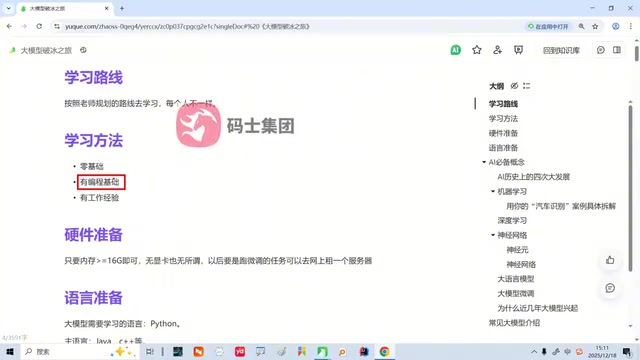
Before going deep into the source code, it's worth understanding the learning and usage logic behind it. For beginners or those unfamiliar with large AI models, jumping straight into syntax or hands-on practice can be very difficult. That's why Harness's design emphasizes building up prerequisite concepts first before entering the framework core. This also reflects a principle of the framework itself: build solid infrastructure so that upper-layer Agent logic can run steadily. Image: You're in this group
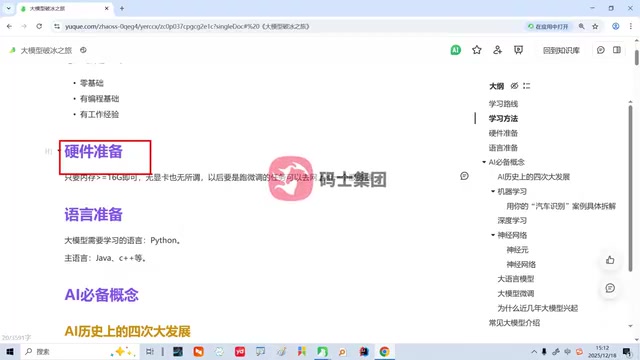
For developers with programming backgrounds or work experience, Harness's learning curve is more incremental — existing syntax can be skimmed quickly, with focus placed on the framework and tool usage. The framework's design also accommodates this difference: core mechanisms are separated from extension points, so users with different backgrounds can each find their entry point. Image: And if you have work experience
The difference between a framework (Harness / Framework) and a library: A library is a set of functions that are called, with control flow in the user's hands; a framework typically defines an inversion-of-control skeleton, where the framework calls the extension code you write (such as tool functions, callback hooks). Therefore, understanding an Agent framework isn't about memorizing APIs — it's about figuring out where it "leaves openings": how prompt templates are assembled, how tools are registered and dispatched, how context is managed, and when the loop terminates. The so-called "separation of core mechanisms and extension points" refers to the boundary between these stable skeletons and replaceable plugins. A framework with clear boundaries incurs lower change costs when upper-layer business logic evolves.
Runtime Preparation: Hardware and Language Stack
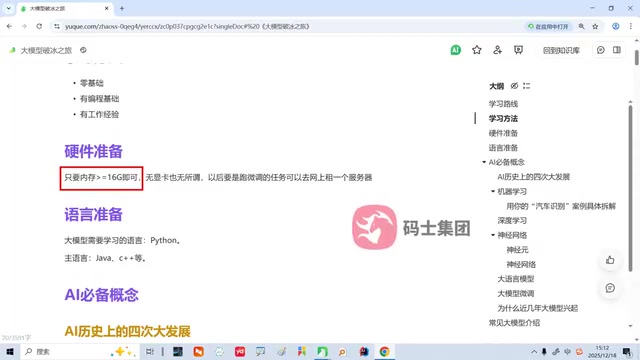
Harness has modest local hardware requirements. According to the course notes, as long as your computer has more than 16G of RAM, you can do large model development — a graphics card is not required. Heavy tasks like fine-tuning can be done remotely on cloud servers, rented by the hour at very low cost, with an operation experience identical to local development. This "local development + cloud compute" combination is explicitly recommended as one of the best practices for learning large models. Image: Let's talk about this here
On the language side, Harness's core development is primarily in Python, and its learning path already includes Python language preparation. However, the course also notes that large models often need to be combined with business logic, which may be implemented in languages like Java or C++. Therefore, developers not focused purely on large model work are advised to master at least one primary language to broaden their career paths. Image: Or if you're researching on your own
The distinction between VRAM and RAM deserves a separate explanation: the 16G of memory mentioned refers to system RAM, which determines whether local development tools can run smoothly and whether smaller quantized models can be loaded. The VRAM required for model inference depends on the model's parameter count and quantization precision. For example, a 7B parameter model at 4-bit quantization needs roughly 4-6GB of VRAM, and without a dedicated GPU you can use CPU inference, just at a slower speed. Fine-tuning has significantly higher VRAM requirements than inference — typically tens of GB — which is exactly why the article recommends renting cloud servers: hourly-billed GPU instances on the cloud let developers complete training tasks without upfront hardware investment.
The Main Loop: The Heartbeat of the Agent
Although the original material doesn't elaborate much on the main loop's source code details, from the general structure of Agent frameworks and Harness's design orientation we can infer the responsibilities of its main loop: receiving input, maintaining context, dispatching tools or subtasks, producing results, and deciding whether to continue looping.
A clear main loop should be observable and interruptible, allowing developers to trace state changes at each step when debugging Agent behavior. Harness handles prerequisite concepts and framework usage in layers, which also suggests that its main loop converges at the abstraction level, preventing upper-layer logic from being drowned in low-level details.
The Agent main loop (Agent Loop) is a common abstraction in most Agent frameworks: it's an iterative process of "perceive — decide — act — observe." In each loop iteration, the framework assembles user input and conversation history into a prompt and feeds it to the large model; the model may return a final answer or a tool call request. If it's the latter, the framework executes the corresponding tool, feeds the result back into the context as a tool message, and calls the model again, until the model gives a termination signal or the maximum step limit is reached. This pattern is often called the ReAct (Reasoning + Acting) loop, whose essence is alternately combining the large model's reasoning ability with external function calling. Engineering implementations typically need to handle context length truncation, loop step limits, exception fallbacks, and streaming output — these are exactly the concrete mechanisms referred to by "observability and interruptibility."
From Source Code to Practice: Learning Path Suggestions
Based on the layered approach given in the course, a reasonable path for using Harness is: first fill in Python and basic AI concepts, then move on to the framework's main loop and tool calling mechanisms, and finally integrate with specific business scenarios. For developers with work experience, you can quickly skim the syntax layer and focus directly on the main loop's extension points and project practice, incrementally improving your mastery of the Agent framework.
Harness's value lies not in providing a black box, but in exposing the core skeleton of Agent operation so developers understand why each step is designed the way it is. This is precisely the meaning of source code analysis.
One-line Summary
An analysis of DeepSeek Harness's engineering approach from design philosophy, runtime preparation, and main loop responsibilities.
Paragraph Summary
This article analyzes the DeepSeek Harness Agent framework from two perspectives: design philosophy and the main loop. It points out that Harness emphasizes building prerequisite concepts before entering the framework core, layering infrastructure and upper-layer Agent logic so developers of different backgrounds can find their entry point. The runtime has modest hardware requirements — more than 16G of RAM suffices for local development, while heavy tasks like fine-tuning can be done on rented cloud servers, forming a "local development + cloud compute" combination; Python is the primary language, with Java/C++ recommended for business integration. The main loop is compared to the Agent's heartbeat, handling input reception, context maintenance, tool dispatch, and result production, and must be observable and interruptible. Finally, it offers a layered learning path, emphasizing that Harness's value lies in exposing the Agent runtime skeleton rather than providing a black box.
Related articles

Yung Pueblo on Self-Awareness: A 365-Day Guide to Inner Transformation
Yung Pueblo shares his new book Journey's 365-day self-awareness structure on Talks at Google, discussing meditation, intuition, co-leadership in relationships, and gratitude practices.

FBI and USDA Hit by Cyberattacks: Critical Infrastructure Security Alarms Sound Again
FBI and USDA reportedly hit by cyberattacks; the FBI was breached for the second time in recent months, this time targeting the National Crime Information Center (NCIC). This article analyzes the incident details, NCIC's strategic value, and common security challenges facing government agencies.
How Do UK Grid Battery Storage Systems Make Money?
How UK grid battery storage makes money: stacking frequency response, capacity market, and wholesale arbitrage revenue, plus operational trade-offs and market risks.