DeepSeek Mobile Quotas, Gemini 4 Tops Math Benchmark, and Alibaba Open-Sources Coding Tool

DeepSeek mobile quotas, Gemini 4 tops the math benchmark, and dense updates in agent engineering and open-source coding tools.
This AI news roundup focuses on compute costs and service adjustments: DeepSeek's mobile app has enabled quota limits, long conversations over 72 hours are suspended, and users should back up early. Google Gemini 4 Carbon tops the Mafurina math benchmark at 85.4%, but its per-unit cost is about 15 times that of open-source models, and the evaluation system itself faces the challenge of benchmarks being broken quickly. Anthropic proposes an event-driven agent paradigm and finds that a unified coordinator performs 10 to 45 percentage points better than independent agents for each person. Alibaba's OpenCodeReview and Tencent's LoopForge are open-sourced on the same day, pushing AI programming toward standardized pipelines and role isolation. Meta proves that models can skip tokenization and read raw bytes directly, reducing storage costs by about 80% and opening space for on-device small models. There are also developments such as Perplexity's agent ROI data, Verso's developer quota increase, and the Grok gray release.
DeepSeek Mobile Enables Quotas, Long-Conversation Users Should Back Up Early
Following earlier adjustments to code generation and long-text processing logic on the web version, DeepSeekAd's mobile app has now officially enabled quota limits. According to screenshots shared by Bilibili bloggers, many users have encountered blocks for overly long content and exceeding modification limits; long conversations exceeding 72 hours are suspended due to insufficient compute and prompted to export. The company has not yet said whether a monthly subscription plan will be introduced, and users who rely on long conversations are advised to back up their records early.
This change reflects the ongoing trade-off between compute costs and user experience in large-model services. As free quotas tighten, users need to reassess their usage habits, especially in scenarios that rely on long context for continuous creation or in-depth analysis.
Gemini 4 Tops Math Benchmark, and the Compute Bill Behind the High Score
The authoritative mathematical benchmark Mafurina has a new leader: Google's Gemini 4 Carbon at its high setting tops the list with 85.4%, surpassing Claude's 82.8% and GPT's 80.6%. The best performer in the open-source camp is Pimi K3.1 Pro at 54.3%, and the gap remains obvious.
The cost of the high score is equally striking. Carbon's per-unit cost is about $15.70, 15 times that of the latter, and the compute bills for high-intensity reasoning differ dramatically.
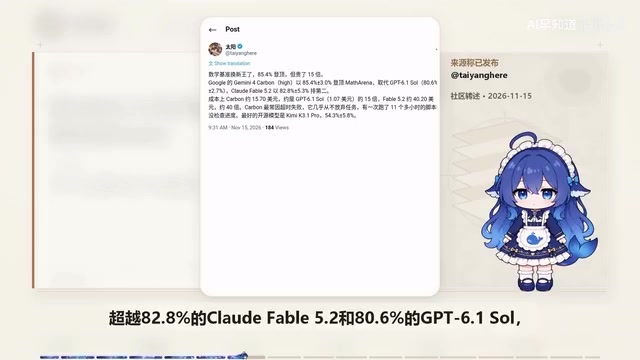
More noteworthy is the evaluation system itself. Wharton professor Ethan Mollick launched a new metric, SatBench, and found that the proportion of benchmarks broken within a year has been rising sharply year after year. The pace of AI evolution is outpacing existing test banks, and the industry urgently needs testing systems that are closer to real productivity.
Mafurina is one of the benchmarks that has risen in the field of mathematical reasoning evaluation in recent years. Its questions cover competition-level algebra, number theory, and geometric proofs, emphasizing multi-step derivation rather than pattern matching, so it is often used to distinguish a model's true reasoning ability from memorization. Compared with more basic arithmetic test banks such as GSM8K, Mafurina's problems are closer to Olympiad difficulty, and score gaps often seesaw within a few percentage points, which makes the fight for the top spot especially sensitive. Precisely because of its high difficulty and automatically verifiable answers, Mafurina has become one of the most frequently cited scorecards when vendors release new models, but it also faces the risks of test bank leakage and targeted training.
Agent Engineering: Event-Driven and Unified Coordination Become Consensus
Anthropic released an engineering guide for building always-on agents, revealing that background agents do not run idle 24 hours a day; instead, they usually sleep and are awakened when an event arrives or on a schedule. The entire system is broken down into five major components: inbox, timer, memory, permissions, and outbox. When human approval is required, it first saves state and releases the executor. This event-driven paradigm is becoming an industry standard.
Rolling out agents across an enterprise is not simply a matter of more people being better. Anthropic's research shows that in scenarios involving contention for shared resources such as budgets, scheduling, and code merging, having one unified coordinator serve the whole team performs 10 to 45 percentage points better than giving each person an independent agent. Going it alone easily leads to internal friction; shared context is the key to collaboration.
Event-Driven Architecture is a classic paradigm in software engineering. Its core is to split system behavior into three stages: event production, event distribution, and event consumption. Components do not call each other directly but are decoupled through message queues or inboxes. After agents adopt this approach, background tasks no longer rely on resident processes polling; instead, they are awakened by timers, external messages, or human approval, and compute resources are released immediately after execution. The benefits are elastic scaling of concurrency, failure of a single task not affecting the whole system, and easy persistence of long-running task state to storage for resumable execution and audit trails.
Alibaba and Tencent Open-Source Coding Tools on the Same Day, AI Programming Enters the Pipeline Era
Tencent open-sourced its self-hosted coding workbench LoopForge under the MIT license, bringing agent-written code into a standardized pipeline covering requirements, design, review, testing, and human acceptance. The write plan and review roles are strictly isolated to prevent self-review, and the whole process runs in a Docker sandbox with support for more than a dozen command-line tools.
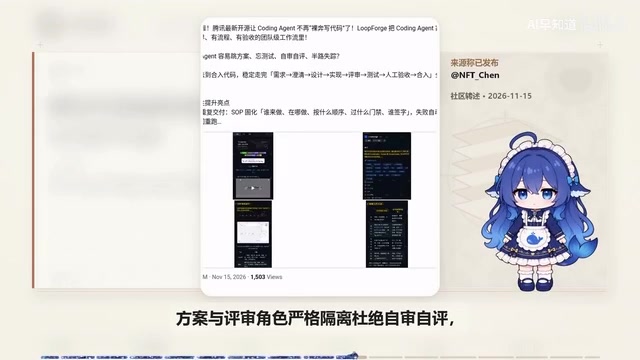
On the same day, Alibaba open-sourced OpenCodeReview, a code review tool refined internally for two years. It has surpassed 50,000 stars on GitHub and reached the top of the daily chart. It adopts a hybrid architecture of deterministic engineering plus agents: file selection and rule location are hard-controlled by code, while the model focuses on dynamic judgment. Comments are precise to specific lines, and it can be integrated into mainstream programming tools with a single NPM command, providing teams with a free and efficient review alternative.
Tokenizers Face a Shake-Up, and On-Device Small Models Open New Space
Tokenizer designs that large models have used for years may be in for a shake-up. New research from Meta proves that models can skip tokenization and read raw bytes directly for training, simplifying vocabularies of tens of thousands of tokens into 256 basic units. A billion-parameter model catches up with traditional tokenized models using only about one-sixth of the training data, reduces storage costs by about 80%, and even outperforms the 2-billion-parameter Gemma, opening new space for on-device small models.

On the local inference side, Bokeli and MIT jointly launched the open-source engine Free Token. Through dynamic scheduling of CPU and GPU compute and intelligent expert caching, it enables an RTX5090 with large memory to run DeepSeek at a throughput of 22 to 25 tokens per second, 1.3 to 2.1 times faster than existing engines, and it can also serve directly as a local free backend for Cloud Code.
A tokenizer is the preprocessing component that splits text into units a model can process. Mainstream approaches are BPE or SentencePiece, with vocabulary sizes usually ranging from tens of thousands to more than 100,000. The larger the vocabulary, the more semantics a single token carries and the shorter the sequence, but the embedding matrix and output layer parameters expand accordingly, and coverage of spelling errors, rare languages, and code symbols can easily have blind spots. Byte-level modeling bypasses the vocabulary and directly uses raw UTF-8 bytes as input. The vocabulary can be compressed to 256 basic units, naturally providing multilingual capability and noise resistance, at the cost of longer sequences and the need for additional optimization of training and inference efficiency. Meta's research achieves a breakthrough in this trade-off, making tokenizer-free approaches practical at small parameter scales.
Agent ROI and Developer Benefits
Perplexity disclosed its internal bill: one week after launch, teammates' agent work hours had reached 11 times the September level, and the number of employees who saved a full day or week of work more than tripled. On an annual basis, an investment of about $10 million returned $80 million to $180 million in labor value, a return of 9 to 19 times.
On developer compute benefits, Verso announced that it will raise the monthly quota from $80 to $150, while the team monthly fee remains unchanged at $30. The quota covers open-weight models such as Pimi K3.1 Pro, GLM5.3, and DeepSeek V4.1 Flash. Usage with a dedicated key stops when exhausted and does not generate overage bills.
Agent ROI is usually calculated by comparing subscription or compute costs with the monetary value of saved labor hours, but this kind of measure needs two caveats: first, saved hours do not necessarily all translate into output; second, agent output still requires human review. Perplexity's reported 9 to 19 times return is vendor self-reported data, limited to internal teams, and should be treated cautiously when extrapolated to other organizations. A more reliable approach is to first run a small-scale pilot in a single high-frequency, low-risk process, record task completion rates, rework rates, and human intervention counts, and then decide whether to expand deployment.
Other Developments: Grok Gray Release and Lower Barriers for Security Models
Overseas blogger Mark says many users report that Grok 4.8 is being gray-released to GrokBot, with the underlying reinforcement learning and reasoning system rewritten from scratch in C and C++. However, the official website has not yet published an announcement, the API remains at version 4.7, and the rollout has not been independently confirmed.
Anthropic, meanwhile, relaxed the application requirements for Cloud Mephos. Individual security researchers no longer need a vulnerability ID or enterprise certification; they only need a paid Cloud subscription or API account and to pass identity verification. One tester said approval came within an hour, but offensive uses remain restricted.
The scientific value of open-source models also received rare praise from a rival researcher. An OpenAI researcher publicly thanked the open-source ecosystem, saying that without modern open-weight models, scholars would find it difficult to do excellent mechanistic interpretability research, and expressed hope that the technology ecosystem can preserve open-source space in the long term.
One-line Summary
DeepSeek mobile quotas, Gemini 4 tops the math benchmark, and agent engineering and open-source coding tools see密集 updates.
Related articles
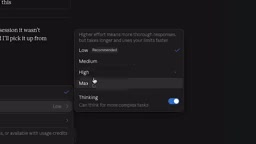
11 Tested Rules to Slash Claude Token Costs to the Bare Minimum
Claude Token costs too high? Creator Doobie rewrote 11 token-saving rules after 30 days of logs: keep effort at medium, use /clear when switching tasks, don't let cache expire, downgrade auxiliary agents to Haiku—with official Anthropic data and cost comparisons.

Build Your First AI Agent with Zero Code: A Claude Code Practical Guide
Build an AI agent in Claude Code with zero code. Learn the full workflow: folder setup, claude.md rulebook, plan-mode briefs, skills, and independent review.
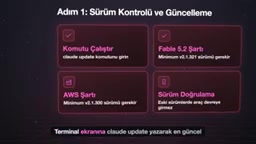
Claude Code Advisor Mode Explained: How Fable 5.2 and Sonnet 5.5 Collaborate on Code
A deep dive into Claude Code's experimental Advisor mode: how Fable 5.2 and Sonnet 5.5 split the work, access requirements, version thresholds, three ways to enable it, Fable's special billing rules, and a fact-check of the "3.4x cost reduction" claim against official docs.