DeepSeek Open-Source Inference Framework Explained: How Production-Grade Technology Is Reshaping the AI Community

DeepSeek open-sources its production-grade inference framework and Token components, sparking community debate about the open-source path.
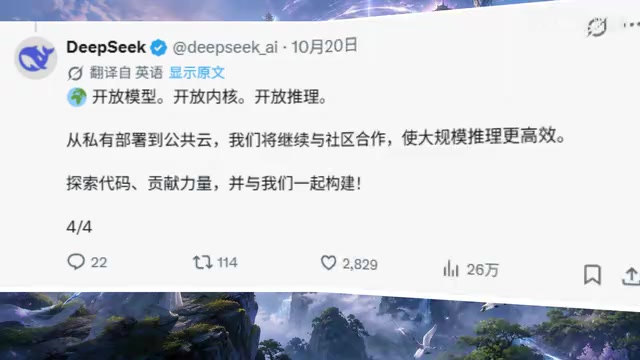
DeepSeek announced "all open-sourced" on social media, releasing the inference framework and Token codec components that support its online services; the post drew 5.7 million views. Unlike previous model releases, this is a production-grade solution covering distributed inference and speculative decoding, with Token processing consistent with the official API, solving a long-standing consistency issue in self-hosted deployment. Community reactions focus on two aspects: appreciation for its open philosophy, believing DeepSeek is doing what OpenAI promised but never delivered; and recognition of its engineering strength, including code quality and SWA-related attention window optimizations. The article argues that this marks competition extending from model performance to the engineering deployment level, with openness itself having become a strategy.
Title
DeepSeek Open-Source Inference Framework Explained: How Production-Grade Technology Is Reshaping the AI Community
Meta Description
DeepSeekAd open-sources its production-grade inference framework and Token codec components, drawing 5.7 million views. The community responds enthusiastically, seeing equal emphasis on open philosophy and engineering strength, a solution to self-hosting pain points, and lower compute costs for independent developers.
Article Content
DeepSeek has once again become the focus of the open-source AI community. A post on X (formerly Twitter) with just four words—"all open-sourced"—garnered 5.7 million views, nearly 40,000 reposts, and over 10,000 likes. What was open-sourced this time was not just the model, but the core inference framework Deepening Fur (note: transliterated from the original; actually an inference framework) that supports its production environment, along with the Token codec component DeepSeek Recipe. The community views this as a direct response to closed-source approaches like OpenAI's, and it marks a new phase in DeepSeek's technology openness strategy.
What Was Open-Sourced: Not Just a Framework, but a Production-Grade Solution
According to the official post cited by a Bilibili creator in a video, the core of DeepSeek's open-source release this time consists of two parts: the inference framework and the Token processing component. Unlike previous releases of models or training experience, what is opened here is a production-grade inference framework that genuinely supports its online services (the original mentions V4.1 Flash). This means developers can access the distributed inference and speculative decoding technologies DeepSeek uses in actual business operations, rather than simplified lab versions.
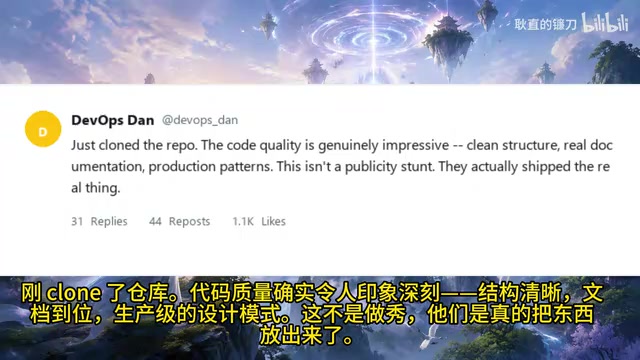
In the comments, a user pointed out that "DeepSeek Recipe is consistent with the official API processing logic," calling it a "true MVP" moment. Consistency in Token encoding and decoding has long been a pain point for self-hosted deployments, and this solution is considered to elegantly resolve it. Another user, after inspecting the repository, said: "The code quality is genuinely impressive—clear structure, thorough documentation, production-grade design patterns. This isn't a show; they really put it out there."
Speculative Decoding is a technique that accelerates large model inference without changing the output distribution. The basic idea is to first use a lightweight draft model (or multiple heads of the same model) to quickly generate several candidate tokens, then have the target large model verify these candidates in parallel; accepted prefixes are kept directly, while rejected positions are resampled. Since the verification phase can be computed in parallel, overall throughput typically improves by 2–3x, while generation quality remains essentially the same as the original model. When combined with distributed inference, it places high demands on scheduling and memory management, and whether it can run stably in real production environments is precisely the key metric for measuring the engineering maturity of an inference framework.
KV Cache (Key-Value Cache) is a mechanism in autoregressive generation that reuses historical attention key-value pairs to avoid redundant computation. The longer the context, the larger the cache footprint, and in long-context scenarios it often becomes a memory bottleneck. Common industry practices include windowed attention, cache quantization, and paged management, all aimed at compressing cache size with minimal loss in quality.
Community Response: Dual Recognition of Open Philosophy and Engineering Strength
Discussions among overseas users centered on two focal points. The first is appreciation for DeepSeek's openness strategy. One comment compared: "OpenAI should have upheld the open philosophy for the benefit of all humanity, but ended up going closed." Another highly upvoted comment read: "DeepSeek is doing what OpenAI promised years ago but never delivered." This irony resonated in the comments, reflecting the community's dissatisfaction with closed-source approaches and its desire for genuine open source.
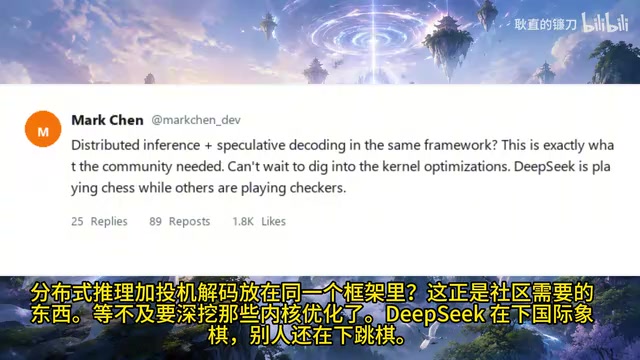
The second is recognition of technical details. One developer noted that "distributed inference plus speculative decoding in the same framework is exactly what the community needs," and was eager to dig into kernel optimizations. Another user used a metaphor: "DeepSeek is playing chess while others are still playing checkers." This assessment points both to technical depth and strategic vision—DeepSeek treats openness itself as a competitive strategy, and the effect is remarkable: a single GitHub link drew 5.7 million views, extremely rare among open-source projects.
Self-hosting refers to deploying models and inference services on servers or private clouds under one's own control, rather than calling vendor APIs. Its core challenge is behavioral consistency: if local tokenization, special token handling, and chat templates are not exactly consistent with the official API, the same input may produce different outputs, and prompt effectiveness and evaluation results will be distorted. Therefore, the official release of Token codec components consistent with online services has substantial value for teams requiring data compliance, cost control, or offline operation.
Open-source licenses are also an unavoidable aspect of such releases. Inference frameworks typically use permissive licenses such as Apache 2.0 or MIT, allowing commercial use and modification; model weights, however, often carry custom license terms. When assessing the actual degree of openness of "all open-sourced," readers should distinguish between open-source code and open-source weights, and pay attention to commercial restrictions, patent grants, and redistribution conditions.
Technical Highlights: SWA Pounday Replay and Attention Window Management
Among the many discussions, a technical detail dubbed a "dark horse" by users is SWA Pounday Replay. According to comments, this is a technique for efficiently managing attention windows in long-context inference. If its actual performance matches its claims, it could significantly reduce the memory footprint of KV caches—crucial for long-context scenarios.
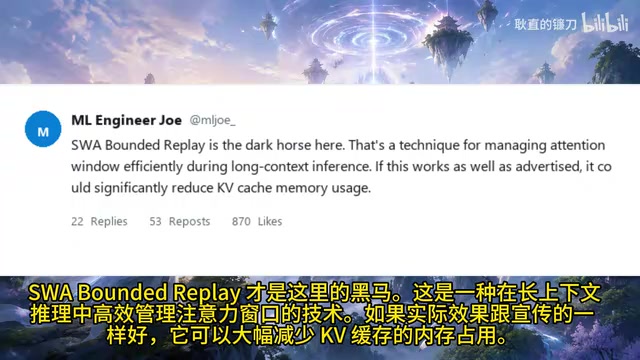
This technical detail was not expanded upon in the post body but was pointed out by community members after digging into the code. This indirectly confirms the depth of the open-source repository—not only framework-level design but also optimizations targeting specific performance bottlenecks. For independent developers and small teams, being able to use the same inference optimization solutions as DeepSeek's production environment means lower compute costs and a greater chance for more AI projects to survive. One user put it bluntly: "This is a treasure trove."
Sliding Window Attention (SWA) lets each token attend only to neighboring tokens within a fixed-length window, reducing attention computation and KV cache from linear growth with sequence length to constant level. The cost is that information can only propagate backward layer by layer and window by window, and ultra-long dependencies need to be supplemented through multi-layer stacking or global tokens. The accompanying Prefix Caching and Replay techniques record and reuse attention states for identical prefixes, avoiding recomputation during multi-turn conversations or repeated prompts. Together, these are the primary means of reducing memory footprint and first-token latency in long-context inference.
Practical Value for Developers: Full-Stack Openness from Model to Deployment
Looking at the timeline, DeepSeek's open-source path is clearly visible: first open-source the model, then open-source training experience, and now open-source the inference framework and Token processing. As a comment put it: "The entire tech stack is being gradually opened up—this is a fundamentally different philosophy from the closed-source approach." For developers doing self-hosted deployment, Token codec consistency solves a long-standing pain point; for performance-sensitive applications, the distributed and speculative decoding technologies in the inference framework can be directly reused.
One user summarized: "Every time DeepSeek open-sources something, the narrative shifts. They're not just competing at the model level; they're competing with openness itself as a strategy." The practical effect of this strategy is lowering the barrier to AI applications, enabling more independent projects to run at lower cost. Judging from community reactions, this "openness as strategy" approach has already won developers' trust.
Conclusion: A New Dimension of Open-Source Competition
DeepSeek's open-sourcing of its inference framework extends competition from model performance to the engineering deployment level. Community reactions show that developers need not only powerful models but also actionable, reproducible production-grade tools. When a company is willing to make its core inference framework and Token processing logic public, the signal it sends is: openness is not a marketing slogan but part of its technical roadmap. For OpenAI, those joking comments about being "left speechless" may serve as a reminder of its openness commitments.
One-line Summary
DeepSeek open-sources its production-grade inference framework and Token components, sparking community debate about the open-source path.
Paragraph Summary
DeepSeek announced "all open-sourced" on social media, releasing the inference framework and Token codec components that support its online services; the post drew 5.7 million views. Unlike previous model releases, this is a production-grade solution covering distributed inference and speculative decoding, with Token processing consistent with the official API, solving a long-standing consistency issue in self-hosted deployment. Community reactions focus on two aspects: appreciation for its open philosophy, believing DeepSeek is doing what OpenAI promised but never delivered; and recognition of its engineering strength, including code quality and SWA-related attention window optimizations. The article argues that this marks competition extending from model performance to the engineering deployment level, with openness itself having become a strategy.
Related articles

Automate Job Search with AI Agents and Residential Proxies for Precise Matching
Build an AI Agent with MCP and residential proxies to bypass recruitment site anti-scraping and geo-restrictions, scrape thousands of DevOps jobs, then have Claude score and rank each against your resume. Includes proxy comparison experiments, project structure, and cost analysis—filtering only, no auto-submission.

The AI Task Assistant That Knows When to Back Off: A Cure for Activation Struggles
One Small Step is an AI assistant for task initiation struggles, using agentic decisions for guilt-free reminders, timely retreat, and cross-platform task management. The developer shares real test results on 13 tasks and architectural trade-offs.

FastAPI: A High-Performance Python Framework and a Production-Ready API Development Powerhouse
FastAPI is a high-performance web framework based on Python type hints, supporting async and automatic OpenAPI docs. With over 100k GitHub stars, this article analyzes its core strengths, production readiness, and selection advice.