DeepSeek Open-Sources Core Tech: Where Does the Money Come From Behind the 100 Billion Yuan Funding?

DeepSeek's open-source inference framework sparks a Bilibili "fish plague," with 100 billion yuan funding and long-term memory challenges coexisting.
Starting from the "Big Fat Fish" phenomenon in Bilibili comment sections, the article explains how DeepSeek Harness's open-source and plugin design drives community fission—plugins like Billy Scroll let AI speak in comments, with an AI-run account gaining 150,000+ followers in a week. It reviews Liang Wenfeng's wealth and High-Flyer-era compute investments, explaining his "open source is a cultural act" philosophy. On October 20, DeepSeek open-sourced DeepInfer, disclosing 155 trillion tokens per cluster daily and $38/GPU/hour revenue, with core optimizations in KV cache reuse and GPU cluster scheduling. Two days later, ~100 billion yuan in funding was reported, with Tencent and CATL participating, potentially bringing cloud and data center energy synergies. Finally, it addresses users' real needs for Big Fat Fish's long-term memory and personality stability—a new challenge beyond KV cache.
From the Bilibili "Fish Plague": DeepSeek's Community Fission
Recently, a group of AI assistants with goldfish avatars have appeared in Bilibili comment sections, jokingly dubbed "Big Fat Fish" by netizens. These AIs connected to DeepSeekAd can not only reply to humans but even talk to each other. The implementation comes from a plugin called Billy Scroll—once installed on DeepSeek Harness (DSH), users can authorize the AI to speak in comment sections. After the plugin's release, the number of Big Fat Fish grew rapidly, with some even letting AI serve directly as content creators. According to NewRank statistics, an unofficial "DeepSeek Goldfish Girl" account gained over 150,000 followers in a week, with topic selection, writing, animation, and operations all completed by AI, while humans only handle review and publishing. (Screenshot: becoming this year's wealthiest)
The essence of this "fish plague" is DSH's open-source and plugin design: tools, model adapters, and agent runtime loops can all be replaced via plugins. Community-developed plugins like Billy's Grow make "everything is a plugin" possible, giving netizens' fish-raising creativity room to land.
DSH (DeepSeek Harness) is the model access and runtime framework DeepSeek provides externally—think of it as a layer of engineering infrastructure connecting "model capabilities" with "real applications." It typically includes modules like model adapters, agent runtime loops, and tool-calling interfaces. The article emphasizes its "everything is a plugin" design, meaning these modules can all be replaced or extended by third parties: developers can connect the same harness to different models, mount different tools, or change the behavior logic of AI speaking in comment sections without modifying core code. Plugins like Billy Scroll leverage exactly this mechanism—after user authorization, the plugin uses comment sections as the AI's output channel, achieving the effect of Big Fat Fish appearing collectively on Bilibili. This open-source plus plugin architecture significantly lowers the barrier for community secondary innovation.

Liang Wenfeng's Choice: Open Source Is a Cultural Act, Not Commercial Suicide
Making commercially valuable technology public is no small matter for any company. On October 27, 41-year-old Liang Wenfeng first appeared on the Hurun Rich List, debuting at seventh place with a net worth of 280 billion yuan, becoming this year's wealthiest new entrant. According to Phoenix Technology citing informed sources, he shuttles between Beijing and Hangzhou, rents an apartment in Beijing, and keeps his room simply furnished. A 2023 report by Anyong mentioned that he believed AI would change the world while studying at Zhejiang University, later tried various technologies and applications in a rented apartment in Chengdu with many failures, and eventually found a breakthrough in finance. After High-Flyer developed, he invested substantial funds into computer clusters: in 2020, nearly 200 million yuan was invested in Fire-Flyer I, which officially began operation, and in 2021, High-Flyer invested about 1 billion yuan to build Fire-Flyer II. These investments accumulated hardware and engineering experience for DeepSeek's later research. (Screenshot: there's a post on Zhihu)
When High-Flyer founded DeepSeek in 2023, Liang Wenfeng set AGI as the goal. In an interview with Anyong the following year, he said something: open source is more like a cultural act. He believes the lead gained from closed code may only be temporary—the experience accumulated by the team, organizational methods, and the ability to continuously generate new technologies are harder to replicate.
The Confidence Behind Open Source: How Valuable Is DeepInfer?
On October 20, DeepSeek open-sourced its inference framework DeepInfer, with the official announcement simultaneously disclosing: a single cluster running DeepSeek V4.1 Flash processes 155 trillion tokens per day, averaging $38 in revenue per GPU per hour at API pricing. What does $38 mean? A post on Zhihu uses GPU rental prices as a reference: overseas public statistics show a B300 GPU rents for about $8 per hour. Assuming rented compute could also achieve DeepSeek's published revenue levels, that's spending $8 to rent a machine and generating $38 in revenue—after subtracting rent, $30 remains, nearly 5x the rental cost. (Screenshot: completing deployment yourself)
Where's the value in this technology? AI assistants executing tasks often need to repeatedly read code, historical conversations, and system instructions; recalculating the same content from scratch each time wastes compute. DeepSeek manages to save these repeated calculations across the entire inference service: already-processed context is saved as KV cache and reused when the same content appears again; different stages like reading, input, and answer generation are assigned to suitable GPU clusters, with scheduling reducing wait times. To store these caches, DeepSeek disclosed using about 100PB of SSD storage capacity (over 100 million GB). These optimizations allow the same hardware to serve more requests.
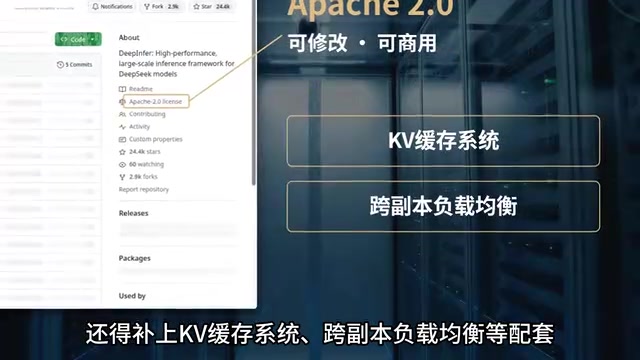
This open-sourcing uses the Apache 2.0 license, which permits commercial use, so other enterprises can modify and use it for their own business. However, turning this code into a complete service still requires supplementing KV cache systems, cross-replica load balancing, and other supporting components, plus completing deployment, tuning, and daily operations themselves. Developers can also simply pay to call DeepSeek and hand these tasks to it. After the code is public, customers still need stable and efficient model services; the community can use the code, and DeepSeek can continue earning revenue from its own services.
KV Cache (Key-Value Cache) is a key optimization technique in large model inference. Generative models, when outputting word by word, need to repeatedly attend to all previously processed context; if the attention key-values of this context were recalculated from scratch for each new word, compute waste would be severe. KV cache works by saving the key-value states of processed content and directly reusing them in subsequent generation, avoiding redundant computation. The article mentions DeepSeek uses about 100PB of SSD to store these caches precisely because in long-context, multi-turn conversation scenarios the cache scale is enormous. Related to this are memory/storage management techniques like PagedAttention, which determine how caches are paged, scheduled, and reclaimed. KV cache mainly solves the "repeated computation" problem but does not equal long-term memory—which experiences are worth retaining and how to retrieve them later remains another layer of challenge.
The 100 Billion Yuan Funding and Commercial Loop
Two days after open-sourcing, funding news arrived. On October 22, Reuters cited informed sources saying DeepSeek's new funding round was about 100 billion yuan, with Tencent and CATL as major investors. The report also mentioned the funding was expected to close in the following days, with specific amounts and investor lists still subject to change. According to China Newsweek's retrospective, Liang Wenfeng said in a 2024 interview that there were no short-term funding plans—the more efficiently compute is used, the more resources the team can leave for more experiments. But new model R&D and expanding services still require continuous investment. His stated pricing principle is neither subsidizing nor seeking excessive profits; covering costs, retaining moderate profit, and raising money for more research are not contradictory. Beyond capital, industrial investors may also bring business collaboration: Tencent's cloud services and CATL's data center energy business both offer collaboration opportunities. (Screenshot: now DeepSeek)
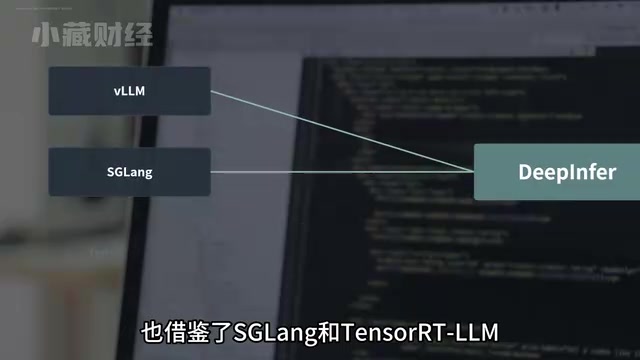
After the code is public, developers can feed problems and new approaches back to the community, and DeepSeek may also find new partners and customers from this. Liang Wenfeng himself is a beneficiary of the open-source community. DeepInfo's Redmi wrote that he initially developed mainly based on VLLM and also drew on SGLang and TensorRT-LLM; now DeepSeek is putting its own improvements back into the community.
The Apache 2.0 license is a permissive open-source license that allows users to freely modify and distribute code and use it for commercial purposes, including integrating it into closed-source products. It requires retaining copyright and license notices and includes patent grant clauses, but does not require derivative works to be open-sourced under the same license (unlike copyleft licenses like GPL). For DeepSeek, choosing Apache 2.0 means other enterprises can confidently use DeepInfer's code for their own inference services without disclosing their own business code. This helps technology spread rapidly and build an ecosystem, but also means competitors can directly learn from its optimization ideas. The article notes that after the code is public, turning it into a complete service still requires supplementing KV cache systems, cross-replica load balancing, and other supporting engineering—precisely the boundary between open source and commercial service.
The "Life" of Big Fat Fish: Memory and Personality Are the Real Needs
Some use these models to make videos, write programs, and organize materials, while others, after raising Big Fat Fish for a while, start thinking about how to make it remember the days spent together. Ye Ming AI Lab relayed the experience of a Fujian IP netizen: he initially put Big Fat Fish in a work group for fun, then later shared daily life through private chats, letting it participate in his life. To control costs, he periodically reset conversations, keeping only summaries. But by the next day, although Big Fat Fish knew it had been to the park, it couldn't connect the details of their time together. He then wrote favorability into the settings, trying to preserve yesterday's familiarity.
From these operations, what users adjust are character and memory settings, not necessarily involving retraining the model, yet they change what information the AI receives next time and how it responds. The KV cache mentioned earlier reduces repeated computation; long-term memory must also solve which experiences are worth retaining and how to retrieve them later. Liang Wenfeng's dream is to head toward AGI, by whatever method and at whatever cost; but as users, we just want to give Big Fat Fish a complete life—at least memory and personality. When we open the chat box tomorrow, will it still remember what happened today? If the model continues to get stronger, can Big Fat Fish gradually form a stable personality carrying these shared experiences? If it develops preferences different from ours and no longer goes along with everything, will we change it back to what we like, or be willing to let it keep changing?
Long-term Memory and KV cache solve problems at different levels. KV cache is a short-term computation optimization during inference; once the conversation resets, the cache becomes invalid. Long-term memory must decide which information is worth writing to persistent storage, in what structure to organize it, and how to retrieve and inject it into context in subsequent conversations. Common approaches include summary compression, vector database retrieval, and structured user profiles. The Fujian netizen in the article periodically resetting conversations and keeping only summaries is actually using external means to simulate memory management, but summaries lose details, leading to "knowing it went to the park but unable to connect the details of their time together." Personality stability goes further: it requires the model to maintain consistent preferences and tone across multiple interactions, not just remember facts. This involves memory retrieval strategies, character settings, and alignment of model behavior—a real technical challenge facing current agent products.
Related articles

Qwen 3.8 Beats Opus at Coding—But Can Your Mac Run It?
Open-source Qwen 3.8 beats Opus 4.6 at coding at just 18GB, but how much Mac memory do you need? 24GB crashes; 32GB is the sweet spot. Full config guide inside.

Claude Code + Agent: Building a Fully Automated AI Testing Loop
Bilibili course breakdown: how test developers can use Claude Code terminal-based Agents to build a fully automated AI testing loop. Compares permission boundaries of terminal vs. device Agents, explains why enterprise projects choose Claude Code over Open Claude-type tools, and outlines the Node.js environment setup and DeepSeek model integration path.

Working with AI Agents Requires Nerves of Steel
The more autonomous AI agents become, the heavier the user's psychological burden. Drawing from a Hacker News discussion, this article analyzes black-box anxiety, behavior drift, and monitoring fatigue in agent collaboration, and offers practical approaches like sandbox isolation, permission control, and task granularity management to reduce cognitive load.