DeepSeek Open-Sources Its In-House Inference Framework DeepInfer, Powering Large-Scale Deployment of V4.1-Flash

DeepSeek open-sources its production-grade DeepInfer inference framework, emphasizing high throughput and low latency.
DeepSeek fully open-sourced its in-house inference framework DeepInfer, which powers large-scale production serving of DeepSeek-V4.1-Flash and emphasizes high throughput and low latency. The move aims to reduce the community's computing costs and energy use, making AI more affordable. Small teams gain a battle-tested inference foundation, while enterprises get an auditable, customizable option. Specific architecture, hardware support, and benchmarks remain undisclosed.
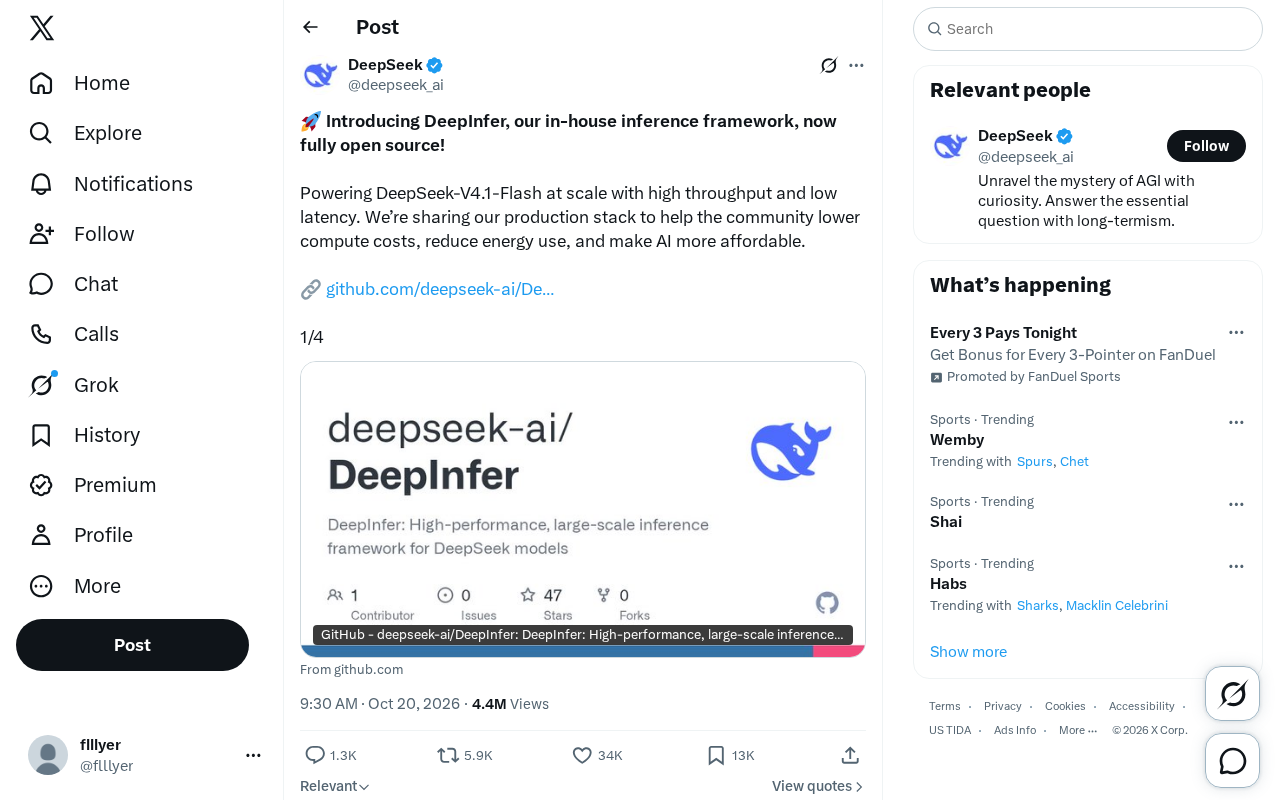
DeepSeek announced on social media that its in-house inference framework DeepInfer has been fully open-sourced. The framework powers the large-scale production deployment of DeepSeek-V4.1-Flash and focuses on high throughput and low latency. According to the official statement, opening up a production-grade tech stack aims to help the community reduce computing costs and energy consumption, making AI more affordable.
What Is DeepInfer?
According to the official tweet, DeepInfer is an inference framework DeepSeekAd has used internally for a long time. It is not a lab prototype but a production system validated by real traffic. It currently powers the large-scale serving of DeepSeek-V4.1-Flash and performs strongly on the two core metrics of throughput and latency.
The tweet did not disclose specific technical details, but the "high throughput, low latency" positioning points to the most critical optimization directions for an inference framework: serving more requests per unit of hardware while controlling response time. For enterprises that need to deploy large models, these two factors directly determine the cost per token.
An inference framework is the software layer between trained model weights and actual online serving. It handles request scheduling, batching, KV Cache management, memory allocation, operator fusion, and parallelism strategies. Unlike training frameworks, the core metrics of an inference framework are the number of tokens per unit of hardware per second (throughput) and the response latency per request (TTFT, TPOT). Mainstream open-source options include vLLM (known for PagedAttention), SGLang (known for RadixAttention and structured output), TensorRT-LLM (deeply optimized by NVIDIA), and Hugging Face TGI. DeepInfer belongs to the same category, and its differentiator is that it has been validated by DeepSeek's own hyperscale traffic.
The Cost Motivation Behind Open-Sourcing
The official tweet clearly states the motivation for open-sourcing: to help the community reduce computing costs, reduce energy use, and make AI more affordable. This framing elevates DeepInfer from an "internal tool" to "public infrastructure."
Inference cost is an unavoidable bottleneck in the commercialization of large models. Training costs are concentrated and plannable, while inference costs grow linearly with user volume. Open-sourcing an inference framework validated at hyperscale means other teams do not have to figure out scheduling, batching, memory management, and other components from scratch and can directly reuse production experience.
Inference cost can usually be broken down into three parts: memory footprint, compute utilization, and scheduling efficiency. Large-model inference is a memory-bandwidth-intensive task. During the decode phase, every generated token requires re-reading all weights and the KV Cache, so the larger the batch size, the lower the marginal cost per token, but the higher the latency. Optimization in an inference framework is essentially about finding the Pareto frontier between throughput and latency. Common techniques include continuous batching, prefix caching, quantization (FP8/INT8), and speculative decoding. This is why a mature framework can significantly change the economics per token.
What It Means for Developers and Enterprises
Open-sourcing DeepInfer provides different value to different roles. For small and medium-sized teams, it offers an inference foundation tested at scale, shortening the path from model to service. For large enterprises, it adds an auditable and customizable inference option, reducing sole reliance on closed-source commercial inference services.
From an ecosystem perspective, DeepSeek open-sources the inference framework together with the model, forming a "model + inference stack" combination. This contrasts with the strategy of some vendors that release only model weights and not the serving layer, and it is more attractive to teams seeking self-controlled deployment.
Synchronously open-sourcing a "model + inference stack" is a trend signal in recent years. Releasing only weights means users still have to solve the engineering problems of the serving layer themselves. Releasing weights together with an inference framework hands the entire chain from checkpoint to serviceable API to the community, facilitating private deployment, compliance auditing, and secondary development. This model is especially important for data-sensitive industries (finance, healthcare, government, and enterprise) because they often cannot accept requests passing through third-party closed-source services. In contrast, some vendors choose to focus on hosted APIs and open weights only to a limited extent, forming a different ecosystem path.
Open Questions
Public information is currently limited. The tweet was published as the first in a series of four, and follow-up content may cover architecture design, performance benchmarks, and deployment documentation. Questions such as which hardware DeepInfer supports, whether it is compatible with other models, and how it actually performs compared with mainstream inference frameworks will need to be answered by technical documentation and community testing.
For developers focused on inference optimization, it is advisable to consult the official repository and follow-up tweets directly and run benchmarks in their own hardware environments rather than making selection decisions based only on promotional metrics.
One-line Summary
DeepSeek open-sources its in-house production-grade inference framework DeepInfer, focusing on high throughput and low latency to reduce inference costs.
Paragraph Summary
DeepSeek announced on social media the full open-sourcing of its in-house inference framework DeepInfer. The framework is not a lab prototype but a system that has long powered large-scale production serving for DeepSeek-V4.1-Flash, officially positioned for high throughput and low latency. The motivation for open-sourcing clearly points to reducing the community's computing costs and energy consumption and making AI more affordable. The article analyzes its value: small and medium-sized teams gain an inference foundation validated at scale, shortening the path from model to service; large enterprises gain an auditable and customizable option, reducing reliance on closed-source commercial inference services. Open-sourcing the model and inference stack together creates a combined advantage and is more attractive to teams pursuing self-controlled deployment. However, the specific architecture, hardware support scope, and performance benchmarks have not yet been disclosed. The tweet is only the first in a series, and practical selection still requires documentation and community testing.
Related articles

Amphibious Transforming Drone: Beyond 100x Power Savings, What Are the Real Needs?
Is the amphibious transforming drone just a gimmick? Starting from the 100x power difference of the M4 Morphobot, explore real application scenarios and thesis topic ideas, analyzing boundary conditions where pure drones and pure ground robots both fail.

Warhound Raises $200 Million: Genetically Engineered "War Dogs" Paired with Anduril Gear
Warhound raises $200M, backed by Ben Lamm and Palmer Luckey, to genetically engineer dogs for military and law enforcement use and equip them with Anduril gear. This article analyzes its technology direction, funding logic, and ethical controversy.

Claude API Comes to Google Cloud: IAM Integration and SDK Access Guide
Anthropic hosts the full Claude API on Google Cloud with IAM-controlled permissions and unified billing. This guide covers the Vertex AI and Anthropic-hosted entry points, IAM role configuration, and SDK access.