DeepSeek Opens Full App API Suite, Qwen4 Set for Nov 17 | AI Daily
Model vendors' competition shifts to developer delivery pipelines: interface completeness, cost, and latency become key.
The article rounds up recent AI industry developments, noting that competitive focus is shifting from model capabilities to developer delivery pipelines. DeepSeek has opened the web search, file parsing, web page reading, OCR, speech recognition, and synthesis capabilities behind its official App as APIs and open-sourced a frontend Demo; the frontend has also launched quota management, hinting that a Coding Plan is near. Alibaba's Qwen4 is set for the November 17 Hong Kong Summit, focused on coding and Agents, with the Qwen4 Max preview already available. Tencent Hunyuan HY4 stands out on the cybersecurity index and vulnerability remediation tests at low cost, and with Aidi Mao University has open-sourced Flash TopK, cutting million-level context token filtering from 5.32 seconds to 1.62 seconds. On inference efficiency, cloud new hardware and device-side offline solutions are advancing respectively. Overseas, OpenAI has disbanded its independent robotics team, while Google has launched a series of TPU and Gemini product lines.
Competition among AI products is shifting from "whose model is stronger" to "who can deliver capabilities to developers more smoothly." Several recent developments, viewed together, make this trend quite clear: DeepSeek has opened the entire suite of capabilities behind its official App as APIs, Alibaba has set a date for Qwen4, Tencent Hunyuan has delivered quantifiable results in security and efficiency, and OpenAI has scaled back its robotics team.
DeepSeek: Turning the App's "Invisible Capabilities" into APIs
According to a roundup by the Bilibili channel "我有书的每日AI动态," multiple capabilities behind the official DeepSeekAd App are now callable via API, including web search, file parsing, web page reading, as well as OCR, speech recognition, and speech synthesis. The team has also open-sourced a frontend Demo so developers can directly reuse the interaction layer implementation.
The significance of this batch of capabilities lies in the fact that they were previously part of the App experience, and developers had a hard time accessing them individually. Web search and web page reading address the timeliness of model knowledge; file parsing and OCR handle unstructured document input; speech recognition and synthesis complete the multimodal interaction chain. Packaging and opening these capabilities means developers no longer need to stitch together multiple third-party services for search, parsing, and speech—they can accomplish everything within a single interface system.

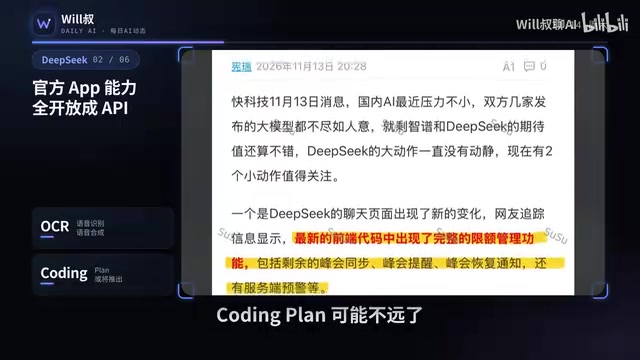
Separately, according to Kuai Technology, DeepSeek's frontend has launched quota management, suggesting a Coding Plan may be coming soon. Quota management is typically the prerequisite infrastructure for a paid or quota system, and viewed alongside the API opening, this points toward a more complete developer monetization path.
OCR (Optical Character Recognition) is the technology that converts text in images, scans, or PDFs into editable text. In AI application pipelines, OCR often serves as the entry point for document input: contracts, invoices, and screenshots uploaded by users are often unstructured images, and the text must first be extracted before the model can understand the content. Its difference from file parsing is that file parsing focuses on parsing the internal structure of formats like PDF and Word (paragraphs, tables, page numbers), while OCR specifically handles text within images. Only when combined can they cover the vast majority of real-world document input scenarios.
Speech recognition (ASR) and speech synthesis (TTS) are the two ends of voice interaction: ASR converts what the user says into text, and TTS converts the model's text replies into natural speech. Together they form voice conversation capability, the most fundamental link in multimodal interaction. Previously, developers building voice capabilities typically had to integrate with independent speech service providers, dealing with additional overhead in latency, authentication, and billing; with official APIs providing this directly, the voice chain can be combined with text and search capabilities within the same interface system.
Alibaba: Qwen4 Set for Nov 17, Focused on Coding and Agents
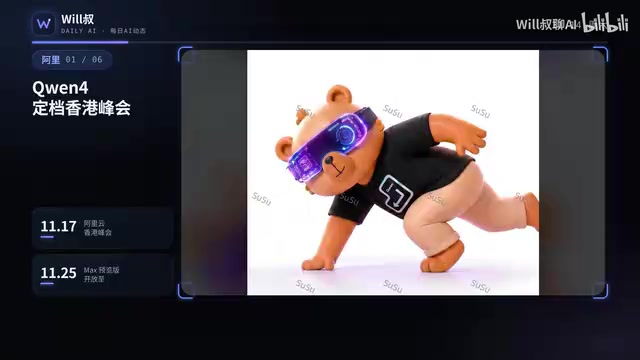
The Alibaba Cloud Hong Kong Summit will open on November 17, with Qwen4 as the absolute centerpiece, focused on stronger coding and Agent capabilities. According to video content, Qwen4 Max may debut that day, and its preview version is already available until November 25.
Coding and Agents are the two most concentrated directions of current model capability competition: the former directly corresponds to developer productivity, while the latter determines whether a model can autonomously plan and execute in real tasks. Making these two the focus indicates that Qwen4 is positioned toward engineering deployment rather than mere benchmark scores.
Agent refers to the ability of a model to not just answer questions but to autonomously decompose tasks around a goal, call tools, observe results, and iterate execution. Compared with single-turn Q&A, the core difficulties of an Agent lie in multi-step planning, accuracy of tool calls, self-correction after errors, and context management for long tasks. Engineering-wise, it depends on foundational capabilities such as Function Calling, structured output, and long context. A model's performance in Agent scenarios directly determines whether it can be used for real business tasks such as automated coding, data analysis, and office workflows—not just chat demos. Therefore, focusing on coding and Agents is essentially competing for the entry point to developers' daily workflows.
Tencent Hunyuan: Tops Security Index, Flash TopK Delivers Major Speedup
Tencent Hunyuan HY4 scored 58% on the Artificial Analysis cybersecurity index, ranked first in vulnerability remediation testing at 76%, with a cost of only $0.92 per task. Security capability and cost being quantified simultaneously makes the reference value for enterprises during selection more direct.
Hunyuan also open-sourced Flash TopK with Aidi Mao University, reducing the time to select tokens under million-level context from 5.32 seconds to 1.62 seconds. In long-context scenarios, token filtering is often a non-negligible overhead in the inference pipeline, and this optimization directly compresses latency in that segment.
TopK filtering is a common operation in model inference: selecting the K highest-scoring candidates from a large pool of candidate tokens (or attention scores). In million-level context scenarios, the number of candidates is enormous, and comparing and sorting them one by one brings significant computation and memory overhead, becoming one of the bottlenecks of long-context inference. Flash TopK targets exactly this segment, using a more efficient algorithm to select the top K results, cutting time from 5.32 seconds to 1.62 seconds. While such low-level operator optimizations don't change model capabilities, they directly affect whether scenarios relying on ultra-long contexts—such as long document understanding and codebase analysis—can be practical.
Artificial Analysis is a third-party model evaluation and comparison platform that aggregates multiple benchmarks and provides a composite index, often used for cross-vendor horizontal comparisons. Its cybersecurity index focuses on model performance in tasks such as vulnerability identification and security analysis; unlike general capability benchmarks, it is closer to the security concerns enterprises have during actual selection.
Inference Efficiency: From Single-Card Throughput to Offline Deployment
The inference performance of DeepSeek V4.1 Flash has been tested by multiple parties. VLMM ran it on NVIDIA VLR Rubin at 2.52 million tokens per second per GPU, 2.7 times that of GP300. Exolabs combined two Mac Studios, battery-powered and fully offline, achieving 220 tokens per second.
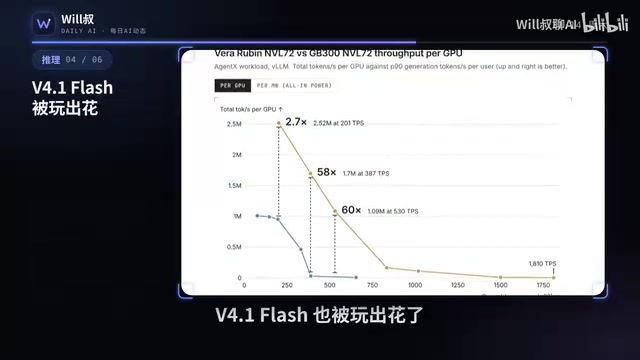
These two cases represent two directions of efficiency optimization: the cloud pushes throughput to a higher order of magnitude with new hardware, while the device side achieves fully offline usable inference through local combination solutions. The latter is especially meaningful for privacy-sensitive or network-constrained scenarios.
OpenAI Scales Back Robotics Team, Google Launches Multiple Product Lines
Overseas, according to reports, OpenAI has disbanded its independent robotics team, with personnel merged into regular model training. At the end of May this year, Altman was still tweeting to recruit; that's only about 4 months ago. The cancellation of team independence typically means resources are being concentrated on mainline model training.

Google, meanwhile, had a packed week, with Pichai showing off new orders: two eighth-generation TPUs, Gemini 4.0 Carbon, Gemini Robotics 2.5, Alpha Genome 2, plus Gemini 4.0 Hydrogen. Advancing on both hardware and model fronts, covering everything from the compute foundation to specific application scenarios.
The Signal Across These Developments
DeepSeek opening App capabilities, Hunyuan open-sourcing Flash TopK, and Alibaba making coding and Agents the focus of Qwen4 all point to one thing: the competitive focus of model vendors is shifting from point capabilities to developers' actual delivery pipelines—whether interfaces are complete, whether costs are controllable, and whether latency is low enough. For developers, this means more composable building blocks; for vendors, whoever makes these blocks easier to assemble will be more likely to be kept around.
Related articles

OMLX 0.7.1 Integrates Splash: Major Speedup for MLX Model Inference on Mac
OMLX 0.7.1 adds Splash as an external engine, letting standard MLX models (Qwen 3.6 35B) match Splash custom setups at 92.8 tokens/s. Setup, D-Flash2 requirements, and M1/M2 compatibility explained.

Running Uncensored AI Locally on Your Phone: LFM3 Hands-On Test and Guide
Learn how to run Liquid AI's LFM3 1.7B uncensored model locally on iPhone and Android—no GPU or network needed. Includes On Device LLM and Layla steps, speed tests, and privacy benefits.

Claude Launches Collaborative Sheets and Whiteboards, Taking On Microsoft and Google Directly
Anthropic rolls out beta Claude Sheets and Whiteboards to paid users, enabling one-prompt spreadsheets with formulas and turning verbal plans into collaborative boards—taking on Microsoft and Google directly.