DeepSeek Paid Coding Plan Imminent, Qwen 4.0 Max Release Date Draws Attention

DeepSeek subscription precursor, Qwen 4.0 Max release date, Meta new model exposure, and ChatGPT Wallet launch signal a shift to productization.
On November 14, the AI industry released multiple stories: DeepSeek's frontend code exposed a full quota management system, hinting at an imminent Coding Plan subscription; Qwen 4.0 Max may debut at the Alibaba Cloud Hong Kong Summit on November 17; Meta's internal merge request revealed Muse Spark 1.4 Internal; OpenAI launched ChatGPT Wallet for agent payments. Anthropic launched Claude Meetings beta but faced outages, and Handoff rolled out to Pro users. Open-source updates included Llama.cpp V1.0.0, Liquid AI's codec, and Perplexity's decision models. OpenAI disbanded its robotics team. The trend points to large models moving into deep productization and ecosystemization.
Title
DeepSeek Paid Coding Plan Imminent, Qwen 4.0 Max Release Date Draws Attention
Meta Description
DeepSeekAd frontend code reveals Coding Plan subscription system, Qwen 4.0 Max scheduled for Alibaba Cloud Hong Kong Summit, Meta's new model Muse Spark 1.4 unexpectedly appears, ChatGPT Wallet payment feature launches, open-source ecosystem and model leaderboards updated in tandem.
Article Content
The AI industry never lacks surprises in its pace. On November 14, the AI trend indicator threw out multiple major stories at once: a complete quota management system hidden in DeepSeek's frontend code, Qwen 4.0 Max's debut time locked in ahead of schedule, Meta's internal model unexpectedly exposed, plus the launch of ChatGPT Wallet payment feature—each one points to the same trend: the large model competition is shifting from pure parameter battles to the deep waters of productization and ecosystemization.
DeepSeek Coding Plan: Subscription Signal Already Lit
Updates to the DeepSeek Chat frontend code reveal key signals. Newly added quota status polling, exhaustion prompts, warning popups, and synchronized coverage of multilingual quota copy constitute a complete set of subscription frontend infrastructure. Previously, the official offering only provided pay-as-you-go API, and many users reported astonishingly fast invocation speeds. Once the Coding Plan lands, Token costs within the quota will become extremely cheap.
The logic behind this is not hard to understand: pay-as-you-go suits trying things out, while subscription is what retains high-frequency developers. The readiness of frontend infrastructure means the productization loop is essentially complete, just one final step away from official launch. For teams relying on DeepSeek for daily coding, this could be a significant adjustment to their cost structure.
Difference between pay-as-you-go and subscription: Pay-as-you-go means users pay based on the actual number of Tokens consumed, suitable for low-frequency or experimental use, with costs growing linearly with usage; subscription means paying a fixed fee monthly or annually, allowing unlimited or heavy usage within the quota. For high-frequency developers, subscription can significantly lower unit Token costs and improve cost predictability. DeepSeek's shift from pure API pay-as-you-go to Coding Plan subscription means its business model extends from "resource retail" to "developer relationship operations," which is also the standard path for cloud vendors and model vendors to lock in long-term users.
Qwen 4.0 Max Scheduled for Alibaba Cloud Summit
According to leaks, Qwen 4.0 Max may officially debut at the Alibaba Cloud Hong Kong Summit on November 17, becoming the focal point of the event. The new model further enhances programming and agent capabilities, supporting ultra-long context and multimodal inputs of images and video. Currently, the Qwen 4 Max preview is open for experience until November 25, accessible via Token solutions, and Tongyi Lab experts will also share a commercial value roadmap.
From the timeline perspective, the preview period highly overlaps with the summit node—this is both a technology showcase and a concentrated mobilization of the developer ecosystem. Programming and agents are two directions emphasized, indicating that Qwen's iteration focus is shifting from general conversational capabilities to deployable productivity scenarios.
MoE architecture and activated parameters: The article mentions "594B total parameters, 18B activated MoE." MoE (Mixture of Experts) is a sparse model architecture. The model contains multiple "expert" subnetworks, and only a small subset is activated in each forward pass. Total parameters of 594B represent the sum of all expert weights, while 18B activated represents the number of parameters actually involved in computation per inference. This design allows the model to maintain large-capacity knowledge while significantly reducing inference compute costs, and is currently the mainstream approach for balancing performance and efficiency in large models.
Meta New Model Exposure and Fable 5.5 Gray Release Rumors
Muse Spark 1.4 Internal appeared in Meta's internal merge request, suspected to be a new model exposure. The request only modified RocksDB experimental Live Tuning logs, and also reported actual model calls using this model, suggesting Muse Spark 1.4 has entered Meta's internal usage phase.
Another piece of news comes from rumors of Fable 5.5 gray testing. Some partners have already received the model, and its 3D, SVG, and code-to-video capabilities are astonishing. Leaks claim internal testing has confirmed the version is live, with some accounts even having scheduling priority over versions 5.1 and 5.2. However, the release has been delayed to next week, reportedly to align with an IPO publicity window, and authenticity remains to be verified.
Agent Commercialization Accelerates: Wallet, Meetings, and Web Operations
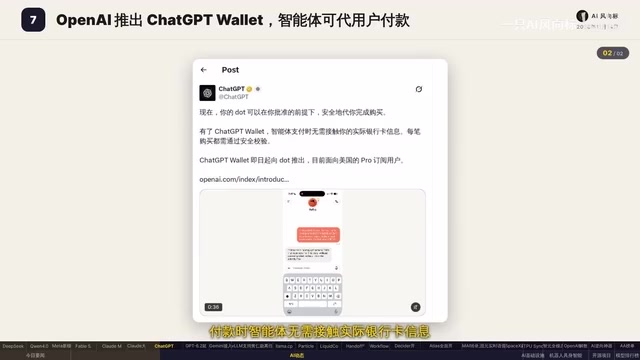
OpenAI launched ChatGPT Wallet, allowing agents to shop and pay on behalf of users. The feature was built by OpenAI in partnership with American Express, Mastercard, and Visa. Users can use it after entering their bank card information once, and it is currently limited to the US. Agents do not need to touch actual bank card information, each purchase requires security verification, and existing points and benefits protections still apply.
Anthropic launched Claude Meetings beta, open to Team and Enterprise plans. Claude can join Google Meet calls as a participant, take meeting notes while listening, draft documents and whiteboards in real time, track action items, and remember discussion content. During the testing period, the notes feature is free. However, on the same day, a large number of services including Claude.ai, Claude Code, and Platform.Claude.com reported errors, with Console and Cowork also affected. Anthropic said it is investigating authentication issues and attributed some failures to connection problems from the Microsoft 365 outage.
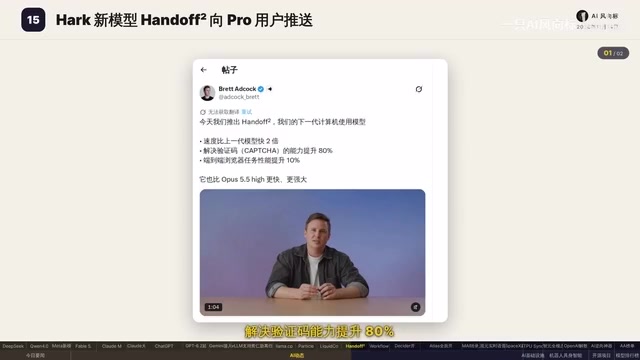
The web operations model Handoff is now fully rolled out to Pro users, with overall speed doubled on average, CAPTCHA-solving capability improved by 80%, and end-to-end browser task performance also improved. In an evaluation of 478 tasks across 238 websites, the completion rate rose from 73% to 82%, with flight booking up to 3.8x faster.
Open-Source Ecosystem and Infrastructure: From Models to Toolchains
Open-source moves are equally dense. VLM supports Inclin 2 Small on day one; the model is a MoE with 594B total parameters and 18B activated, with context up to 1M, supporting image-text input and text output, and weights are already available for download on Hugging Face under the Apache 2.0 license.
The local inference library Llama.cpp released its first stable version V1.0.0. The author stated that users can control their own intelligence for free on phones, laptops, and workstations, without sending data to anyone. The new version introduces MoE offloading and intelligent LRU caching, allowing large models that don't fit in VRAM to run at high speed.
Particle AI coding model Particle E is available for free on OpenRouter, with no charge for input or output, based on reinforced training of DeepSeek V4.1 Flash, featuring long context and tool calling support. However, some users have already reported poor real-world performance, with rate limiting triggered after 40 minutes of thinking on long tasks.
Liquid AI open-sourced Liquid Codec, a streaming audio codec for speech large models, with about 74M parameters, capable of compressing human speech into discrete features and reconstructing it in real time. It breaks the sequential dependency of traditional codecs, allowing speech models to generate all audio features in parallel, achieving real-time encoding and decoding speeds of 361x and 87x on a single core of Apple M4 Max, greatly reducing on-device latency.
Perplexity open-sourced the Decider V1.3 and Flash V1.3 decision models, free on OpenRouter for one week, adding Locate positioning capability, significantly outperforming general models on 17 PII and extraction QA evaluations, with 91.6% accuracy on 63 classification tasks.
At the infrastructure level, Google launched the TPU-Sync open-source solution for inference and reinforcement learning scenarios on TPUs, reducing task switching overhead through fast KV cache and weight transfer, and improving training and deployment efficiency of TPU clusters.
KV cache and inference optimization on TPUs: KV cache (Key-Value Cache) is a key mechanism in Transformer inference, used to store already-computed attention key-value pairs to avoid repeated computation during autoregressive generation, thereby greatly reducing latency. Google's TPU-Sync solution shortens data movement overhead when switching between different inference tasks or reinforcement learning environments through fast KV cache and weight transfer. In multi-tenant or RL training scenarios, frequent switching of models and tasks leads to cache invalidation and weight reloading; such optimizations can improve overall throughput and utilization of TPU clusters.
Robot Roadmap Divergence and Capital Variables
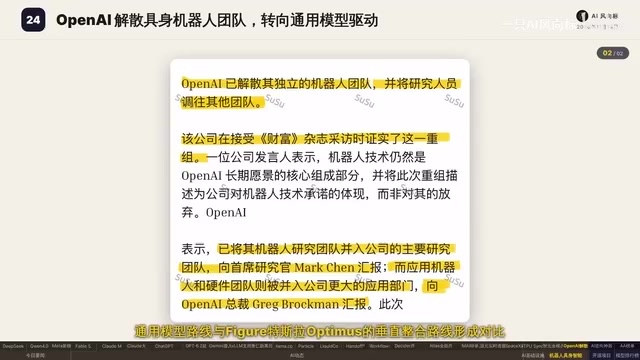
BAAI released the embodied omni-modal interaction large model WidTX.VA Omni, which has been deployed on robot bodies, meaning omni-modal interaction capability has moved from the model layer to full-machine operation. On the other side, Sam Altman has disbanded OpenAI's embodied robotics team, which was established only four months ago. OpenAI confirmed the restructuring, with the robotics team merged into the main research team and applications department. A spokesperson said this is a commitment rather than abandonment; the general model route contrasts sharply with the vertically integrated routes of Figure, Tesla, and Optimus.
Bloomberg published an analysis of what impact Jensen Huang's sudden departure from Nvidia would bring, expanding from three dimensions: capital markets, AI companies, and US-China relations. As the head of the world's leading AI chip company, Jensen Huang's sudden departure is seen as a major variable that could reshape the industry landscape.
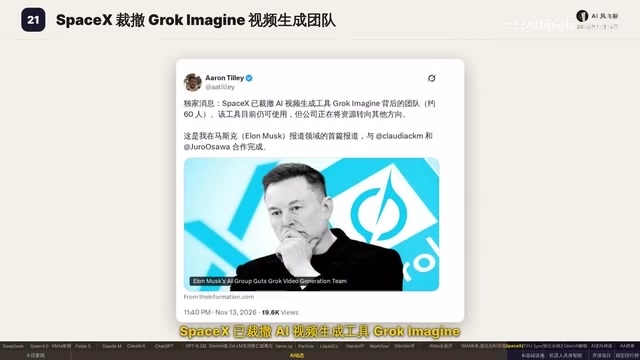
In addition, according to an exclusive report, SpaceX has laid off the approximately 60-person team behind the AI video generation tool Grok Imagine. The tool is still usable, but resources are shifting to other directions.
Leaderboard Quick View: Top Landscape and Domestic Catch-Up
The top of the intelligence leaderboard is clear: Claude Fable 5.2 Max tops with 65 points, Gemini 4 Carbon High is second with 60 points, Claude Opus 5.5 Max is third with 59 points, and Anthropic leads on both lines. Among open-source domestic players, Kimi K3.1 Pro performs best, ranking 11th with 46 points, closely chasing the first tier.
Overall, the news of this day covers almost all key links of the AI industry: subscription commercialization, model iteration, agent payments, open-source toolchains, and hardware infrastructure. What is truly worth watching is not any single leak, but the direction these moves collectively point to—large models are moving from the demo stage into the ranks of everyday production tools.
One-line Summary
DeepSeek subscription precursor, Qwen 4.0 Max release date, Meta new model exposure, and ChatGPT Wallet launch—the large model competition shifts toward productization and ecosystemization.
Paragraph Summary
On November 14, the AI industry released multiple stories in quick succession: DeepSeek's frontend code exposed a complete quota management system, hinting that the Coding Plan subscription is about to launch; Qwen 4.0 Max may appear at the Alibaba Cloud Hong Kong Summit on November 17, strengthening programming and agent capabilities; Meta's internal merge request exposed the Muse Spark 1.4 Internal model; OpenAI launched ChatGPT Wallet, allowing agents to shop and pay on behalf of users. Meanwhile, Anthropic launched the Claude Meetings beta but suffered service outages, and the Handoff web operations model was fully rolled out to Pro users. On the open-source side, Llama.cpp released its first stable version V1.0.0, Liquid AI open-sourced a streaming audio codec, and Perplexity open-sourced decision models. Robot roadmaps diverged, with OpenAI disbanding its embodied robotics team. The overall trend points to large models moving from parameter battles into the deep waters of productization and ecosystemization.
Related articles

OpenAI to Shut Down Agent Builder and Two Other Services on November 30, Developers Must Migrate Urgently
OpenAI will shut down Agent Builder, the evals dashboard, and reusable prompts on November 30; evals is already read-only. Here's the scope, OpenAI's migration paths (Agent SDK, PromptFu, your own code), and what developers should export and rebuild this week.

RankSpot: A Pay-Per-Use SEO & AI Search Execution Layer That Lets Agents Write, Publish, and Build Backlinks for You
RankSpot is an SEO & AI search execution layer for AI Agents. Connect via MCP to Claude or ChatGPT to write, publish & build backlinks. Pay-per-use, $3/article.

Appxiom: Giving AI Coding Assistants Production Context
Appxiom gives AI coding agents production context—crashes, jank, memory leaks, failed network calls—across Android, iOS, Flutter, KMP, and Web, ranking bugs by Goal Friction Impact.