DeepSeek Releases Application API, Gemini and Hunyuan Voice Update Together
DeepSeek, Google, Tencent and others collectively update APIs and agent toolchains, with competition shifting toward engineering usability.
Today's AI roundup covers 14 updates, characterized by "few new models, more engineering capabilities." DeepSeek released an application-layer full-suite API, moving web search, file parsing, tool calling, and context assembly to the server side, with pricing of 0.39 yuan per hour for speech recognition and 1.5 yuan per 10,000 characters for speech synthesis. Google launched Gemini Hydrogen with a 1 million token context and an Anti-Gravity capability for planning-execution model handoff, while Flow added 5 creation tools. Tencent Hunyuan HiRealTime added tool calling and singing and is already used in Yuanbao and Tencent customer service. On the agent side, Thinking Machines open-sourced Inkling 2 Small weights, Anthropic launched a manufacturing plugin and Managed Agents self-hosting, and OpenAI showcased red-team and defense tools—all emphasizing human review and responsibility boundaries. On hardware, Gemini glasses opened pre-orders, while the Claude service experienced fluctuations. Overall, API-layer competition is shifting from model scores to engineering usability, with observability and controllability becoming key selection criteria.
Today's AI Roundup
Today's AI daily brings together 14 industry updates, covering large model API openings, multimodal model releases, agent toolchain refinements, and enterprise-grade AI service upgrades. DeepSeekAd released a full-suite API aimed at the application layer, Tencent Hunyuan launched the real-time voice model HiRealTime, and Google updated both Gemini Hydrogen and its Flow creation tools in one go. Below is a rundown and analysis of the key information.
Note: This article is compiled from public reports and video materials. Some product names are speech-transcription results and may contain spelling deviations; refer to the official pages for accuracy.
DeepSeek Releases Full-Suite Application API: Handing Engineering Details to the Server Side
The core of DeepSeek's release is not a new foundation model, but a set of API capabilities aimed at application development. Developers can access tool-calling capabilities such as web search, file input, link reading, and security validation. Context assembly and tool orchestration are handled server-side, and speech recognition and speech synthesis are also offered as standalone interfaces.
On pricing, speech recognition is 0.39 yuan per hour, and speech synthesis is billed at 1.5 yuan per 10,000 billed characters, with Chinese characters counted as two characters. The official team also open-sourced the source code of a demo chat client that supports importing historical conversations. Note that this release focuses on the application interface layer, while the underlying layer still uses the existing Flash model.
From a product strategy perspective, DeepSeek is packaging "model capabilities" into "modules that can be embedded directly into business workflows." Capabilities like web search and file parsing previously required developers to assemble prompts and toolchains themselves; now the server side handles this uniformly, lowering the barrier to integration—though it also means callers have correspondingly less granular control over the underlying process.
Google: Gemini Hydrogen and Flow Creation Tools Advance on Two Fronts
Google released Gemini Hydrogen, positioned for everyday programming and agent execution. The model supports a 1 million token context, with paid API pricing at $1.5 per 1 million input tokens and $7.5 per 1 million output tokens. The simultaneously added Anti-Gravity orchestration capability allows task handoff between a planning model and an execution model, with availability varying across platforms and subscription tiers.
On the creation side, Google Flow added 5 tools designed by visual artists. Character Arc can show how the same character changes across different age stages, Pocket Studio can generate more camera angles from a single phone clip, and the remaining tools target character posters, retro pixel style, and glass optical effects. The official team notes that specific results depend on the source material and generated output.
The simultaneous iteration of coding agents and creative tools reflects Google betting in parallel on two lines: "productivity" and "creativity." The task handoff mechanism in Anti-Gravity is especially worth watching: separating planning from execution is a common path toward engineering maturity in agent systems, but information loss and error propagation during handoff remain practical difficulties in real-world deployment.
Tencent Hunyuan Real-Time Voice Model: From Conversation to Singing
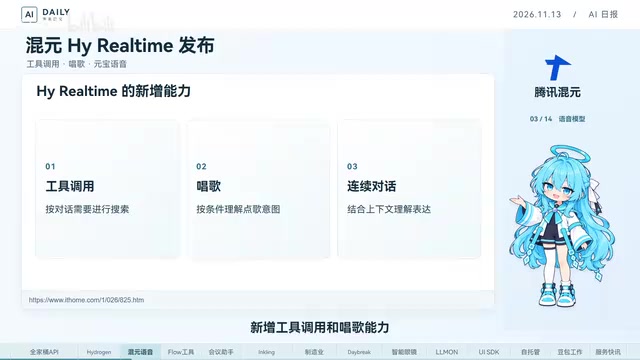
According to IT Home, Tencent released the real-time voice model HiRealTime, adding tool-calling and singing capabilities. It is already used in products such as Yuanbao voice calls and Tencent customer service. Users can experience it by selecting the overseas voice style in the latest version of Yuanbao. Tencent Cloud's external API is planned to launch soon, and duplex interaction and long-term personalized memory remain directions for future iteration.
The competitive focus in the real-time voice track is shifting from "low latency" to "interruptible, tool-callable, and memory-equipped." The addition of singing capability may look entertainment-oriented, but it actually tests the model's fine control over rhythm and timbre. When such capabilities migrate to customer service scenarios, they may translate into more natural tone expression and emotional adaptation.
Agent Toolchains: Vertical Penetration from Coding to Manufacturing
Thinking Machines Open-Sources Inkling 2 Small Weights
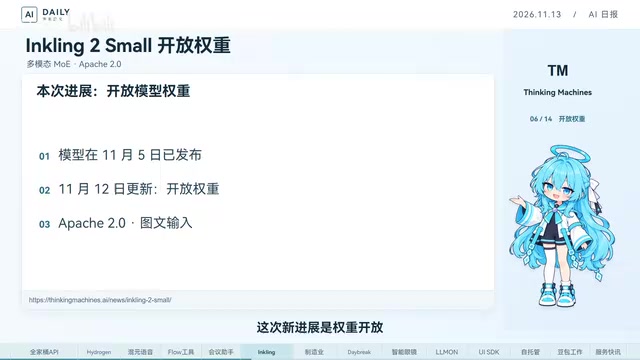
Thinking Machines open-sourced the model weights of Inkling 2 Small, using a multimodal mixture-of-experts architecture with 594 billion total parameters and 17 billion activated per pass. It supports image-text input and a 1 million token context under the Apache 2.0 license. The barrier is that the native 4-bit version requires at least 500GB of aggregate VRAM.
Mixture of Experts (MoE) is an architecture that splits a model into multiple "expert" subnetworks: each forward pass activates only a subset of experts, so the total parameter count can be very large while the compute cost per inference is close to that of a small model. Inkling 2 Small's 594 billion total parameters and 17 billion activated parameters are a reflection of this approach—high storage requirements, relatively manageable running costs. Native 4-bit quantization means weights are stored at 4-bit precision after or during training, which can cut VRAM usage to about a quarter of 16-bit, but brings precision loss and toolchain compatibility issues. This is why the model requires at least 500GB of aggregate VRAM: the total weight volume remains large even at low precision, and practical deployment often requires multi-GPU aggregate VRAM or CPU offloading. The Apache 2.0 license means commercial use and modification are permitted, which is relatively friendly to enterprises that want to build on it locally.
Anthropic Launches Manufacturing Plugin
Anthropic released a manufacturing plugin offering 17 skills and 4 connectors, covering tasks such as quotations, quality reports, troubleshooting, and supplier inquiries, and can connect to Autodesk Fusion, Microsoft 365, and Oracle NetSuite. Engineers can compare design variants based on existing models, but operations facing customers or suppliers still require human review and approval.
Plugins and Connectors are two types of components for landing agents in enterprise systems. Plugins typically encapsulate a set of skills for a specific role (such as quotation or quality report generation), defining the prompt templates and workflows the agent can invoke in that scenario; connectors are responsible for integrating external systems, such as CAD tools like Autodesk Fusion, Microsoft 365 documents and email, and Oracle NetSuite ERP data. Only with both working together can an agent read real business data and write back results. The human approval step is designed because outputs facing customers or suppliers carry contractual and compliance implications: once a model-generated quotation or inquiry goes wrong, responsibility is hard to define, so the process requires human review and approval before sending. This is also a key difference between enterprise-grade agents and traditional chatbots—the latter only offer suggestions, while the former must be embedded in the chain of responsibility.
OpenAI Showcases Security and Defense Tools
OpenAI showcased Daybreak Red Team and Defense Factory. Red Team lets collaborative agents test web applications, verify vulnerabilities, and validate patch effectiveness within an authorized scope, and is currently offered as early access; Defense Factory is in preview and can connect to GitHub repositories to scan code, continuously monitor new commits, and generate fix suggestions for engineer review.
Versal Labs Open-Sources UI SDK
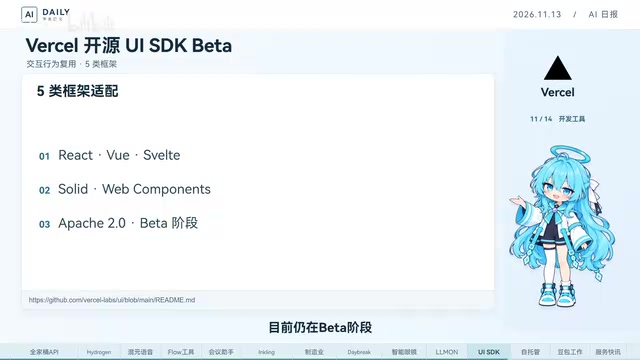
Versal Labs open-sourced a beta UI SDK that organizes keyboard navigation, focus overlay selection, and accessibility behaviors into reusable foundations for coding agents to build interfaces. It supports React, Vue, Svelte, Solid, and Web Components under the Apache 2.0 license and is currently still in Beta.
Anthropic Managed Agents Supports Enterprise Self-Hosting
Anthropic Managed Agents added enterprise self-hosted deployment. Enterprises can place agent service sandboxes, credential management, and session history in their own cloud or on-premises environment, with model requests sent to a selected provider or gateway. Access currently requires an application, and self-hosted service does not equal obtaining Claude model weights.
This group of updates points to the same trend: agents are moving from "demo-ready" to "enterprise-manageable." The human approval step in the manufacturing plugin, the manual review design in Defense Factory, and the isolation of credentials and history in self-hosting are all leaving interfaces for responsibility boundaries and compliance auditing.
Self-hosted deployment and "obtaining model weights" are two different things. In Managed Agents' self-hosted mode, the service sandbox, credential management, and session history required for agent operation are all placed in the enterprise's own cloud or on-premises environment, while model inference requests are sent through a gateway to a designated model provider. This lets enterprises control sensitive data so it does not land with third parties, meeting data residency and auditing requirements, but the model itself is still called remotely—weights are not delivered, so it cannot run offline or be fine-tuned independently. Credential management refers to the hosting and rotation of sensitive information such as API keys and database passwords; self-hosting keeps these credentials within the enterprise boundary, reducing leakage risk; localization of session history relates to whether conversation records constitute data assets that require compliant retention. This type of deployment usually requires an eligibility review, because the provider needs to confirm the enterprise's security baseline and operational capabilities.
Hardware and Services: Gemini Glasses Pre-Orders, Service Status Fluctuations
Google partnered with Samsung, Gentle Monster, and Warby Parker to launch Gemini smart glasses and opened pre-orders. The Warby Parker series starts at $395, and the Gentle Monster series starts at $449, with a planned release date of December 10. The glasses support voice interaction, navigation, and translation, and can be used with Pixel and Samsung phones as well as iPhone.

IBM released the LLMOM markup language and provided 3B and 8B experimental preview models based on Granite 4.1, using special markers to distinguish instructions, data, and constraints, to study the model's ability to resist indirect prompt injection. The official team makes clear this is a learned behavior and does not constitute a security guarantee; it is currently mainly used for exploration and evaluation.
On the service status front, Claude experienced a new round of anomalies on the evening of November 13, involving web, API, Claude Code, and connectors. An official evening update said the web and API had recovered, but errors may still be returned; check the official status page for the latest recovery status.
Ecosystem and Integration: Doubao Work Integrates Third-Party Models
According to a Xin Jing Bao report, Doubao Work has integrated more third-party Kimi models and displays the quota consumption multiplier for each model. Doubao 2.1 Lite and DeepSeek V4.1 Flash have entered limited-time promotions. This is a product integration and quota policy update; refer to the product page for the specific scope of the campaign.
Multi-model integration and quota transparency are becoming standard capabilities for office AI products. For users, multiplier display makes costs predictable; for platforms, model routing and billing strategies themselves have become part of product differentiation.
Observation: API-Layer Competition Enters the "Engineering Details" Stage
Among today's updates, there are not many truly new models; most are refinements of APIs, plugins, SDKs, and deployment forms. DeepSeek brings tool calling and context assembly back to the server side, Anthropic builds approval and self-hosting into enterprise workflows, and Versal Labs distills accessibility behaviors into an SDK. The common thread is that the competitive focus is shifting from "model scores" to "engineering usability."
For developers, this means integration costs are falling, but it also imposes new requirements on the explainability and controllability of system behavior. When the server side handles assembly and orchestration for you, it also becomes harder to trace the chain when problems occur. When choosing which API to use, beyond price and context length, you also need to look at whether it provides sufficient observability and responsibility boundaries.
Background Notes
Indirect prompt injection refers to attackers hiding malicious instructions in external content that the model will read—such as web pages, emails, documents, or tool return results—rather than speaking directly to the model. Once an agent has web access or file-reading capabilities, this attack surface expands significantly: the model may mistake a piece of text on a web page for a user instruction and execute it, thereby leaking data or calling tools it should not call. The markup-language-style defense approach is to use special markers to explicitly distinguish three types of content in the input—"instructions," "data," and "constraints"—so that the model learns during training to obey only the instruction region and treat the data region as untrusted text. But the official team emphasizes that this is only a learned behavioral tendency, not a formal security guarantee, because the model may still be bypassed by carefully constructed content. The current 3B and 8B experimental preview models are mainly used to evaluate the effectiveness and boundaries of such defenses.
Related articles

OpenAI to Shut Down Agent Builder and Two Other Services on November 30, Developers Must Migrate Urgently
OpenAI will shut down Agent Builder, the evals dashboard, and reusable prompts on November 30; evals is already read-only. Here's the scope, OpenAI's migration paths (Agent SDK, PromptFu, your own code), and what developers should export and rebuild this week.

RankSpot: A Pay-Per-Use SEO & AI Search Execution Layer That Lets Agents Write, Publish, and Build Backlinks for You
RankSpot is an SEO & AI search execution layer for AI Agents. Connect via MCP to Claude or ChatGPT to write, publish & build backlinks. Pay-per-use, $3/article.

Appxiom: Giving AI Coding Assistants Production Context
Appxiom gives AI coding agents production context—crashes, jank, memory leaks, failed network calls—across Android, iOS, Flutter, KMP, and Web, ranking bugs by Goal Friction Impact.