DeepSeek's New Compression Tech Hits a Nerve: How the Inference Cost War Could Shake OpenAI
DeepSeek's KV cache compression may reshape AI inference costs and challenge Big Lab compute advantages.
DeepSeek-V4.1-Flash reportedly achieves significant KV cache memory compression during LLM inference — an optimization with implications well beyond engineering. Since KV cache governs context length limits and per-request GPU usage, compressing it means longer contexts and lower inference costs. This threatens to erode the strategic value of OpenAI and Anthropic's large-scale compute advantage, and pressures a business model that depends on API pricing to recoup enormous training sunk costs. The analysis originates from Reddit and lacks official verification, but the directional shift — from capability arms race to efficiency competition — is increasingly hard to ignore.
DeepSeek's KV Cache Compression: An Underrated Technical Signal
A recent discussion on Reddit has prompted a fresh look at where AI inference costs are headed. At the center of it is DeepSeek-V4.1-Flash — described in the post as delivering a dramatic reduction in the memory required for KV cache (Key-Value Cache). On the surface, this looks like a straightforward engineering optimization. But its ripple effects could extend far beyond a single technical improvement.
KV cache is the mechanism large language models use during inference to store historical token key-value pairs. It directly determines how long a context the model can handle, and how much GPU memory is consumed per request. The larger the KV cache, the greater the memory pressure — and the higher the cost to serve. Any technique that compresses KV cache therefore translates directly into two observable outcomes: longer context windows and lower per-inference costs.
Why Memory Compression Moves the Whole Industry
The reasoning chain in the original post is worth unpacking: lower memory requirements mean models can support larger contexts, while the memory intensity per request drops significantly. When inference becomes cheaper, consumes less memory, and model quality itself keeps improving, a factor previously treated as a competitive moat — access to compute — starts to lose its strategic value.
This is the critical point. OpenAI and Anthropic's competitive advantages are built in substantial part on their ability to lock in large-scale compute. They've poured enormous resources into training frontier models and depend on massive inference infrastructure to serve users. If inference-side efficiency is continuously driven down by outside players, then "who can secure more GPUs" becomes less important — because the same hardware, under a more efficient architecture, can serve far more requests.
In other words, efficiency optimization is shifting the competitive dimension: from "who can pile on more compute" to "who can do more with less." That's not good news for capital-heavy frontier labs.
The Business Logic Behind the Cost War
The original post makes a pointed argument: DeepSeek and other Chinese labs are "ruthlessly" driving down inference costs, making it difficult — or even impossible — for OpenAI and Anthropic to recoup their massive investments in building top-tier models.
This cuts to the core tension in the current large model business model. Training a frontier model carries enormous sunk costs, and recouping that investment relies primarily on inference service pricing. If the market offers alternatives that are close in quality but far cheaper to run, pricing power gets continuously squeezed. When inference approaches cost price — or is actively pushed below it as a competitive weapon — the path to recovering training costs through API revenue becomes fragile.
This isn't alarmism. Over the past year, the capability gap between models has narrowed, and signs of price competition have grown increasingly visible. When an open or low-cost efficient model is "good enough," many users have little reason to pay a premium for marginal quality gains.
Where Caution Is Warranted
It must be noted that this discussion originates from an individual analysis posted on Reddit — it represents opinion-based inference, not official technical disclosure or third-party benchmark verification. The specific compression ratios, context length improvements, and quantified inference cost reductions attributed to DeepSeek-V4.1-Flash are not provided in the original post.
Its conclusions therefore deserve two layers of interpretation:
On the Technical Trend
KV cache compression is genuinely a key direction in current LLM inference optimization. Reducing memory footprint, extending context, and cutting costs are widely recognized value propositions in the industry. The broad directional claim here holds up.
On the Business Conclusion
"OpenAI and Anthropic cannot recoup their investments" is a strong inference, resting on several unverified premises: the real-world production performance of the new approach, whether model quality is truly comparable, and whether leading labs will deploy similar optimizations in response. Frontier labs are themselves continuously investing in efficiency improvements — the flow of technical advantage is not one-directional.
Closing: Efficiency Is the New Battlefield
Regardless of whether the specific numbers in this Reddit discussion are accurate, the direction it points to is clear — AI competition is gradually shifting from an "capability arms race" toward a battle of efficiency and cost. As inference costs are systematically driven down, the entire industry's pricing structure, business models, and competitive landscape may be reshaped.
For those tracking the AI industry, what's truly worth following isn't any single product launch's marketing narrative — it's the slope of the inference efficiency curve. Whoever can push the cost per token to its lowest while maintaining quality will hold the initiative in the next phase of competition.
Related articles
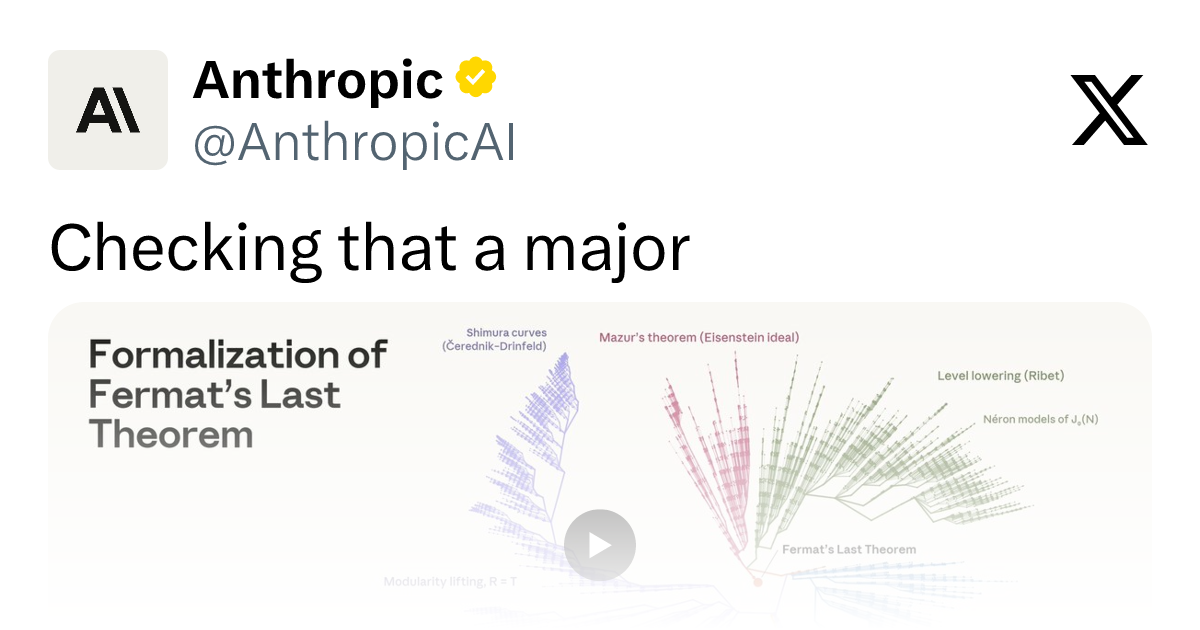
Claude Completes First Formal Proof of Fermat's Last Theorem: A Record-Breaking 13 Million Lines of Lean Code
Anthropic's Claude completes the first formal proof of Fermat's Last Theorem in over 13 million lines of Lean code — the largest ever — plus 29,000+ subsidiary theorems, opening new paths for AI-assisted math verification.

Microsoft Copilot Enters the NFL: How AI Is Supporting On-Field Decision-Making
Microsoft Copilot and Excel are entering NFL sidelines and booths, helping Seahawks analysts and coaches with real-time game decisions. Here's what it means for AI in pro sports.
Microsoft Copilot Goes Autopilot: From Assistant to Autonomous Long-Running Task Execution
Microsoft is evolving Copilot into autonomous Autopilots powered by Opal and Windows 365 cloud PCs, enabling end-to-end completion of long-running tasks without human intervention.