DeepSeek's Triple Move, Xiaomi MiMo V2.6 Tops Open-Source Rankings, Grok 4.7 Closes In on Opus

DeepSeek, Xiaomi MiMo V2.6, and Grok 4.7 headline a day of major AI releases across the board.
DeepSeek revealed its DSEC sandbox platform, a Huawei chip strategy, and a new CFO in a single day. Xiaomi's open-source MiMo V2.6 Pro topped the Artificial Analysis intelligence index and reached the cost-efficiency Pareto frontier at $0.13/task. Major AI coding tools rushed to integrate domestic models, while xAI's Grok 4.7 scored 46.3% on CursorBench — within striking distance of Anthropic Opus 5 Max's 46.6%. Meanwhile, an EU proposal to allow AI data use without user consent sparked privacy backlash, and Alibaba unveiled a new AI chip three times faster than its predecessor.
AI industry updates continue at a relentless pace. In a single day, DeepSeek disclosed its sandbox platform, chip strategy, and a key hire; Xiaomi's open-source MiMo V2.6 claimed the top spot on the open-source model intelligence index; and xAI's Grok 4.7 closed the gap with Anthropic's Opus on coding benchmarks. This daily briefing covers the most important storylines from that day.
DeepSeek's Three Moves: Technology, Chips, and Team
DeepSeekAd released three pieces of information simultaneously, painting a complete strategic picture.
On the technology front, DeepSeek published the technical report for its DSEC sandbox platform. The platform provides four sandbox backends — function calls, containers, MicroVMs, and full virtual machines — through a unified SDK, balancing lightweight execution with varying levels of isolation. The scale is impressive: a single production unit comprises roughly 160 nodes, serving approximately 3 million sandboxes per day, with peak concurrency exceeding 380,000 and sandbox creation speeds surpassing 5,000 per second. This kind of infrastructure underpins large-scale agent code execution and command running, and the numbers reflect DeepSeek's deep engineering investment in agent execution environments.
On the chip front, The Information reported that DeepSeek plans to prioritize Huawei chips for model training. CEO Liang Wenfeng told investors he wants to use more domestically manufactured training chips and expects to receive a new batch of Huawei chips between Q4 2026 and Q1 2027. This aligns with the broader trend toward domestic compute self-sufficiency in China.
On the personnel front, veteran venture capital partner Yan Wentao officially joined DeepSeek on September 21, ending the company's more than three-year run without a CFO. Filling the finance role typically signals that a company is entering a more mature phase of fundraising and capital operations.
The four-tier isolation architecture used by the DSEC sandbox platform is worth unpacking. Function calls are the lightest option, executing directly within the process and suited for simple, side-effect-free computation. Containers use Linux cgroups/namespace isolation with low resource overhead but share the host kernel. MicroVMs (such as Firecracker) run inside lightweight virtual machines with millisecond startup times, balancing speed with kernel-level isolation — the dominant choice for modern serverless platforms. Full VMs offer the strongest isolation and are appropriate for tasks requiring a complete OS environment or high security levels. For AI agents, executing arbitrary user-submitted code (e.g., a Code Interpreter) inherently requires sandbox isolation to prevent malicious code from escaping to the host system. Serving 3 million sandboxes per day at a peak concurrency of 380,000 means DeepSeek's agent infrastructure has entered industrial-scale operation — a critical backdrop for understanding the logic behind its infrastructure investment.
Xiaomi MiMo V2.6: Open-Source Model Tops the Intelligence Index
Xiaomi officially released and open-sourced two full-modality models in the MiMo V2.6 series — Pro and Flash — making this the most significant open-source event of the day.
The Pro version scored 46 on the Artificial Analysis Intelligence Index, leading all open-source models. More importantly, it excels on value: on the intelligence-cost frontier chart, MiMo V2.6 Pro costs approximately $0.13 per task, placing it on the Pareto frontier at a fraction of the price of overseas flagship models. On agentic benchmarks, its performance is comparable to Claude Opus 5 and GPT-5.6-tier results.
The Flash version outperforms the previous generation's Pro across the board. In under six days of Live RL training, Flash and Pro improved their Deep SWE scores from 48.8 and 58.4 to 65.7 and 72.6, respectively, at training costs of approximately $850,000 and $2.62 million — a significant capability leap at relatively controlled cost. The simultaneously open-sourced Distill quantized 9B model, after RL training, outperforms the SFT baseline across all 11 agentic evaluations, achieving 66.2 on SWE-Bench Verified.
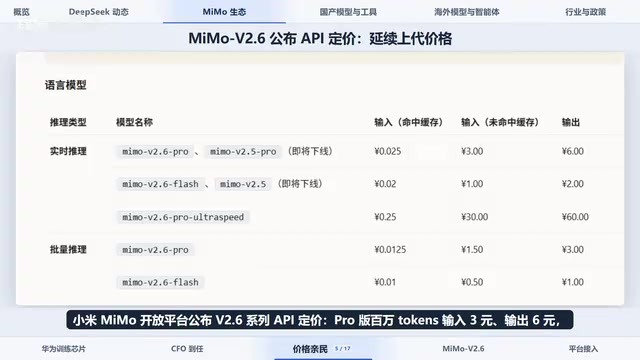
On pricing, Xiaomi's MiMo open platform announced V2.6 API rates: Pro is ¥3 per million input tokens and ¥6 per million output tokens; Flash is ¥1 input and ¥2 output. In USD, Flash comes to roughly $0.14 per million input tokens and $0.28 output, while Pro is $0.435 and $0.87 — further lowering the cost barrier for calling open-source models.
The Pareto Frontier mentioned repeatedly here is a core framework for evaluating model cost-efficiency. On a scatter plot with "model intelligence score" on the x-axis and "cost per task" on the y-axis, the Pareto frontier is formed by connecting models where "no other model can be simultaneously smarter and cheaper without sacrificing one dimension" — in other words, the optimal solution set. A model on the Pareto frontier means no other model offers higher intelligence at the same cost, or lower cost at the same intelligence level. MiMo V2.6 Pro's placement on this frontier at $0.13/task means it represents the current optimal combination of price and capability among open-source models — not merely "cheap" or merely "powerful." Deep SWE is a software engineering agent benchmark from Artificial Analysis that requires models to autonomously fix code in real GitHub repositories. It emphasizes end-to-end agent execution ability more than SWE-Bench does, and is currently one of the most important references for measuring the real-world capability of coding agents.
Coding Tools Rush to Integrate Domestic Models
The rising capabilities of domestic models are being rapidly absorbed by mainstream AI coding tools.
Command Code added the MiMo V2.6 series. In its GOAT coding plan, DeepSeek V4.1 Flash allows 30,800 model requests every 5 hours (approximately 76,900 per week), while MiMo V2.6 Flash allows 43,500 requests every 5 hours — noticeably more generous for high-frequency coding users.
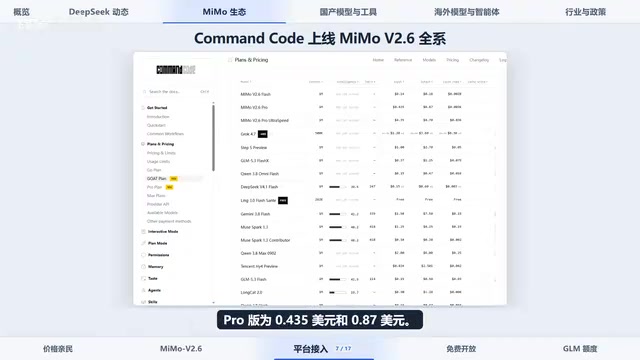
OpenCode announced a one-week free trial of MiMo V2.6 Flash, with both Flash and Pro available in its GOAT subscription plan. Zhipu AI's GLM Coding Plan extended its nighttime unlimited usage promotion through October 7, offering free unlimited access to GLM-5.3 Flash on Z.code every night from 11 PM to 9 AM; during the national holiday period (September 25 to October 7), all-day usage is billed at off-peak rates.
Moonshot AI released Kimi Code Desktop, bringing agentic coding capabilities into an official graphical desktop client for macOS and Windows. Users can instruct the agent via conversation to read and write code, run commands, execute automation tasks, and create reviewable, feedback-ready execution plans. The client offers Plan, Go, Swarm, and an experimental Tower mode that breaks large tasks into subtasks distributed across multiple sub-agents — a sign that agentic coding is moving from the command line into graphical interfaces.
Grok 4.7 Closes In on Opus; Overseas Frontier Race Intensifies
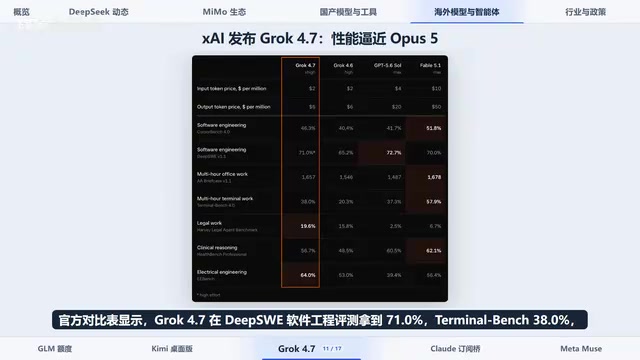
xAI officially released Grok 4.7, supporting image and text input with a 500K token context window, at the same price as the previous generation: $2 per million input tokens and $6 per million output tokens.
On performance, Grok 4.7 Extra High scored 46.3% on CursorBench 4.0, approaching Opus 5 Max's 46.6%, at a cost of just $6.01. Official comparison tables show Grok 4.7 scoring 71.0% on the Deep SWE software engineering benchmark and 38.0% on TerminalBench — both improvements over Grok 4.6. On the GDPVal evaluation designed for professional workflows, Grok 4.7 achieved an Elo of 1695, second only to Fable 5.1's 1735, and ahead of both Grok 4.6 and GPT-6.
On the consumer side: Meta's personal agent app Muse topped the US App Store free apps chart roughly 10 days after launch, pushing ChatGPT to second place — a sign of intensifying competition among major players for consumer-facing agent entry points. Cloudflare announced that Python Workers is now generally available, making Python a first-class, fully supported language on its developer platform.
CursorBench is a real-world coding capability benchmark from AI code editor Cursor. Using real software engineering tasks (bug fixes, feature implementation, code refactoring) as its test set, scores reflect a model's completion rate when working with an existing codebase. The industry considers it one of the more production-realistic coding evaluations, as it simulates daily developer workflows in an IDE rather than isolated algorithm problems. GDPVal (General Developer Productivity Valuation) is a comprehensive evaluation of professional development workflows using an Elo competitive scoring system to measure relative model performance across a range of professional scenarios — a higher Elo means a higher win rate in head-to-head comparisons. Together, these two benchmarks provide a multidimensional view of coding model performance from both "specific code tasks" and "general development workflows" perspectives, making them the two most commonly cited metrics in AI coding tool selection today.
Data Privacy Controversy and Domestic Compute Buildout
Two more AI-adjacent stories — one policy, one hardware — deserve attention.
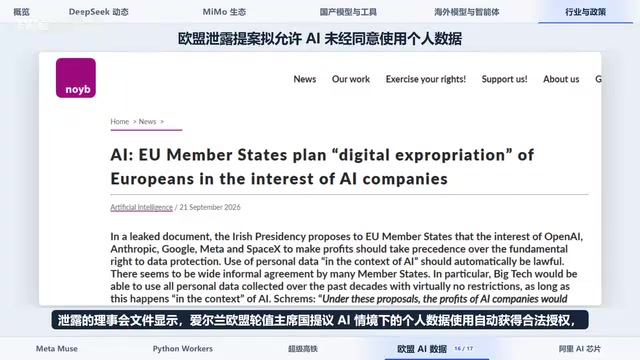
Leaked Council documents revealed that Ireland, as the EU's rotating presidency, has proposed that personal data use in AI contexts be automatically granted legal authorization, without requiring user consent. The provision would cover personal data collected over the past several decades, applying even to users who have never used an AI product. Privacy group Noyb criticized the proposal as a "digital dispossession" of Europeans. If passed, the measure could have far-reaching implications for AI training data compliance.
On the compute front, Alibaba unveiled its T-Head PPU (True 5V900) AI chip, delivering three times the performance of its predecessor and capable of forming clusters of up to 500,000 chips — a direct challenge to Nvidia. Alibaba pledged over $53 billion in investment over three years, targeting 20+ exawatt-scale global Alibaba Cloud data center capacity by 2032 to support frontier model training. This domestic compute buildout echoes DeepSeek's own pivot toward Huawei chips.
Ireland's proposal targets one of the six legal bases for processing personal data under GDPR — "consent." GDPR requires that data processing be lawful, fair, and transparent, with a valid legal basis, the most common of which is the "data subject's consent." The controversy over AI training data stems from the fact that many models were trained on decades' worth of publicly available internet text involving hundreds of millions of users — text that was never collected with AI training in mind. If the EU passes a provision granting automatic legal authorization for AI-context data use, it would effectively introduce a new legal basis that bypasses the need for individual consent, dramatically reducing compliance costs for AI companies. Privacy group Noyb (None of Your Business, founded by Max Schrems) has long pushed GDPR enforcement through litigation and calls this proposal "digital dispossession" — arguing it amounts to retroactively authorizing users' historical data for AI use without their knowledge. If passed, the provision would set an important global precedent for AI training data compliance regulation.
Summary
The day's key themes were clear: domestic models continue to advance on open-source rankings and cost-efficiency, with Xiaomi MiMo V2.6 as the most representative example; AI coding tools are rapidly incorporating these models into their subscription offerings; gaps between overseas frontier models are narrowing to decimal points on benchmarks; and data privacy and domestic compute self-sufficiency have emerged as unavoidable underlying issues.
Related articles

"Black October": Did AI Uncover 3% of All Critical Vulnerabilities Ever?
A Reddit post claims 3% of all critical software vulnerabilities ever were found in the past month, dubbed 'Black October.' We break down the statistical issues, how AI-assisted code auditing accelerates discovery, and how developers should respond.

Microsoft Project Gecko: Using AI to Bridge Language Gaps for African Farmers
Microsoft's Project Gecko launches PharmaChat, letting African farmers ask questions in their native language and get precise video clips and farming book chapters via AI. The project also releases three interactive manuals to advance inclusive AI.

Musk's Space Dominance: How Starlink Throttling Undermines Ukraine's Defense
SpaceX's Starshield throttling disabled Ukraine's high-speed interceptor drones, exposing how Musk's private control over low Earth orbit communications affects battlefield dynamics and national security, and highlighting the risks of commercial space militarization and space governance dilemmas.