DeepSeek Super Agent In-Depth Breakdown: The Architectural Leap from Raising Shrimp to Raising Fish
Super Agent isn't a revolution but the inevitable evolution of agents from solo work to organizational collaboration.
Based on a livestream discussion, this article examines the DeepSeek Harness Super Agent architecture from technical, product, and business angles. Its Router + Worker two-layer structure delegates human coordination to AI—essentially an organizational upgrade, not a from-zero-to-one leap. Compared with OpenClaw's wow factor, Super Agent currently looks more like a research prototype, valuable mainly when tasks are complex enough to require decomposition. The article frames a year of evolution as raising shrimp, raising horses, and raising fish: doing work, long-term memory, and personification plus a plugin ecosystem. Practical bottlenecks center on post-hoc verification of task decomposition and security isolation among sub-agents. Looking ahead, the entry point will converge to can speak, can display, can input; utility Apps will be replaced first, while A2A optimization and the acceptance link stand out as clear startup opportunities.
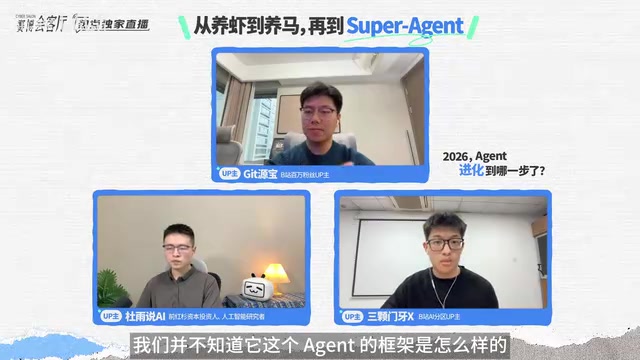
When the DeepSeek Harness team unveiled the Super Agent architecture, discussion in the community heated up quickly. Three observers with different backgrounds—Yuan Bao from a technical perspective, Menya from a product experience perspective, and a host from a business perspective—offered a rather measured judgment during a livestream: this is not an epoch-making revolution, but an inevitable evolution of organizational form.
From a Brain in a Vat to a Project Manager: What's Actually New About Super Agent
To understand Super Agent, we first need to go back to the starting point of agents. A large language model was initially a "brain in a vat"—very smart, but only capable of outputting text, unable to operate any external tools. The emergence of OpenClawAd (commonly known as "raising shrimp") let the model reach out its hands: it could operate browsers, read local files, and invoke command lines. For the first time, agents could "do work."
But solo operations quickly hit a bottleneck. Yuan Bao used an analogy during the livestream: every interaction with a traditional Agent is an independent loop. If you ask it to make a PPT, it first collects materials, then generates an outline, then fills in content—each step requires waiting for completion before moving to the next. Even if you open three or four windows in parallel, a human is essentially acting as the coordination hub.
What Super Agent does is delegate "human coordination" to AI as well. It adopts a two-layer Router + Worker architecture: the upper Router layer acts as the project manager, responsible for receiving tasks, breaking them down, and scheduling resources; the lower Worker layer handles concrete execution. This is highly isomorphic to organizational logic in enterprises—the CEO doesn't execute, but decides where resources go.
Yuan Bao specifically emphasized that you cannot call any ordinary Agent capable of invoking sub-agents a Super Agent. The key is whether the Router layer can reliably schedule tasks, manage permissions, handle message passing, and recover tasks. "If you put just any Agent into the Router layer, it's a rather lousy project manager, and the framework simply won't run stably."
The Difference Between Router-Worker Architecture and 'Sub-Agent Invocation'
Router-Worker is a classic hierarchical parallel computing paradigm: the upper Router is only responsible for task decomposition, routing decisions, and result aggregation, while the lower Worker statelessly executes assigned subtasks. It has long been practiced in distributed systems and microservices, with its core value being the decoupling of 'scheduling logic' from 'execution logic,' thereby enabling horizontal scaling and fault isolation. Mapped to the Agent context, the Router layer needs capabilities far beyond 'being able to call tools': it must maintain a task dependency graph, decide whether to retry or reroute when a subtask fails, control the scope of context visible to sub-agents, and maintain global state consistency across multiple rounds of interaction. This is precisely the technical reason Yuan Bao stressed that 'you cannot call any ordinary Agent capable of invoking sub-agents a Super Agent'—without stable scheduling, permission, and recovery mechanisms, the Router layer is just a fragile single point, and the entire system will quickly destabilize as task scale grows.
Why the Impact Feels Weaker Than the OpenClaw Moment
Menya offered a candid assessment: "For now, I don't think the current Super Agent is epoch-making." If OpenClaw's leap deserves a ten, he gives Super Agent a five.
This judgment has a realistic basis. The wow factor OpenClaw brought back then came from two levels: first, open source, which turned a closed black-box Agent framework into an open ecosystem that could be modified and remixed; second, UI interaction that made ordinary people feel for the first time that "there's a capable agent inside my computer." Super Agent, by contrast, currently looks more like a research prototype—an architecture system at the research stage, not a terminal product aimed at the general public.
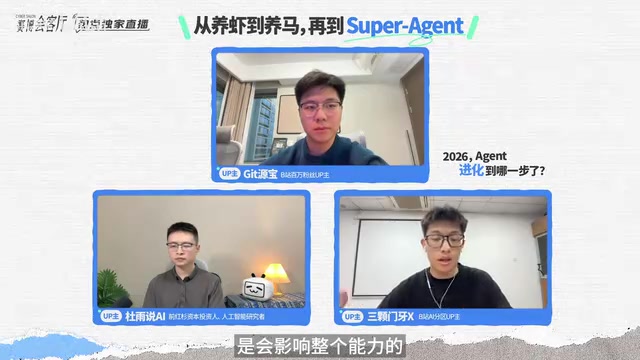
Yuan Bao added from the experiential angle: going from LM to Agent was a leap "from nobody to somebody," with tremendous impact; going from Agent to Super Agent is "from somebody to a pyramid structure," essentially an upgrade of organizational form. Only when tasks are complex enough that they must be decomposed can users perceive the value of this change. For everyday lightweight tasks, a single Agent is enough.
Raising Shrimp, Raising Horses, Raising Fish: Three Metaphors for a Year of Evolution
The livestream offered a rather vivid retrospective framework.
Raising shrimp corresponds to OpenClaw, with the keyword being "can do work"—the most basic Agent capability: operating tools and executing commands. Raising horses corresponds to Hermes Agent, with the keyword being "long-term memory"—allowing the Agent to understand the user's context and preferences better over time. Raising fish refers to the plugin ecosystem the community built on DeepSeekAd Harness, where interactive little fish characters appear on the desktop, able to browse Bilibili, find videos, and even let users have virtual avatars livestream to earn tokens.
What this thread reveals is a pattern: behind each generation of "animals" is an additive expansion of capabilities. From doing work to memory, then to emotional interaction and personification, the capability boundary keeps expanding outward. Yuan Bao described this trend as an "inverted hourglass"—the opening was small at the start of the year, and the radiating scope grows larger over time.
Drawing on his own experience, Menya offered another thread: during the closed-source Claude Code era, users didn't care what the framework looked like; after OpenClaw went open source, the community began modifying code and tuning frameworks, and the Agent framework itself became an object of optimization; by the time of DeepSeek Harness's "everything is a plugin," a high degree of customization handed the imaginative space to users, letting everyone craft a tool combination that fits their own needs.
Why Long-Term Memory Deserves to Be a Standalone Generational Leap
An Agent's 'memory' is usually divided into three layers: short-term memory within the context window, long-term memory persisted across sessions, and preferences and experience distilled from historical interactions. Long-term memory deserves to be treated as a standalone generational capability because it changes the Agent's cost structure—without memory, users must repeat background every time and the Agent cold-starts every time; with memory, the Agent can retain the user's project structure, terminology habits, and common paths, significantly reducing interaction rounds and token consumption. Implementation generally relies on a combination of vector retrieval, structured profiles, and summary compression: raw conversations are compressed into searchable entries and recalled by relevance when needed. The difficulty lies in the writing strategy and forgetting mechanism for memory—too much memory introduces noise and privacy risks, while too little degrades into statelessness. This trade-off directly determines whether an Agent truly becomes 'smoother the more you use it.'
The Boundaries of Multi-Agent Collaboration and Its Practical Bottlenecks
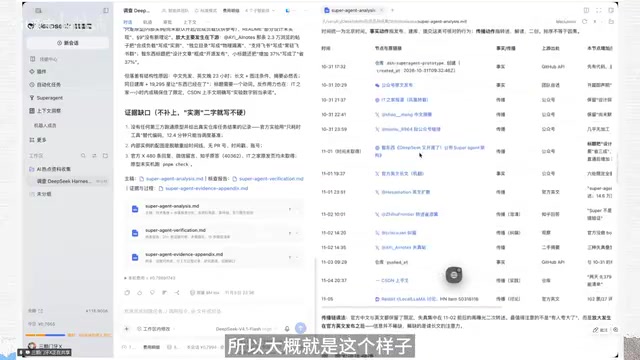
Menya shared a real research case: using the Super Agent architecture to simultaneously schedule multiple sub-agents to collect information from X, official documentation, WeChat public accounts, and other channels, then having one Agent perform cross-validation and finally aggregate everything into a report. The whole process took about thirty minutes.
What kinds of tasks suit multi-agent setups? Menya's experience is: any task that in the real world could be handed to multiple people working collaboratively can in theory be handed to multiple Agents. Examples include research (parallel multi-channel work) and code development (separating writing from review, using a fresh context to keep review objective). But the project kickoff phase suits multi-agent groundwork, while the subsequent fine-polishing phase is actually more controllable with a single Agent—because acceptance requires human judgment.
Yuan Bao pointed out a deeper bottleneck. Task decomposition relies on "post-hoc verification"—the main Agent doesn't know the final result when decomposing tasks, and only gets feedback after everything has run. How to optimize this lagging feedback loop is an engineering challenge the current architecture faces. Another issue is permission management and security: should context be shared or isolated among sub-agents? If one Agent discovers a vulnerability and syncs it to other Agents, could that create the illusion of "cheating and escaping"? In more complex Agent organizations, one might even need to introduce a direct reporting mechanism akin to an "anti-corruption mailbox."
'Post-Hoc Verification' and the Credit Assignment Problem for Agents
Post-hoc verification means: at the moment the main Agent decomposes a task, it cannot foresee the quality of each subtask's result; only after all subtasks finish and the final output is aggregated can it judge whether the original decomposition was reasonable. This is isomorphic to the 'delayed reward' and 'credit assignment' problems in reinforcement learning—the quality of the final result is hard to trace back and attribute to a specific decomposition or a specific sub-agent instruction. Common engineering mitigations include: inserting intermediate checks at key nodes (using rules or lightweight models for instant scoring), having sub-agents output structured confidence and rationale, and preserving complete execution traces for after-the-fact review. But all these approaches increase token overhead and latency. How to balance 'catching errors early' against 'interrupting the flow less' remains an open question with no standard answer in current multi-agent system design.
The Ultimate Form and the Battle for the Entry Point
Speaking of the long-term form, Yuan Bao's vision is a personal Agent in the cloud, with the interaction entry point converging to three elements—"can speak, can display, can input." Smart glasses, watches, and phones all meet this condition, while computers with keyboards may actually be excluded. The further endgame points to brain-computer interfaces, where even screens are no longer necessary.
Menya's vision is closer to the present: Agents will more proactively perceive the environment, identify valuable questions from group chat noise, and solve them autonomously; self-evolution and self-iteration will make outputs no longer require repeated verification.
On whether Apps will be replaced, the two reached a rough consensus: utility Apps will bear the brunt—high-learning-curve tools like photo editing and video editing will struggle to hold their ground; but experience-oriented products with a "browsing" and "scrolling" nature, such as Taobao, Douyin, and Bilibili, will not be replaced—sometimes people just want to browse on their own. Service platforms like food delivery and e-commerce will form a symbiotic relationship with Agents, but the frequency of opening Apps will gradually shrink, and merchants will shift toward optimizing for Agents.
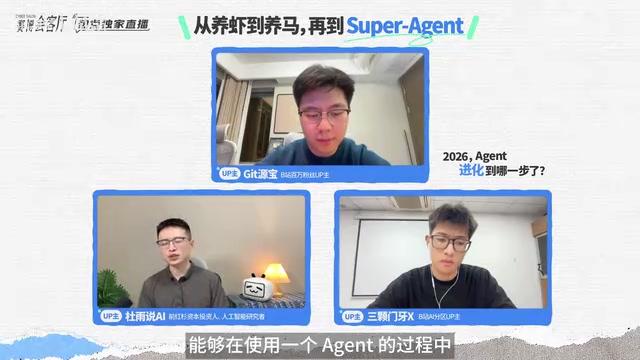
The host added a business perspective: if the technology truly achieves "one Agent handles all scheduling," that would be a massive monopoly business—both an opportunity and a picture other players would strive to prevent on business-logic grounds.
As for startup directions, A2A (Agent to Agent) services were unanimously favored: helping merchants optimize recommendation strategies for user-facing Agents is essentially doing SEO for the AI era. Another named opportunity is the "acceptance" link—Menya noted that a considerable share of time is currently spent verifying AI output, and an Agent that can help users make basic judgments is itself a real need.
The value of this discussion perhaps lies precisely in its restraint: Super Agent is not magic; it is a step in agents moving from solo operations toward organizational collaboration. Whether this step is big enough depends on how many complex tasks you have that need to be decomposed.
One-line Summary
Super Agent is not a revolution, but the inevitable evolution of agents from solo operations to organizational collaboration.
Paragraph Summary
Based on a livestream discussion, this article examines the DeepSeek Harness Super Agent architecture from technical, product, and business perspectives. It adopts a two-layer Router + Worker structure, delegating the coordination and scheduling once performed by humans to AI—essentially an organizational upgrade rather than a from-zero-to-one leap. Compared with the wow factor OpenClaw brought, Super Agent currently looks more like a research prototype, and its value is obvious only when tasks are complex enough to require decomposition. The article sums up a year of evolution with raising shrimp, raising horses, and raising fish: doing work, long-term memory, and personification plus a plugin ecosystem. Practical bottlenecks center on post-hoc verification of task decomposition and permission management and security isolation among sub-agents. Looking further ahead, the entry point will converge to can speak, can display, can input; utility Apps will be the first to be replaced, while A2A optimization and the acceptance link become clear startup opportunities.
Related articles

Anthropic's IPO Eve: Five Risks Behind the Trillion-Dollar Valuation and the Truth About Its Governance
Breaking down Anthropic's IPO prospectus: $184M daily revenue at a trillion-dollar valuation, the truth behind $104B in paper losses, a five-class share governance structure, unusual disclosures in 94 pages of risk factors, and how the lock-up schedule may affect retail investors.
FBI Warns: Hackers Weaponize AI Agent ARTEX to Attack 200+ Organizations
FBI warns that AI penetration framework ARTEX is being used to attack 200+ organizations, with CrowdStrike tracking the VaporPanda group. We break down ARTEX's agent orchestration architecture, the real attack chain, loss data, and the FBI's five defense recommendations.
FBI Warns: Free AI Hacking Tool Artex Spirals Out of Control, Breaches Cloud Systems in Three Hours
FBI warns that the free open-source AI penetration tool Artex is being abused by criminals and state-backed hackers to breach cloud systems in as little as three hours. This article analyzes real attack cases, overlooked side-door risks, and defense measures enterprises and individuals can take immediately.