DeepSeek V4.1 Flash 1017 Edition Hands-On: All Four Brutal Challenges Passed, Legacy Bugs Fixed

DeepSeek V4.1 Flash 1017 Edition passes all four brutal challenges, legacy bugs fixed.
A Bilibili creator tested DeepSeek V4.1 Flash 1017 Edition (763B parameters, coding flagship) with four high-intensity challenges: constrained writing, nighttime Ferris wheel, retro handheld Tetris, and 3D racing. All four passed and legacy bugs were fixed, though the Ferris wheel still had minor flaws and the test is a single-source, small sample.
A Bilibili creator ran a high-intensity hands-on test of DeepSeek V4.1 Flash 1017 Edition on the WorkBuddy platform, again using the four "brutal" challenges that have tripped up many models before. According to the video description, this version is positioned as a coding flagship with 763B parameters, its EM context capability remains unchanged, and all four challenges were passed, with legacy bugs from previous versions also fixed.
The Four Challenges in Review: From Writing to 3D Racing
These four challenges span text generation, image logic, game interaction, and 3D engineering capability, with difficulty escalating at each step. The creator tested them in order: constrained writing, a nighttime Ferris wheel, retro handheld Tetris, and a 3D racing game. Each challenge has clear pass criteria rather than vague subjective evaluation.
Challenge 1: Constrained Writing
The task required writing ten sentences with strictly increasing character counts, while banning common characters such as "的" and "了", and verifying that the table was fully correct. This tests the model's fine-grained control over Chinese. The creator reported that "the banned-character check also passed—its Chinese character skills are impressive this time," and Challenge 1 was passed smoothly. From the screenshot, both the increasing character counts and the banned-character check met the requirements.

Banning "的" and "了" is a negative constraint, which is especially difficult for autoregressive language models: these two characters appear extremely frequently in Chinese, and during token-by-token decoding the model can easily "slip" back to high-frequency usage driven by local fluency. To pass reliably, the model needs to plan sentence structures in advance over the long range rather than greedily generating sentence by sentence. This also explains why the creator highlighted "impressive Chinese character skills"—it reflects global planning ability rather than mere vocabulary size.
Challenge 2: Nighttime Ferris Wheel
The Ferris wheel challenge required the cabins to remain horizontal as they revolve, with the portions occluded by the spokes behind them handled correctly. The creator commented that "the image is beautiful, the cabins are correct, and the linkage is correct," but admitted that "there are still minor flaws at this level." Despite the small issues, the overall logic and visual effect met the standard, and Challenge 2 was passed.

Challenge 3: Retro Handheld Tetris
This challenge required rigorous logic, a retro Game Boy-style shell and buttons in the UI, and block drops that run fully end to end. It tests code logic, interface fidelity, and real-time interaction at the same time. The creator did not mention any obvious problems, and Challenge 3 was passed.
Challenge 4: 3D Racing
The finale was 3D racing, testing the large model's 3D engineering capability, physics feel tuning, and modeling skill. It required a loop track, a speedometer, and lap timing, and had to run to completion directly. After testing, the creator reported that it "ran to completion directly, finishing at 0:42," and Challenge 4 was passed.
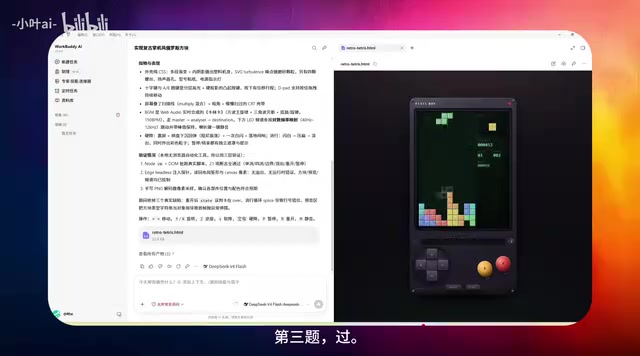
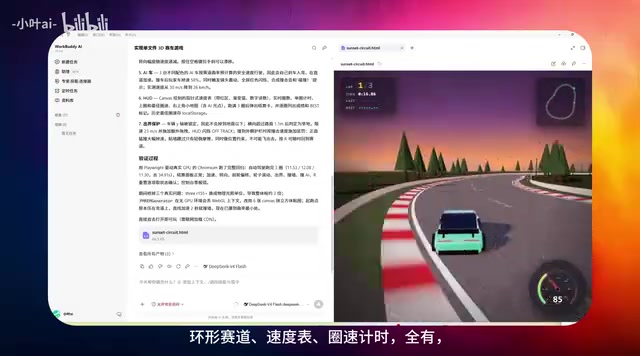
This kind of "brutal challenge" test belongs to a constraint satisfaction benchmark: the task specifies multiple hard rules (e.g., increasing character counts per sentence, banning specific Chinese characters, keeping cabins horizontal), and the model must satisfy all constraints simultaneously to pass. Unlike traditional subjective scoring, it breaks "capability" down into discrete, automatically verifiable conditions, reducing evaluator bias—but with a small sample size per task and limited coverage, it is better suited as a qualitative signal than as a basis for ranking.
One of the core difficulties of the 3D racing challenge is physics feel tuning: vehicle acceleration, steering, and drifting require approximately realistic models of inertia, friction, and grip, typically involving simplified rigid-body dynamics and tire lateral force calculations. To generate runnable code in one shot, the model must, without iterative debugging, tune parameters (mass, damping, steering rate) into a range where the car "completes the course without losing control"—this places higher demands on numerical intuition and state management in code generation than pure text tasks.
Legacy Bug Fixes and Capability Improvements
The video title states that "the bugs from the old version are fixed," but the original content does not specify which bug. Judging from the performance on the four challenges, there may previously have been issues with constrained Chinese generation or 3D linkage logic, all of which passed in this version. The creator's comment on Challenge 1 that "its Chinese character skills are impressive" suggests improved text control, while the correct linkage in the Ferris wheel and racing challenges indicates more stable spatial logic and engineering implementation.
With the 763B parameter scale and a coding flagship positioning, the focus is not on the parameter count itself but on engineering deployment. All four challenges involve runnable, interactive outputs rather than pure text answers, placing comprehensive demands on the model's code generation, state management, and physics simulation capabilities.
In "763B parameters," B stands for billion, i.e., a scale of roughly 763 billion parameters, placing it in the large tier of current large models. Parameter scale mainly affects model capacity and knowledge density, but engineering deployment capability depends more on training data mix, post-training (instruction fine-tuning, RLHF), and context management at inference time. Therefore, the "coding flagship" positioning cannot be inferred from parameter count alone; its hands-on performance on runnable-output tasks must also be considered.
Hands-On Conclusion: Where This Version Stands
Passing all four challenges is a convincing signal. Constrained writing tests linguistic precision, the Ferris wheel tests image spatial logic, Tetris tests real-time interaction, and 3D racing tests engineering and physics tuning. The creator left the final judgment to the comments section at the end of the video, but from the testing process, DeepSeekAd V4.1 Flash 1017 Edition delivered a passing result for its coding flagship positioning.
It should be noted that this is a hands-on test from a single source with a sample size of four challenges, and it cannot represent all scenarios. The Ferris wheel challenge still had minor flaws, indicating that the model is not perfect in complex visual generation. For developers interested in AI coding and model hands-on testing, this round of testing provides a valuable reference, but actual model selection still needs to be validated against one's own business scenarios.
One-line Summary
DeepSeek V4.1 Flash 1017 Edition passed all four brutal challenges, with legacy bugs fixed.
Paragraph Summary
A Bilibili creator ran a hands-on test of DeepSeek V4.1 Flash 1017 Edition—positioned as a coding flagship with 763B parameters—using four high-intensity challenges that have tripped up many models before: constrained writing, a nighttime Ferris wheel, retro handheld Tetris, and 3D racing, covering text generation, image logic, real-time interaction, and 3D engineering capability. All four were passed, legacy bugs were fixed, and Chinese constrained generation and spatial linkage logic performed stably. However, the Ferris wheel challenge still had minor flaws, and the test is from a single source with a small sample, so actual capability still needs validation against business scenarios.
Related articles

OpenCode Hit by Large-Scale Attack: Distillation Attacks and the New AI Security Tax
OpenCode suffers a large-scale distillation attack affecting 1.4% of Console users. This article analyzes the mechanics of distillation attacks, OpenCode's million-dollar security costs, and the new AI-era security tax and defense lessons for enterprises.

Growing Potatoes in a Paper Bag: A 3-Month Harvest Big Enough to Feed a Family of Four
A YouTuber grew three Delaware potatoes in a paper bag and harvested enough small potatoes for a family of four in three months, proving the bag works as a container.

Advertisers Pull Meta Ads: AI "Glow-Up" Backfires and Sparks a Trust Crisis
Meta's AI ad tool added unwanted beautifying effects to ad creatives without consent, prompting advertisers to pull ads. This article analyzes the brand control, compliance risks, and platform AI design dilemmas behind the incident, and offers three lessons for improving AI content tools.