DeepSeek V4.1 Flash Deep Dive: How an Encoder Architecture Slashes Inference Costs to Pennies
DeepSeek V4.1 Flash's encoder-decoder hybrid architecture slashes inference costs to $0.27 per task.
DeepSeek V4.1 Flash combines a 20-layer causal encoder with a 20-layer decoder and compresses KV cache from 3,500 to 890 bytes per token, achieving ~$0.27/task inference costs while outperforming the previous V4 Pro on benchmarks. Hands-on tests show it matches GLM 5.3 Flash, with better code quality. The article also covers OpenAI's contested Navier-Stokes counterexample, Anthropic CEO's recursive self-improvement fears, and Mistral's record $3B+ Series D round.
The most noteworthy AI event this week was DeepSeek striking again with its V4.1 Flash model. Through a novel efficient architecture, it delivers high intelligence while driving down both runtime cost and latency to jaw-dropping levels. This article draws on a French AI blogger's hands-on testing and technical breakdown to unpack the model's core breakthroughs, while also covering this week's other hot topics: OpenAI's controversial solution to a millennium math problem, Anthropic's call to slow down frontier development, and Mistral's record-breaking funding round.
DeepSeek V4.1 Flash: Smaller, Cheaper, Faster
DeepSeek releases models infrequently, but each release carries significant weight — it typically sets a new bar for the Chinese open-source model market. In the months following a release, competitors like GLM and Kimi usually absorb its architectural innovations, applying them to their own models through distillation from cloud data.
On technical benchmarks, V4.1 Flash scores 40 on the Artificial Analysis leaderboard, placing just behind GLM 5.3 Flash while surpassing DeepSeek's previous best, V4 Pro (including the version released earlier this month). In other words, this is a smaller, cheaper model that nevertheless outperforms its predecessor.
The most striking metric is cost per task. According to the blogger's calculations, most cloud models cost around $8 per task, frontier models around $5, while DeepSeek comes in at approximately $0.27 — firmly placing it as the cheapest model on the market.
Hands-On Comparison: DeepSeek vs. GLM 5.3 Flash
The blogger designed a clever "meta-demo" experiment: he had the AI generate a dynamic page on his production website explaining DeepSeek's new architectural innovations — requiring rich visuals, interactivity, and detailed content — with the model verifying the rendered output before publishing. The entire task ran on the minimal PiAgent framework (giving the agent only terminal tools).
DeepSeek completed the task for about €0.30, while GLM 5.3 Flash was faster but harder to measure precisely in cost.
Both models produced impressive results. GLM's page featured empathetic introductory copy, diagrams accurately extracted from the original paper, and a layer-by-layer animated visualizer — earning a "9/10" from the blogger, who revealed it has become his go-to daily model. DeepSeek's output was equally impressive, going so far as to spontaneously add a sidebar navigation to the website, with slightly better code quality, though its diagrams were somewhat less pedagogically clear.
The blogger's conclusion: the two models are "neck and neck" — DeepSeek edges ahead on code quality, GLM on language intelligence. But the real takeaway is this: given that open-source models cost mere cents, can be deployed on European servers, and offer faster token throughput, why pay €200/month for ChatGPT or Claude subscriptions? He argues that even entry-level models today are capable of handling vast amounts of third-sector work: business proposals, customer service, website building, and more.
Under the Hood: The Efficiency Revolution of the Encoder's Return
To understand why V4.1 Flash is so cheap to run, you have to pop the hood and look at the architecture.
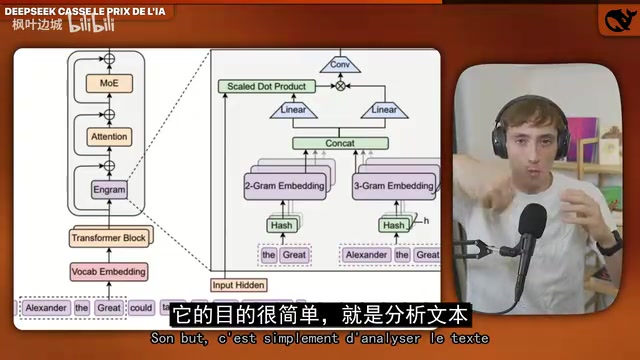
Typical large language models use a "Decoder Only Transformer" architecture: they analyze prior context and predict the next token, passing through all layers for every single prediction. The original landmark Transformer paper, however, described an "Encoder-Decoder" architecture — early Google Translate, for instance, used an encoder to process French and a decoder to output English. The industry largely abandoned the full encoder-decoder structure over time.
DeepSeek's approach is to bring the encoder back. According to the blogger's breakdown, the model has 40 layers in total: the first 20 are a causal encoder, used only for semantic understanding, activating 8 billion parameters; the last 20 are a decoder for next-token prediction, activating 16 billion parameters. This single change alone delivers a rough 25% inference speedup — because there's about a quarter less computation to perform.

Even more significant is the VRAM optimization. The team made extensive innovations in KV cache storage (the key-value pairs each token needs to compare against subsequent tokens): alternating across layers, with some stages indexing all tokens precisely and others dramatically reducing indexing by reusing prior computations. The result is that storage per token drops from 3,500 bytes in the previous generation to just 890 bytes.
This means storing a 1-million-token conversation now requires less than 1 GB of memory, whereas larger previous-generation models needed at least 3.7 GB. Since RAM is extremely expensive, this improvement directly slashes inference costs — and DeepSeek has passed those savings along through another round of price cuts.
KV Cache Explained: The KV cache (Key-Value Cache) is central to understanding this optimization. In the Transformer attention mechanism, each token being generated must compute relevance scores against all preceding tokens in the sequence — requiring a "key" and "value" vector to be stored for every token. As context length grows, the total storage for these vectors scales linearly, making the KV cache one of the primary sources of VRAM consumption during inference. Traditional models maintain a complete set of KV pairs at every layer to preserve precise attention. DeepSeek V4.1 Flash's innovation lies in a layer-alternation strategy: certain layers share or reuse KV computations from previous layers rather than recomputing them from scratch, compressing per-token cache size to roughly one-quarter of the original with minimal accuracy loss. This optimization is especially impactful in long-context scenarios (such as processing lengthy documents or extended multi-turn conversations) and is the core engineering reason its pricing can significantly undercut competitors of comparable capability.
OpenAI Cracks a Millennium Problem: Glory or Appropriation?
Beyond DeepSeek, another major event this week stirred considerable controversy: OpenAI announced that using 10,000 AI agents over 88 hours, it found a counterexample to the Navier-Stokes equations — one of the seven "Millennium Prize Problems" posed by the Clay Mathematics Institute.
These equations, which have been used daily by engineers since 1845 but never rigorously proven mathematically, admit two possible resolutions: either prove they hold under all conditions, or find a single counterexample. OpenAI chose the latter, applying an external force to spin a fluid into vortices, causing the vortex center to contract and stretch until velocity approaches infinity and viscosity breaks down — producing a singularity. The answer, in other words, is "most likely no."
The controversy isn't about whether the result is correct — it's about the disruption to how scientific research is conducted. According to the blogger's account: two researchers, Tristan Buckmaster and Levent (an Anthropic employee), had been working on the same approach (forcing singularities) for nearly a year. On August 15th, they found a singularity in the Euler equations and wrote it up in a 245-page paper that had not yet been published. OpenAI caught wind of this, launched its 10,000-agent effort on September 1st, and within days produced a counterexample for the more complex equations — getting there first.
More troubling still: both researchers had been using Codex throughout their research to test simulations, meaning OpenAI theoretically had access to the entirety of their work. OpenAI initially acknowledged that "the model may have been anonymously trained on this content," then hours later reversed course and said "absolutely not" — a retraction that only raised more suspicion. OpenAI also invited only Buckmaster to co-author the paper, refusing to include Levent because he works at rival Anthropic, prompting public accusations of misconduct.
The blogger notes this exposes a game-theoretic trap: as long as researchers keep interacting with AI systems to work through their ideas, labs gain access to their full reasoning — and can then leverage vastly superior compute to "prove" the result first. If this continues, no one will have any incentive to share. All that said, an AI that four years ago couldn't identify which country Paris is in — now accomplishing this kind of mathematical reasoning — is genuinely astonishing.
Navier-Stokes Equations Explained: The Navier-Stokes equations, developed independently by French engineer Navier and British mathematician Stokes in the 19th century, are a set of partial differential equations describing the motion of viscous fluids (such as water, air, and blood). They remain widely used today in aerodynamics, weather forecasting, and ocean modeling. The Millennium Prize version of the problem asks: in three-dimensional space, given reasonable initial conditions, do smooth solutions always exist and remain bounded — or can velocities blow up to infinity in finite time (a "singularity")? The difficulty lies in the extreme complexity of turbulent fluid behavior; existing mathematical tools struggle to simultaneously handle the interaction between nonlinear terms and energy dissipation. The Clay Mathematics Institute has offered a $1 million prize for a solution. OpenAI's work does not "prove the equations hold" — rather, by constructing specific forcing conditions, it demonstrates that singularities can arise in certain scenarios, constituting a counterexample. If confirmed by peer review, this would mean the equations do not possess global smooth solutions in the most general sense, fundamentally reshaping our understanding of the limits of fluid simulation.
Anthropic's Call to Slow Down, Conceptual Space Training, and Mistral's Record Funding
Several other developments this week are worth noting.
Anthropic CEO Dario Amodei published an essay titled "We Must Pause the Frontier," calling for a slowdown in frontier model development. He offered two reasons: first, recursive self-improvement is already manifesting — he claims more than 90% of the next-generation Claude model is designed by the previous generation, and once this threshold is crossed, improvement rates could accelerate 10 to 20 times until humans can no longer understand the innovations being made; second, his concerns about safety incidents at OpenAI. He proposed three measures: embedding external auditors at every lab, coordinating standards across democratic nations, and reaching a global agreement with China on the pace of self-improvement.
The blogger is skeptical, noting the latter two proposals are geopolitically near-impossible, and that manufacturing fear narratives conveniently serves these companies' business models — lacking genuine moats, they can be undercut at any moment by open-source labs at a fraction of the cost, making regulatory capture their true competitive advantage.

On the research front, a paper called "NCP Arc Preview" proposes training models not just to predict the next token, but to simultaneously predict the "next concept." Concretely, tokens are grouped in 4×4 blocks and mapped to concept vectors (represented as 32 segments of 128 dimensions each); during training, the model first predicts the next concept and then uses that to guide token prediction. Compared to traditional causal training — which trains only token prediction and hopes that logical reasoning emerges as a byproduct — this approach explicitly trains for logical coherence, offering a new avenue for improving model creativity.
Finally, a major capital story: French AI company Mistral closed a Series D round exceeding $3 billion at a valuation of over $21 billion, led by Samsung with participation from BlackRock, a Luxembourg fund, ASML, and NVIDIA — setting the record for the largest funding round in European tech history. The controversy: Mistral has recently begun hosting Chinese open-source models on its platform, looking more like an inference provider than a frontier lab, drawing criticism for straying from its original mission as a "French sovereign AI model."
The blogger takes a pragmatic view: true sovereignty means "owning local inference capacity" — building data centers in France and controlling intelligent infrastructure the way a nation controls its energy infrastructure. What enterprise customers actually need is the ability to fine-tune small models at 100x lower cost on GDPR-compliant European servers to run production workflows like customer service ticket classification and routing. That's where Mistral's revenue comes from, and why its business logic holds up.
Recursive Self-Improvement Explained: Recursive self-improvement is one of the central risk scenarios long discussed in AI safety: if an AI system can design a successor that is more capable than itself, and that successor can in turn design an even more capable next generation, the rate of improvement accelerates exponentially — potentially outpacing human understanding and control. Dario Amodei's claim that 90%+ of the next-generation Claude is designed with input from the current generation suggests this feedback loop is already beginning to close. This closely resembles the "intelligence explosion" scenario described by AI safety researchers. Notably, there is significant academic disagreement over whether recursive self-improvement necessarily implies uncontrollable acceleration — skeptics argue that model design remains hard-constrained by compute, data, and human review, and won't spontaneously break through these bottlenecks; proponents counter that once a model can autonomously optimize its own training objectives, the effectiveness of external constraints will be severely diminished. This is the technical backdrop behind Amodei's call for external auditors.
Related articles

AI Programming at Xiamen University: A Full Breakdown from Textbook to Teaching
Xiamen University's Lin Ziyu shares how he built an AI programming course — covering three coding eras, Claude Code's production-ready milestone, three methodologies, and a fully free, reproducible curriculum design.

A DeepSeek Researcher's Confession: The AI He Trained Is About to Replace Him
DeepSeek V4.1 kernel engineer Liu Shengyu admits the AI he trained will surpass his own skills within a year—yet he keeps pushing forward. Here's why.

n8n Automation in Practice: How AI Workflows Help SMBs Cut Costs and Boost Efficiency
Learn how SMBs use n8n and AI tools to automate multi-platform messaging, AI customer service replies, and bulk exam data entry — real-world workflows for cutting costs.