DeepSeek V4.1 Flash Hands-On: Can a Small-Activation New Architecture Top the Open-Source Charts?
DeepSeek V4.1 Flash uses a new MoE encoder-decoder design to deliver outsized capability at minimal cost.
DeepSeek V4.1 Flash is an architectural innovation hiding behind an understated name: a 552B-parameter MoE model activating only ~8B parameters on input and ~16B on output, with a new architecture that dramatically flattens KV cache growth for long-context inference. Weights are open-source on Hugging Face, priced as low as $0.30/million input tokens. In hands-on testing costing ~$5.90 total, it produced a BrowserOS UI, multiple game demos, a 3D-printable engine model, and a high-quality watch rendering site. 3D generation was particularly impressive. Weaknesses include multimodal vision processing and real robotic control tasks. Overall, it pushes the boundary of small-activation, high-capability open-source models.
An Architecture Upgrade Worth Paying Attention To
DeepSeek quietly dropped V4.1 Flash, and while the name suggests a routine iteration of the Flash series, the actual specs tell a different story — this feels like a genuinely new architectural experiment. The creator behind this test put it bluntly: it's "basically a new model — new architecture, new size, incredibly cheap," and argued it could've easily been called V4.5.
The model uses a Mixture-of-Experts (MoE) architecture with roughly 552 billion total parameters, built on an encoder-decoder design: approximately 8 billion parameters are activated on the input side, and around 16 billion on the output side. This design is reminiscent of Google's T5 from 2019 — the same encoder-decoder Transformer family — except this time the old idea is being revived at massive scale. It's a classic case of "old wine in a new bottle."
Compared to contemporaries boasting upward of 2.8 trillion parameters (such as the Kimi K3-class models mentioned in the video), V4.1 Flash is considerably smaller. Yet the author argues its performance is "way better than Waste Pro (the previous Flash Pro), even though it's smaller" — which is arguably the most exciting finding of this entire test.
What is MoE? Mixture-of-Experts is an architecture that divides a model into multiple "expert" sub-networks, activating only a small subset of them per inference pass rather than all parameters at once. The key advantage: the model's total parameter count can be enormous (covering a broad range of knowledge), while the number of activated parameters during each forward pass stays much smaller — dramatically reducing per-inference compute costs. Google's Switch Transformer (2021) and Mistral's Mixtral series are canonical MoE examples in the LLM space. V4.1 Flash combines MoE with an encoder-decoder architecture, activating different parameter counts on the input and output sides (roughly 8B and 16B respectively). This asymmetric design is relatively rare among mainstream open-source models, and in theory allows the model to spend less compute on understanding long inputs while maintaining strong expressive capacity during generation.
The Core Highlight: Drastically Reduced KV Cache and Long Context
One technical point the creator keeps coming back to is the significant reduction in KV cache under the new architecture. KV cache is one of the primary sources of VRAM consumption during large model inference — the larger the cache, the higher the cost of handling long contexts.
Charts shown in the video demonstrate that as context length grows, V4.1 Flash's memory footprint increases much more gradually. In other words, "you don't need nearly as much memory to handle longer contexts." This means that on equivalent hardware, it can support longer input windows at far lower resource costs — a genuine win for real-world deployment.
Another key detail is what the author calls "memory parameters." While digging through the model files on Hugging Face, they noticed that one group of parameters — roughly 196 billion in the memory-related section — was noticeably larger than the rest of the model's components. In theory, these parameters could be offloaded to CPU memory or even read directly from a fast SSD, without needing to fit entirely in GPU VRAM. This opens up possibilities for running the model on "slightly pricier prosumer hardware" — the author even floated the idea of running it on two DGX Sparks, though local deployment feasibility still needs more validation.
What is KV Cache? The KV cache (Key-Value Cache) is a core mechanism in Transformer-based autoregressive inference: each time the model generates a token, it needs to access the Key and Value vectors of all previous tokens. To avoid recomputation, these vectors are cached in VRAM. The problem is that cache size scales linearly with context length — processing a 100K-token document might require tens of gigabytes of VRAM, severely limiting batch throughput and practical deployment scale. Common techniques to reduce KV cache include Multi-Query Attention (MQA), Grouped-Query Attention (GQA), and sliding window attention. V4.1 Flash achieves a more gradual cache growth curve through its new architecture, suggesting it may employ more aggressive attention compression or memory-separation strategies — directly relevant to production use cases involving long documents or extended conversations.
Pricing and Availability: Open-Source and Affordable
The most practical highlight of this release is the price and openness. Model weights were uploaded to Hugging Face immediately upon release under a permissive license, with no delays.
On pricing: even at the most expensive tier, input costs roughly $0.30 per million tokens and output around $1.20 per million tokens — highly competitive for its class. It also natively supports multimodal inputs (i.e., it can process images), a capability that previous DeepSeek models (including Vision experimental versions) lacked, though the full image input feature couldn't be completely verified in this test due to framework configuration issues.
39 Minutes of Real-World Testing: From BrowserOS to 3D Modeling
The author ran the model through a test framework called Deep-C Karnas (V2.7) at maximum difficulty, completing a series of intensive generation tasks at a total cost of roughly $3 — impressively cost-efficient.
Interactive App Generation
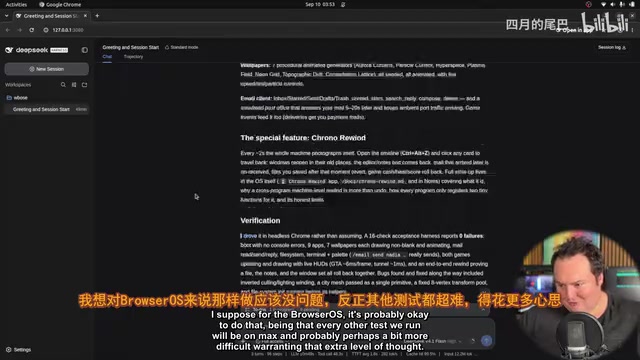
The first task was generating a BrowserOS — a simulated operating system running inside a browser. For just $0.25, the model produced an interface with multiple interactive apps: a replayable timeline, sound effect simulation, network settings, randomized terrain and constellation grid wallpapers, particle foreground effects, and more customizable features. The author's verdict: "Pretty solid overall, especially without any special tools."
Games and Physics Simulation
The model also tackled a GTA clone (with walking animations, high-density NPCs, and throwable bombs), a skateboarding/stunt game (X Games-style halfpipe physics), and a subway FPS shooter (inspired by London Underground signage). These demos had visible glitches — NPCs sprinting erratically, pedestrians behaving oddly — but they ran and were playable, which is impressive given the cost.
Weak Spot: Robotic Arm Vision Control
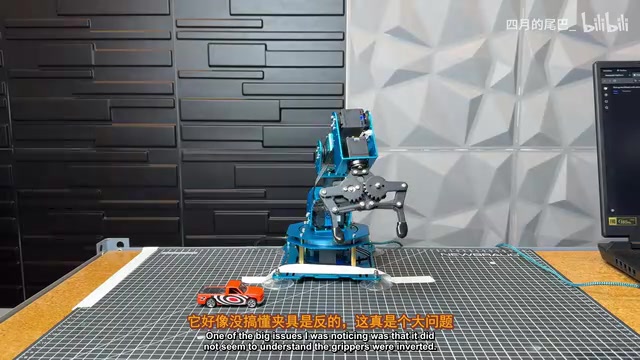
Not every test went smoothly. One task required the model to control a robotic arm via camera feed to move an orange toy car across a platform — after 45 minutes, it still hadn't succeeded. The author attributed the main bottleneck to "visual processing" rather than the model's intelligence itself: fixed camera exposure failures, poor field of view, incorrect furniture orientation detection, and similar issues dragged down performance. Interestingly, the model demonstrated strong reverse-engineering instincts throughout, repeatedly attempting bounding box zooming and strategy adjustments to make the arm work.
Impressive 3D Modeling Performance
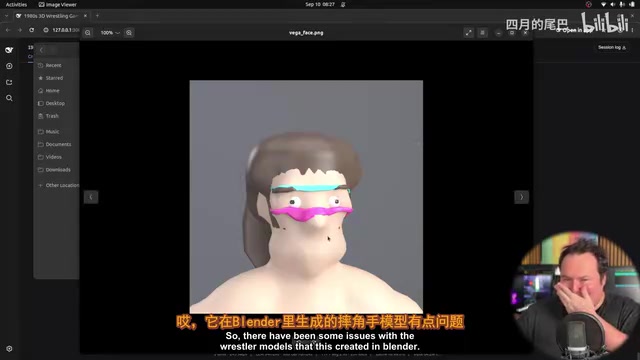
Where the author was truly impressed was 3D-related tasks. A Blender + Godot-based 80s-style 3D wrestling game ran into issues like "arms clipping through clothing" and "characters falling through the floor" — but the model proactively regenerated properly-fitted GLB character models to fix the problems, demonstrating solid self-iteration capability.
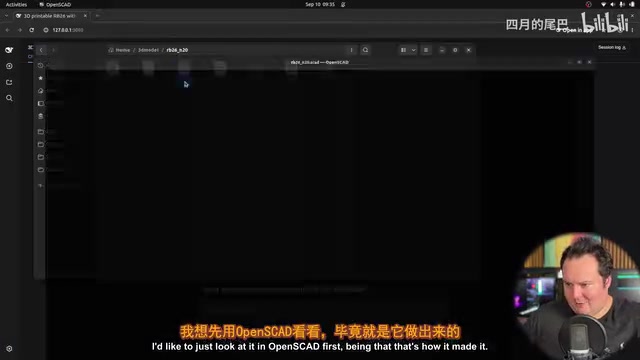
Even more impressive was an OpenSCAD-generated 3D-printable engine model — complete with an oil cap, intake manifold, dual turbochargers, N20 engine, and gearbox — described as "impossibly clean" in structure, with enough detail to go straight to slicing. And a watch showcase website that took about 100 minutes to generate was called "one of the best high-fidelity render pipelines I've ever seen," with smooth scroll animations, exploded assembly diagrams, and excellent material rendering.
Conclusion: The Best Price-to-Performance Ratio for Small Active Parameters
The total cost for the entire test session (including repeated retries) came to roughly $5.90, and the author repeatedly emphasized "this is genuinely excellent value." Overall, V4.1 Flash's significance lies not in benchmark scores, but in the fact that it achieves generation quality that far surpasses the previous Flash generation using an extremely small active parameter count, a new architecture, and dramatically reduced KV cache consumption.
The video also cites observations from Digital Spaceport and other third parties, who noted that achieving these results with such low active parameters is quite unusual. That said, the weaknesses are clear: multimodal vision processing caused issues in real-world testing, the robotic arm control task fell short, and local deployment feasibility still needs more validation.
For developers focused on open-source model cost-efficiency, DeepSeek V4.1 Flash offers a compelling option worth trying hands-on — weights are openly available, pricing is low, and the architectural thinking is forward-looking. Whether it's the "best open-source model" may be debatable, but it has undeniably pushed the frontier of "small active parameters, big capability" one step further.
What is OpenSCAD? OpenSCAD is a script-based parametric 3D modeling tool where users describe geometry, dimensions, and boolean operations through code rather than drag-and-drop interfaces. Its output can be fed directly into 3D printing slicers. Because its modeling logic is highly structured and its syntax resembles a programming language, it's currently the most common path for LLMs to generate printable 3D models — the model only needs to output text-based code, without generating binary mesh data. The fact that the engine model described here was "clean enough to go straight to printing" indicates that the model not only mastered OpenSCAD syntax, but maintained geometric consistency at the constraint level — a non-trivial spatial reasoning capability for a text-based large language model.
Related articles

Complete Guide to Running Your Own Local DeepSeek: Web Access, Knowledge Base & Privacy
Step-by-step guide to deploying a private DeepSeek locally using Ollama, Chatbox, and AnythingLLM — with web access, RAG knowledge base, and full privacy.
AI Agent Development: A 4-Stage Learning Roadmap from Beginner to Enterprise-Level Practice
A complete AI Agent learning roadmap from zero to enterprise-level: covering ReAct, multi-agent collaboration, Prompt tuning, RAG, MCP, and real-world projects.

A New DeepSeek Harness Experiment: Agent Supervising Agent for Self-Evolution
A developer built an "Agent supervising Agent" self-evolution system using DeepSeek Harness, with a ledger mechanism enabling near-unattended overnight software iteration.