DeepSeek V4.1 Flash Released: New Architecture Outperforms the Flagship

DeepSeek V4.1 Flash outperforms its own flagship Pro model with asymmetric MoE architecture at a fraction of the cost.
DeepSeek's V4.1 Flash is a 552B-parameter MoE model featuring an asymmetric Coastal Encoder-Decoder architecture (8B input / 16B output activations) that surpasses both the flagship V4 Pro and competitors like GPT-5.6 and Opus 5 on agentic benchmarks. Engineering improvements cut KV Cache HBM demands to one-quarter and SSD needs to one-eighth, enabling aggressive pricing — third-party tests show it hits 98% of GPT-6 Astra's score at just 1.4% of the cost. On the product side, three separate modes merge into one native multimodal entry point, with platforms like WorkBuddy and OpenCode offering additional limited-time discounts.
Flash Beats Pro: The Lightweight Model Dethrones Its Big Brother
DeepSeekAd has officially launched V4.1 Flash, claiming it outperforms the flagship V4 Pro across performance, speed, and cost. This is a rare reversal — models with a "Flash" suffix are typically positioned as lightweight, budget-friendly options for cost-sensitive use cases. This time, Flash has knocked the higher-tier Pro off the top of the performance charts.
V4.1 Flash is a 552B-parameter MoE (Mixture of Experts) model. Its core innovation is the new Coastal Encoder-Decoder architecture, which features an asymmetric activation design: only 8B parameters are activated during input, and 16B during output. This keeps compute requirements significantly lower than comparably sized models during inference — and it's the architectural foundation behind the model's ability to deliver both high performance and low cost.
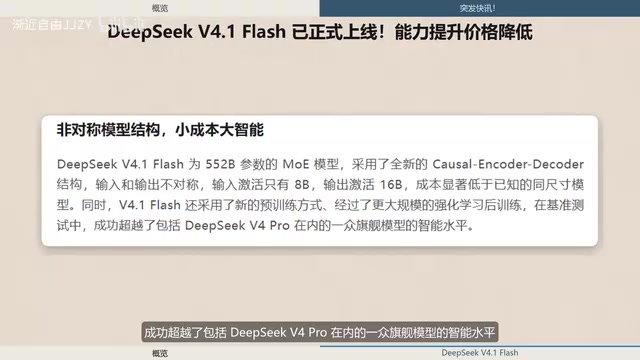
Beyond the architecture, V4.1 Flash also uses a new pretraining approach and has undergone a larger-scale reinforcement learning post-training process. According to coverage from Bilibili AI News, it's precisely this post-training pipeline that enabled it to surpass a range of flagship models — including DeepSeek's own V4 Pro — on benchmark evaluations.
What is MoE? Mixture of Experts (MoE) is the mainstream approach for reducing the cost of large models. Unlike dense models that activate all parameters on every inference pass, MoE models distribute parameters across multiple "expert" sub-networks and activate only a few of them per inference. This means the total parameter count (e.g., 552B) can be very large — covering a wide range of knowledge and capabilities — while actual compute during inference depends only on the activated portion (e.g., 8B or 16B). V4.1 Flash takes this further with its asymmetric design: 8B parameters activated during input, 16B during output, allowing each phase to do its job at the minimum necessary compute.
Benchmarks: Surpasses GPT-5.6 and Opus 5 on Multiple Metrics
In Agentic Benchmark evaluations, V4.1 Flash was pitted directly against today's top frontier models. According to the source material, it outperformed GPT-5.6 SOAR and Opus 5 on several tests, including Terminal Bench 2.1, DeepSWE 1.1, CyberGym, HLE, Automation Bench, and Agent's Last Exam.
These tests generally emphasize agentic capability, long-horizon task execution, and complex reasoning — not simple knowledge recall. This suggests V4.1 Flash's improvements are concentrated in "getting things done" rather than "reciting facts." For developers building Agent workflows, these benchmarks carry more practical weight than general conversation leaderboards.
It's worth noting that all figures cited here come from official release materials, and independent third-party verification is still pending. Model names like GPT-5.6 and Opus 5 appear in the source material as the video's labels for competing products at the time; the exact competitive mapping should be interpreted with reference to the official benchmark methodology.
What are Agentic Benchmarks? The core difference between agentic benchmarks and traditional LLM evaluations is that they measure not what a model knows, but what tasks it can complete. Typical agentic tests equip the model with tool-calling, code execution, and file operation capabilities, then assign complex multi-step tasks requiring planning, cross-turn decision-making, and error recovery — such as debugging code in a terminal environment (Terminal Bench), completing software engineering tasks (DeepSWE), or security red-teaming exercises (CyberGym). HLE (Humanity's Last Exam) is an extremely high-difficulty comprehensive test targeting expert-level knowledge. These benchmarks are more valuable for developers because real-world AI applications — especially automated pipelines and Copilot tools — demand that models "continuously complete multi-step tasks" rather than "answer a single question once."
KV Cache Dramatically Slimmed Down: Hardware Requirements Cut to a Quarter
Another noteworthy engineering improvement in V4.1 Flash is a significant reduction in KV Cache size. Compared to the previous generation, HBM (High Bandwidth Memory) requirements are reduced to one-quarter, and SSD requirements drop to one-eighth.
KV Cache is the dominant consumer of GPU memory during long-context inference. A smaller cache means higher concurrency and longer context windows per GPU. This optimization directly reduces the marginal cost of inference deployment — which explains why DeepSeek can afford to slash its pricing. Architecture-level cost reductions ultimately translate into competitive API pricing.
What is KV Cache? KV Cache (Key-Value Cache) is a core mechanism in Transformer architectures for processing long texts. When generating each new token, the model must repeatedly reference the attention key-value vectors corresponding to all previous tokens. KV Cache stores these vectors in GPU memory to avoid redundant computation. The longer the context, the more memory the KV Cache consumes; the more concurrent requests, the more total cache needed — growing linearly. This makes KV Cache the primary GPU memory bottleneck at scale, directly limiting the maximum context length and concurrent users per GPU. HBM is the high-speed on-chip memory in GPUs/TPUs — extremely high bandwidth but limited capacity and expensive. SSDs act as secondary storage when HBM overflows. By compressing both to one-quarter and one-eighth of previous levels respectively, V4.1 Flash can serve more users or handle longer conversations on the same hardware — the direct source of lower inference costs.
Product Line Consolidation: Three Modes Become One Entry Point
Alongside the new model launch, DeepSeek made a significant product-side consolidation. The app and web interface previously offered three separate modes — "Fast / Expert / Vision" — which have now been merged into a single native multimodal model. One entry point handles everyday conversation, image understanding, and complex reasoning simultaneously, so users no longer need to manually switch modes or wonder which one to pick.
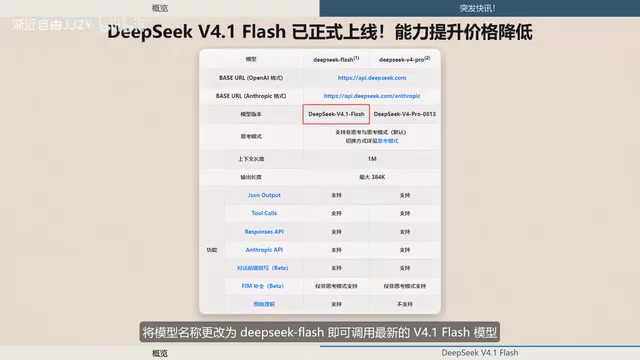
There are corresponding changes on the API side:
- V4.1 Flash is now live on the DeepSeek API with native multimodal support. Simply update the model name to
DeepSeek Flashto call the latest version. - The older V4 Flash and V4 Flash Vision EXP have been taken offline. For compatibility purposes, requests using those model names will be temporarily routed to V4.1 Flash.
- V4 Pro's deprecation has been extended to September 14 at 12:00. Until V4.1 Pro launches, all requests to V4 Pro will be routed to V4.1 Flash and billed at V4.1 Flash pricing.
This routing strategy means that even if you're still using an old model name, you're already calling the new model — and being charged at the new rate.
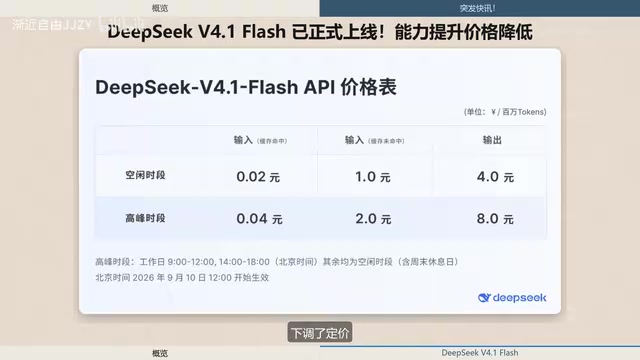
Pricing: Architecture Cost Reductions Enable Aggressive Rates
Thanks to the architectural innovations, V4.1 Flash's infrastructure costs have dropped substantially, and DeepSeek has passed those savings on through lower pricing. One detail worth noting from the source material: vision-related pricing still carries a 2× premium — multimodal input processing remains more expensive than pure text.
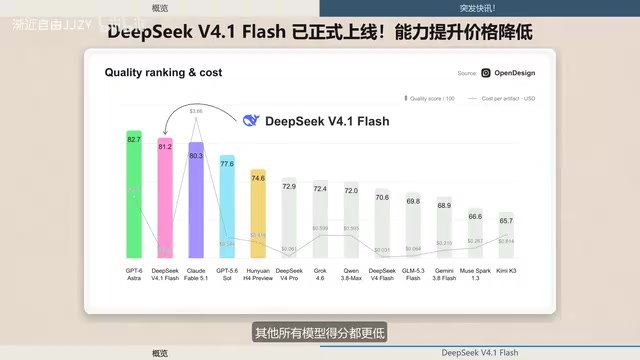
OpenDesign ran V4.1 Flash through a benchmark of real-world design tasks based on user requirements. The results were striking: V4.1 Flash achieved 98% of GPT-6 Astra's score at just 1.4% of the cost. Every other model in the comparison scored lower while costing more. In other words, for this category of practical tasks, it delivers near-top-tier results at a fraction of the price.
Ecosystem Adoption: Multiple Agent Platforms Offer Limited-Time Discounts
WorkBuddyAd and OpenCode have both fully integrated V4.1 Flash. According to the source material, WorkBuddy is offering an exclusive limited-time promotion from September 10 to September 23, with rates as low as 0.03× and no peak-hour restrictions. When DeepSeek's own price cuts are stacked with additional discounts from cloud providers and general-purpose Agent platforms, the effective call cost becomes almost negligible. OpenCode's Go plan has also added Flash V4.1.
For developers, the combination of lower model pricing and platform subsidies creates a short-term window to trial a high-performance model at minimal cost. That said, these ultra-low promotional rates are typically time-limited — long-term cost planning should still be based on official standard pricing.
Conclusion
V4.1 Flash is more than just another benchmark update. Through architectural innovations like the Coastal Encoder-Decoder, it simultaneously advances two goals that are usually in tension: high performance and low cost. The dramatic reduction in KV Cache requirements — and the corresponding drop in hardware demands — is the underlying logic behind the price cuts. The product line consolidation also signals that DeepSeek is actively reducing the complexity of model selection, making native multimodal the default experience. The current data is still primarily from official sources; real-world performance awaits broader third-party validation.
Related articles

Free Unlimited Claude Code Solution: Agnes AI + CC Switch Setup Guide
No paid subscription needed — pair the free AI platform Agnes AI with the open-source tool CC Switch to provide a backend for Claude Code, enabling unlimited free calls to text, image, and video models. This guide covers the full setup, test results, and usage boundaries.

A Complete Zero-Cost Guide to Getting Started with Claude Code for Beginners in China
A beginner's guide to Claude Code for users in China: two installation methods (command line and IDE plugin), full configuration steps for replacing the official API with the free domestic LongCat model, and a hands-on demo of building a small tool with natural language, plus tips.

When the NSA Gets Involved: The AI Supply Chain Crisis Behind Open-Source CVEs and API Key Hijacking
Multiple open-source projects disclosed severe CVEs in one day, PHP flaws alarmed the FBI, and Railway and OpenCode were breached with API keys stolen. This article breaks down the vulnerability window, AI-accelerated exploitation, and the AI supply chain crisis behind the API key black market, with a developer defense checklist.