DeepSeek-V4.1-Flash Review: 1.3B Tokens per Dollar on vLLM, 5x Agent Throughput Gain
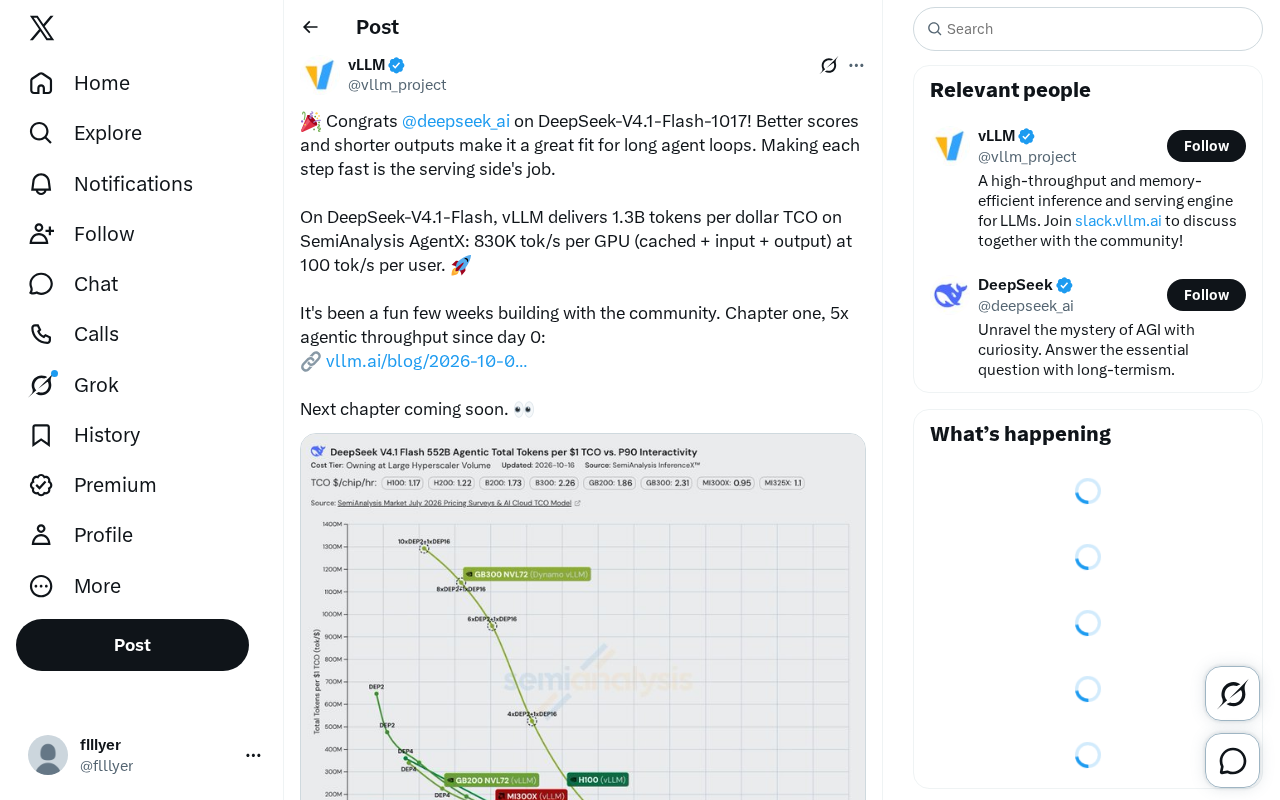
DeepSeek-V4.1-Flash-1017 outputs are shorter, and vLLM measures 1.3B tokens per dollar—great for long agent loops.
After DeepSeek-V4.1-Flash-1017 launched, the vLLM team published results on the SemiAnalysis AgentX benchmark: 1.3 billion tokens per dollar in TCO, 830K tokens/s aggregate single-GPU throughput, and 100 tokens/s per-user interactive speed. The article notes the model scores higher and outputs less than its predecessor—limited impact in single-turn Q&A, but amplified in agent loops by step accumulation, directly reducing context inflation and per-step latency. The gap between aggregate throughput and per-user speed is bridged by batching and cache hits; the former determines unit cost, the latter the interactive experience. vLLM says agent throughput improved 5x since the project's start and teases a "next chapter." The article cautions that benchmark numbers can't be extrapolated directly to production and recommends re-testing under your own traffic patterns.
DeepSeek's new model DeepSeek-V4.1-Flash-1017 has just been released, and the vLLM team promptly published results on the SemiAnalysis AgentX benchmark: 1.3 billion tokens per dollar in TCO, 830K tokens/s of single-GPU throughput (including cache, input, and output), at an interactive speed of 100 tokens/s per user. For teams building long-horizon agents, these numbers are more useful than raw benchmark scores.
What changed on the model side: higher scores, shorter outputs
According to vLLM's social media announcement, DeepSeekAd-V4.1-Flash-1017 brings two direct changes over its predecessor: higher evaluation scores and shorter output length.
Shorter outputs don't matter much in single-turn Q&A, but in agent loops the effect gets amplified over and over. A single task typically goes through planning, tool calls, reading results, and re-deciding—multiple steps, each of whose outputs feed into the next round's context. The shorter the output, the slower the context inflates and the lower the per-step latency, which is what makes long loops feasible. In vLLM's words, this trait makes the model "well suited to long agent loops."
The model is responsible for making each step smarter; the serving side is responsible for making each step faster—that's the division of labor explicitly stated in the announcement.
Agent loop refers to the closed cycle in which a model repeatedly executes "observe—think—call tool—read result" until the task terminates. Unlike single-turn Q&A, each round's output is appended to the context and becomes the next round's input, so context length grows roughly linearly with step count—or faster. This has two consequences: first, KV Cache usage keeps rising, increasing pressure on VRAM and cache; second, each step must run attention over a longer context, so latency accumulates with step count. Shorter output tokens matter because they simultaneously slow context inflation and reduce per-step generation time, making loops of dozens or even hundreds of steps affordable in both cost and latency. That is the technical meaning behind vLLM's emphasis that the model is "well suited to long agent loops."
The serving scorecard: 1.3 billion tokens per dollar
vLLM's core figures come from the SemiAnalysis AgentX benchmark:
- TCO throughput per dollar: 1.3 billion tokens
- Single-GPU throughput: 830K tokens/s (cache + input + output combined)
- Single-user interactive speed: 100 tokens/s
These numbers only make sense together. 830K tokens/s is aggregate throughput; 100 tokens/s is what an individual user experiences. The gap between them is bridged by batching and cache hits. For agent workloads, the former determines unit cost, while the latter determines whether the interactive experience is acceptable.
Over the past few weeks of community co-building, vLLM says agent throughput has improved 5x compared with the project's starting point, calling this "chapter one"—with the next chapter not yet announced.
TCO (total cost of ownership) here refers to the fully loaded resource cost of running inference services, typically including GPU depreciation or rental fees, power, cooling, and allocated operations costs—not just the per-call API price. Converting throughput into "tokens per dollar" essentially spreads hardware and operating costs across every output token, making it easier to compare the efficiency of different hardware configurations and inference frameworks. For agent workloads—long loops with many rounds of calls—TCO determines business viability more than single-call latency, because costs are multiplied by step count. Note that TCO figures depend heavily on GPU model, electricity price, utilization, and rental agreements, so teams must align on methodology before comparing numbers directly.
Prefix caching refers to the inference framework reusing the KV Cache for prefix context that repeats across multi-turn requests (such as system prompts, tool definitions, and conversation history) to avoid redundant computation. In an agent loop, each step carries an ever-growing history, so prefix reuse rates tend to be high—meaning cache hit rate directly determines effective throughput. The "cache + input + output combined" accounting in this article includes cached tokens, which is why an aggregate figure like 830K tokens/s can be far above the 100 tokens/s per user: many requests share a prefix, spreading the computation thin. In real deployments, if contexts vary widely and cache hits are low, throughput will drop noticeably.
Practical implications for agent developers
The cost structure of long-horizon agents has little to do with vendor pricing; it's mainly per-step overhead multiplied by step count. Shorter per-step outputs and higher single-GPU throughput squeeze the same bill from both directions.
For automated workflows that repeatedly call models to make decisions, a TCO of 1.3 billion tokens per dollar means long-loop tasks previously shelved due to cost are now viable. But note that this figure was measured on a specific benchmark and configuration; real-world cache hit rates, context length distributions, and concurrency patterns will all push results away from it.
vLLM emphasizes that this was built together with the community and teases that "chapter two" is coming, without revealing specifics.
How to read these numbers
Benchmark figures are worth consulting, but they shouldn't be extrapolated directly to production. SemiAnalysis AgentX targets agent workloads and is closer to reality than general chat benchmarks, but every team's request patterns differ—so re-measure throughput and cost under your own traffic patterns.
Faster models and cheaper serving benefit long-running applications that were previously bottlenecked by latency and cost. As for how much of the "5x" and "chapter two" will materialize, we'll have to wait for future versions and more third-party reproductions.
Related articles

WorkBuddy Full Tutorial: Build an AI Office Automation Agent from Scratch
A complete WorkBuddy tutorial: installation, three working modes, multimodal picture book video practice, expert team agent building, and workflow configuration for low-cost AI office automation.

WorkBuddy Agent Complete Guide: From Beginner to Automation in 7 Days
Based on Bilibili's 256-episode WorkBuddy masterclass, this systematically breaks down Tencent's AI office workbench core capabilities: Agent principles, Skill encapsulation, cross-platform connectors, scheduled automation, knowledge bases, and zero-code development, with learning path recommendations.

8 AI Accounts, 7 Failed: An Honest Review of Using AI to Get Work Done
Only 1 of 8 AI-run Bilibili accounts succeeded. We break down the real difference between "performing AI" and "using AI to get work done."