DeepSeek V4.1 Flash Tops Open-Source Model Rankings

Reddit says DeepSeek V4.1 Flash tops open-weight models, sparking heated community debate.
A Reddit post shows that the new model DeepSeek V4.1 Flash (1017) has surpassed previous open-source leaders across multiple evaluation dimensions to become the new top open-weight model. The article analyzes that the "Flash" suffix indicates a lightweight, high-inference-efficiency variant, while "1017" is likely an internal build number, suggesting DeepSeek is iterating rapidly with a rolling-release cadence. This top ranking aligns with the trend of Chinese open-source models frequently dominating leaderboards over the past year and reflects the continued narrowing gap between open-weight and closed-source frontier models. However, the author cautions that single-source leaderboard conclusions require care, evaluation criteria vary widely, and model size, context window, and license terms are undisclosed; developers should cross-verify with official model cards and third-party evaluations and test with their own data before deciding whether to migrate.
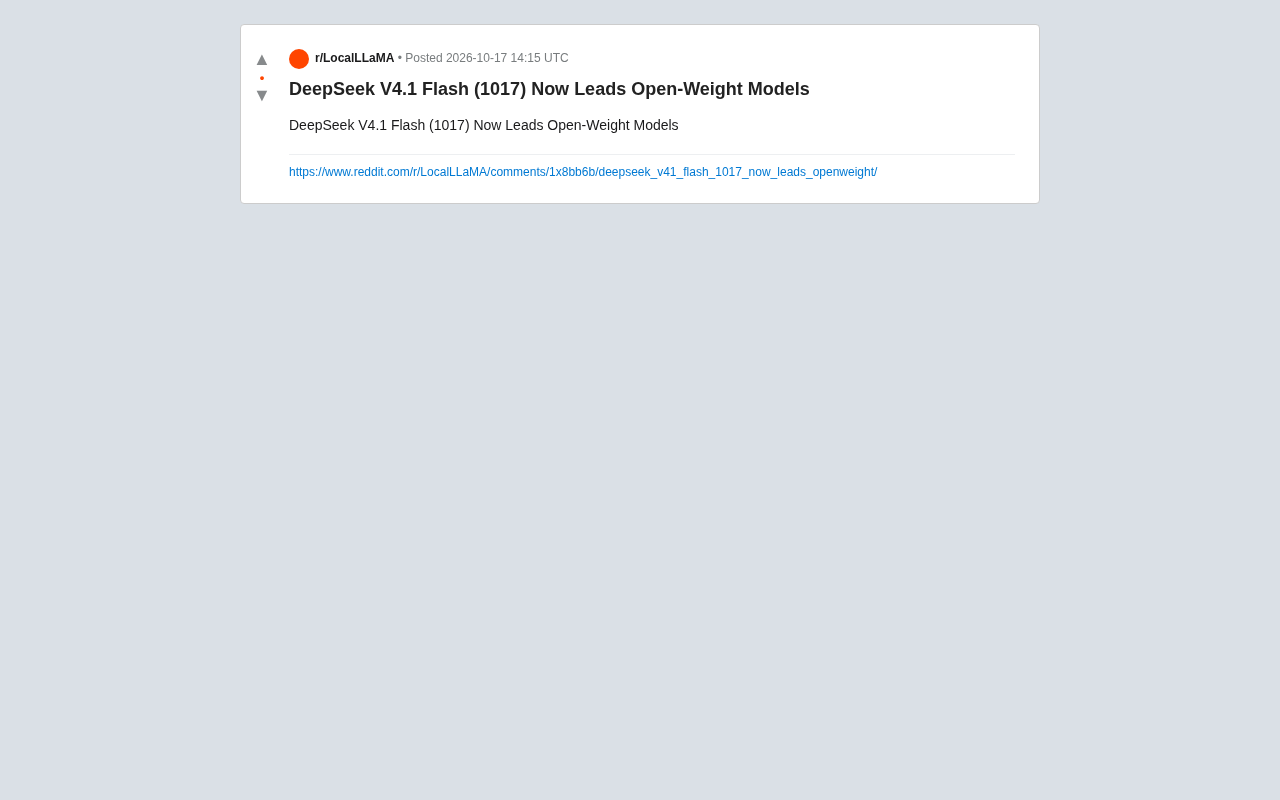
DeepSeek has once again dropped a bombshell in the open-weight model race. A post on the Reddit community shows that a new model with the version designation DeepSeek V4.1 Flash (1017) has surpassed previous open-source leaders across multiple evaluation dimensions and taken the top spot. As soon as the news broke, the developer community immediately began heated discussions around its real capabilities, the logic behind its version naming, and its open-source strategy.
The Signal Behind the Version Number: What Flash and 1017 Mean
Judging from the naming convention, this release of DeepSeekAd V4.1 Flash continues the "Flash" suffix favored by recent model vendors, which usually points to a lightweight variant with faster inference and lower cost. The "1017" in parentheses looks more like an internal build number or evaluation batch identifier rather than a formal version segment. This suggests that DeepSeek may be iterating on models at a faster pace, using a rolling-release-like approach to continuously push the performance ceiling of open weights.
For developers, this naming ambiguity is both an opportunity and a source of confusion: the opportunity is earlier access to weights with a leap in performance; the confusion is that it is hard to directly infer model size, context window, and license terms from the name. In community discussions, many people called on the official team to provide model cards and benchmark details as soon as possible.
The difference between open weights and open-source models: Open-weight means the parameter files after model training can be downloaded, but the training data, training code, and even the complete training process may not be public; a strictly open-source model must also meet conditions such as reproducible training and a license that permits commercial use and redistribution. This distinction has a direct impact on users: possessing the weights means local inference, quantization compression, and fine-tuning are possible, but if the license restricts commercial use or prohibits derivative models, enterprises' deployment paths will be limited. The DeepSeek series has long been known for open weights, but the specific terms vary by version, so the community is paying especially close attention to the license agreement for V4.1 Flash. To judge whether an open-weight model is "usable," besides performance, one should also check the license type (such as Apache 2.0, custom commercial terms), parameter scale, and availability of quantized versions.
Another Reshuffling of the Open-Weight Landscape
The core message of the phrase "Now Leads Open-Weight Models" is that among the camp of models with downloadable weights, DeepSeek V4.1 Flash (1017) currently holds the leading position. This judgment from the Reddit community aligns with the trend over the past year in which Chinese open-source models have frequently topped third-party leaderboards.
What is noteworthy is the narrowing gap between open-weight models and closed-source frontier models. The DeepSeek series has consistently entered the market with a combined strategy of "open weights + high performance," and this top ranking further strengthens the influence of that approach. For enterprise users who need local deployment, data compliance, or are cost-sensitive, the leaders in open weights are often more attractive than closed-source APIs.
However, leaderboard conclusions from a single source still need to be viewed with caution. Different evaluation sets assign very different weights to capabilities such as code, math, and long text, and the conclusion of "leading" depends heavily on the specific evaluation criteria. When adopting this conclusion, readers should ideally cross-verify it with official model cards and independent third-party evaluations.
The evaluation criteria problem behind the "leading" conclusion: Open-source model leaderboards are usually aggregated by third parties from multiple benchmarks (such as MMLU, HumanEval, GSM8K, long-text retrieval, etc.) and weighted together, and the weight designs of different leaderboards vary greatly. A model that leads on code benchmarks may not necessarily also have the advantage on mathematical reasoning or Chinese long text; evaluation prompt formats, few-shot settings, and whether tool calls are allowed can also significantly change scores. In addition, some leaderboards carry data contamination risk, meaning test questions may appear in the training corpus, causing inflated scores. Therefore, "open-weight No. 1" is only a relative conclusion under a specific set of conditions. Rigorous model selection should look at sub-item scores, reproduction scripts, and cross-checked results from independent third parties (such as LMSYS Chatbot Arena's human blind tests), rather than judging solely from a single leaderboard headline.
Practical Impact on Developers and Enterprises
If the model is indeed leading among open-weight models as the community says, the most direct impact is reflected at three levels.
Deployment cost: Flash-type models are usually optimized for inference efficiency and have a lower cost per token, making them suitable for high-concurrency scenarios.
Fine-tuning space: Open weights mean teams can adapt the model to their domain based on their own data, which is especially critical in industries sensitive to data privacy, such as finance and healthcare.
Selection and migration: Existing inference pipelines built on other open-source models may face a one-time reassessment of cost-effectiveness. But migration costs cannot be ignored; interface compatibility, quantization support, and toolchain maturity all need to be evaluated.
It should be emphasized that the original information only gives the conclusion of "leading" and does not disclose key parameters such as model size, context length, or license agreement. Before actual model selection, developers are advised to wait for official documentation and reproducible benchmark data.
Key concepts of quantization and inference deployment: When open-weight models are deployed, quantization is an unavoidable step—compressing FP16/BF16 weights into INT8, INT4, or even lower precision can greatly reduce VRAM usage and inference costs, but it brings some accuracy loss. Common approaches include GPTQ, AWQ, and the GGUF format; the latter, combined with llama.cpp, can run medium-sized models on consumer-grade hardware. Toolchain maturity (such as vLLM's throughput optimization and SGLang's scheduling support) directly determines cost per token and concurrency limits. If the Flash variant itself has already been pruned or distilled for inference efficiency, performance degradation after quantization may be more pronounced, so before migration it is necessary to rerun benchmarks at the target precision to verify real task performance rather than only looking at FP16 scores.
Community Reaction and Follow-Up Points to Watch
The Reddit post itself contains limited information, but its title is enough to ignite discussion. The community's focus is concentrated on: the differences between this version and other variants in DeepSeek's previous V4 series, whether commercial use is permitted, and stability in real tasks.
Signals worth tracking going forward include the release of an official model card, independent verification by third-party leaderboards, and whether any heavyweight users publicly share production deployment experience. In an era when open-source models are iterating faster and faster, the top spot often lasts only a few weeks, and true competitiveness still depends on ecosystem building and continuous iteration capability.
For ordinary developers, the pragmatic approach is: first include the model in local testing, run a small-scale benchmark with your own business data, and then decide whether to replace the existing solution. Leaderboards are a reference; real testing is the answer.
One-line Summary
A Reddit post says DeepSeek V4.1 Flash has topped open-weight models, sparking heated community discussion.
Paragraph Summary
A Reddit community post shows that the new model designated DeepSeek V4.1 Flash (1017) has surpassed previous open-source leaders across multiple evaluation dimensions and become the new top-ranked open-weight model. The article analyzes that the "Flash" suffix points to a lightweight, high-inference-efficiency variant, while "1017" is suspected to be an internal build number, suggesting that DeepSeek is iterating quickly with a rolling-release cadence. This top ranking aligns with the trend over the past year in which Chinese open-source models frequently dominate leaderboards, and it also reflects the continued narrowing of the gap between open-weight and closed-source frontier models. However, the author cautions that leaderboard conclusions from a single source need to be treated carefully, evaluation criteria vary widely, and model size, context window, and license terms have not been disclosed. Developers should cross-verify with official model cards and third-party evaluations, and test with their own data before deciding whether to migrate.
Related articles

Huberman's Rational Supplement Guide: A Five-Layer Health Framework and Scientific Decision-Making
Stanford neurobiology professor Huberman proposes a rational supplement framework: behavior and nutrition are the foundation, basic combination supplements serve as insurance, and sleep/hormonal/cognitive directions should stick to single-ingredient experiments. Omega-3 is the top single-ingredient choice, and melatonin is not recommended.

The Unsung Painter Behind Gilded Age Manhattan Interior Design
HN discussion highlights the painter behind Gilded Age Manhattan interiors: he created murals and decorative paintings but was long overlooked as his work was seen as architectural appendage.

Can AI Agents Be Socially Engineered? Understanding Prompt Injection and Tool Permission Risks
Through Invariant Lab's GitHub Issue injection and Brave's AI browser attack, this article analyzes how Prompt Injection induces AI Agents to perform unauthorized actions, and offers protection advice across three layers: least privilege, tool validation, and operation auditing.