DeepSeek V4.1, Gemini Argon, GPT 6.1 Sol Short Film Hands-on Comparison

Three AI models compared for short film production: DeepSeek richest, Gemini strongest interaction, GPT fastest—delivery form defines evaluation.
Based on a Bilibili creator's evaluation video, this article compares DeepSeek V4.1 Flash1017, Gemini Argon, and GPT 6.1 Sol in AI short film production. The review emphasizes unified metrics, distinguishing web from video delivery, and verifying logs against self-reports. DeepSeek invested most (64m44s, 82.26M cumulative tokens, 350 tool calls) with the richest output; Gemini Argon had the most complete web interaction but no MP4 and lacked raw usage logs; GPT 6.1 Sol delivered fastest (12m27s, 2.755M tokens) but with the simplest visuals. The conclusion: evaluating AI short film capability requires balancing output quality, completeness, timeliness, and usage transparency—token count or speed alone can't determine a winner.
Evaluation Methodology: Unifying the Numbers First
The reviewer emphasizes from the start that judging a model's animation work can't just focus on the final few dozen seconds of footage—you have to account for which models were used, how long it took, how many tokens were consumed, which tools were invoked, and how far the task was actually carried. Generating a webpage and delivering a video must be assessed separately.
The definition of the metrics matters greatly: figures verifiable from logs are counted per the logs, while those only visible in documentation are marked as "documented self-reports." What's being evaluated is how well the work was done this time, not who wrote the prettiest self-introduction. This principle runs throughout and is what distinguishes this comparison from simple benchmark scores.
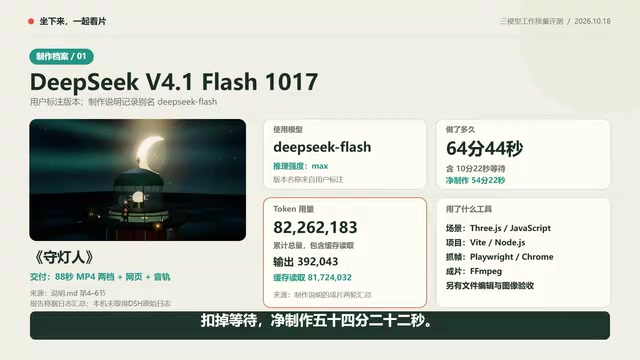
Tokens and cache reads: When processing long contexts, large models often cache recurring prompts or conversation history in GPU memory and reuse them on the next call; this counts as a "cache read" (cache hit) and is typically billed at a lower rate. In this article, "cumulative tokens" includes cache reads and actual output, while "output tokens" refers only to newly generated text. Thus, of DeepSeekAd V4.1 Flash1017's 82.26 million cumulative tokens, the vast majority are cache reads, with actual output at just 390,000—a difference of two orders of magnitude. Comparing only cumulative tokens would severely overestimate actual computation; comparing only output tokens would ignore the impact of context length on cost. A unified metric must specify whether cache is included, whether tokens from tool calls are counted, and whether cache is double-counted (e.g., GPT 6.1 Sol's cache is already included in input and must not be added again).
DeepSeek V4.1 Flash1017: Most Investment, Richest Output
Production Data and Toolchain
According to the production notes, DeepSeek V4.1 Flash1017's model alias is DeepSeek Flash with reasoning effort set to Max. From start to delivery took 64 minutes 44 seconds, of which about 10 minutes were waiting for the user to continue; excluding the wait, actual production took 54 minutes 22 seconds. Cumulative tokens were about 82.26 million, but the bulk was cache reads, with actual output at 392,043. The toolchain covered 3D scenes, scripting, music, browser frame capture, and video encoding—the entire chain was built.
Output Quality Analysis
The production record for the 88-second film shows the model made 350 tool calls and 57 image inspections, with visible iterative refinement of the lighthouseAd, sea surface, weather, and lighting. Its strength is producing a fairly complete and rich set of deliverables with all supporting files included. But more investment doesn't mean everything is perfect—small movements in dark areas and undersized subtitles still affect the viewing experience.
Gemini Argon: Impressive Web Interaction, Missing Video Export
Self-Reported Data Needs Caution
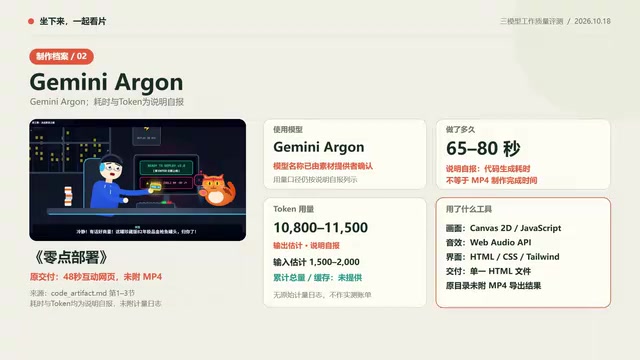
Gemini Argon's notes claim code generation took 65 to 80 seconds with output of about 10,800 to 11,500 tokens, but no raw user-facing logs were provided—these numbers can only be treated as a self-reported range. It used 2D animation JavaScript, web audio, and web styling tools; the original deliverable was an interactive webpage with no MP4 file. The video you're watching now was separately recorded during evaluation.
Front-End Completeness Wins Recognition
The complete 48-second webpage work has clear advantages: it compresses everything into a single webpage, with direct character expressions, split-screen, slow motion, subtitles, and control bars all present—front-end completeness is quite high. Chapter speed controls, subtitles, director's view, and other elements are all in place, making it most like a complete interactive player; the reviewer casts their vote for Gemini on interface completeness.
But the problem is equally direct: if the task requires a video file, delivering a runnable webpage can't count as the final step being done. The short code-generation time can't be directly compared with the other two's final delivery times. The code scale in the notes differs from the current files, and timing and usage lack raw logs—these self-reported figures shouldn't be treated as measured results.
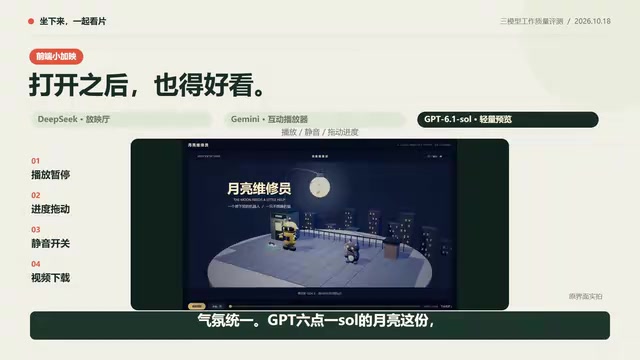
The difference between web and video delivery: Web works (HTML/CSS/JavaScript) and MP4 videos are fundamentally different delivery forms. Webpages are interactive, screen-adaptive, and can embed control bars, but require a browser environment and cannot be uploaded directly to video platforms; MP4 is linear media, easy to distribute and play, but loses interactivity. In AI short film tasks, if the prompt explicitly requires a "video file," a webpage deliverable can only be considered an intermediate product or supplementary material, not final completion. The reviewer recorded Gemini's webpage as video solely for side-by-side visual comparison, but the recording process itself consumed extra time and may have lost interaction logic. Therefore, when comparing production time and usage, one must distinguish "generating a webpage" from "exporting a video," or wrong conclusions will follow.
GPT 6.1 Sol: Fastest Delivery, Simplest Visuals
Real Data from Logs
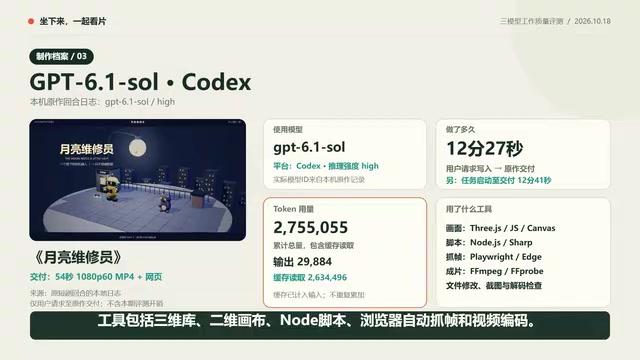
The "Moon Repairman" project completed in Codex shows in its original logs that the actual model was GPT 6.1 Sol with High reasoning effort. From user request to delivery took about 12 minutes 27 seconds, with cumulative 2.755 million tokens, of which output was 29,884 and cache reads about 2.634 million (cache is already included in input and must not be double-counted). Tools included 3D libraries, 2D canvas, Node scripts, automated browser frame capture, and video encoding. These figures cover only the original short drama, not subsequent evaluation dubbing and re-editing.
The Trade-off Between Efficiency and Visual Quality
The 54-second film reads like "turning in a usable assignment on time first": story causality is clear, and music, subtitles, webpage, and MP4 are all present. Compared with DeepSeek's records, both time and output tokens are far lower, but the cost is equally visible—simple staging, limited cat body performance, and limited camera layering. It delivered a playable product relatively quickly, but smaller numbers don't mean visual quality won.
Reasoning Effort: Some large models offer adjustable reasoning effort parameters (e.g., Max, High, Medium) that control how deeply the model thinks internally before generating a final answer. Higher effort means the model consumes more tokens for multi-step reasoning, self-verification, and tool-call planning, typically improving quality on complex tasks but significantly increasing latency and cost. DeepSeek V4.1 Flash1017 uses Max effort, GPT 6.1 Sol uses High, and Gemini Argon isn't explicitly labeled. Different reasoning effort directly causes differences in tool-call counts, output tokens, and time. In side-by-side comparison, without unifying reasoning effort, comparing time and token usage alone is unfair; but if the task allows the model to choose its own effort, actual performance is the basis for evaluation.
Side-by-Side Comparison: Output Quality, Completeness, Timeliness, and Usage
Looking at the quality of this work in one table: DeepSeek invested more, produced the richest visuals, and delivered the most complete film and supporting files; GPT 6.1 Sol delivered an MP4 faster but with simpler visuals and performance; Gemini Argon's webpage interface and comedic expression are energetic, but the original task's video export still needs completing, and usage remains only documented self-reports without raw measurement records.
What truly should be compared is output quality, how far the task was completed, plus verifiable video duration and usage. It's not that whoever reports fewer tokens automatically wins. Front-end work is also part of work quality, but a good-looking player and an exported MP4 are two different things and cannot substitute for each other.
On multi-source cross-validation: according to analyses of similar model evaluations by Bilibili uploaders and YouTube channels, the ranking of the three on toolchain completeness is basically consistent with this conclusion, with consensus centering on "delivery form determines evaluation dimensions"; the disagreement is whether Gemini's webpage delivery should count as task completion—some argue an interactive webpage is itself a valid deliverable, while others insist a video file is the hard standard.
Conclusion: Which Do You Care About More?
The value of this comparison isn't in ranking but in revealing a fact: AI short film capability can't be judged by just a few dozen seconds of output. Delivery form, usage transparency, toolchain depth, and visual quality each affect the final judgment. Which you care about more may yield completely different answers.
Related articles

WorkBuddy Full Tutorial: Build an AI Office Automation Agent from Scratch
A complete WorkBuddy tutorial: installation, three working modes, multimodal picture book video practice, expert team agent building, and workflow configuration for low-cost AI office automation.

WorkBuddy Agent Complete Guide: From Beginner to Automation in 7 Days
Based on Bilibili's 256-episode WorkBuddy masterclass, this systematically breaks down Tencent's AI office workbench core capabilities: Agent principles, Skill encapsulation, cross-platform connectors, scheduled automation, knowledge bases, and zero-code development, with learning path recommendations.

8 AI Accounts, 7 Failed: An Honest Review of Using AI to Get Work Done
Only 1 of 8 AI-run Bilibili accounts succeeded. We break down the real difference between "performing AI" and "using AI to get work done."