DeepSeek-V4-Flash Local Deployment Test: $8,000 Hardware Approaches Frontier Model Performance

DeepSeek-V4-Flash achieves near-frontier intelligence scores while running on $8,000 consumer hardware.
DeepSeek-V4-Flash-0731 scored 50 on the Intelligence Index, just one point below the frontier model peak of 51 from five months earlier. Running on approximately $8,000 of consumer hardware (4× RTX 5060 Ti + 128GB DDR4), this open-source model demonstrates that the gap between open and closed-source AI has compressed to months rather than years, marking a significant milestone in AI democratization.
DeepSeek-V4-Flash's Benchmark Data Sparks Community Frenzy
Recently, a stunning set of comparison data has been circulating in Reddit's local LLM community: DeepSeek-V4-Flash-0731, released by DeepSeek-ai, achieved a score of 50 on the Intelligence Index, while just a few months ago on March 6, 2026, the world's top frontier models had only just reached a maximum Intelligence Index score of 51.
The Intelligence Index is a comprehensive benchmark scoring system maintained by independent evaluation organizations or communities. It typically integrates multiple mainstream evaluation dimensions—including MMLU (Massive Multitask Language Understanding), HumanEval (code generation), MATH (mathematical reasoning), GPQA (graduate-level question answering), and others—normalizing model performance across different capability dimensions into a single numerical value for easy cross-comparison. The value of such composite indices lies in providing a quick anchor for judging a model's overall capability level, though their limitations are also apparent: differences in benchmark weighting and evaluation methodologies can affect the comparability of final scores.
In other words, if these benchmark results are accurate, then an open-source model that can run on local hardware has now nearly matched the intelligence level of the industry's strongest closed-source frontier model from just five months ago.
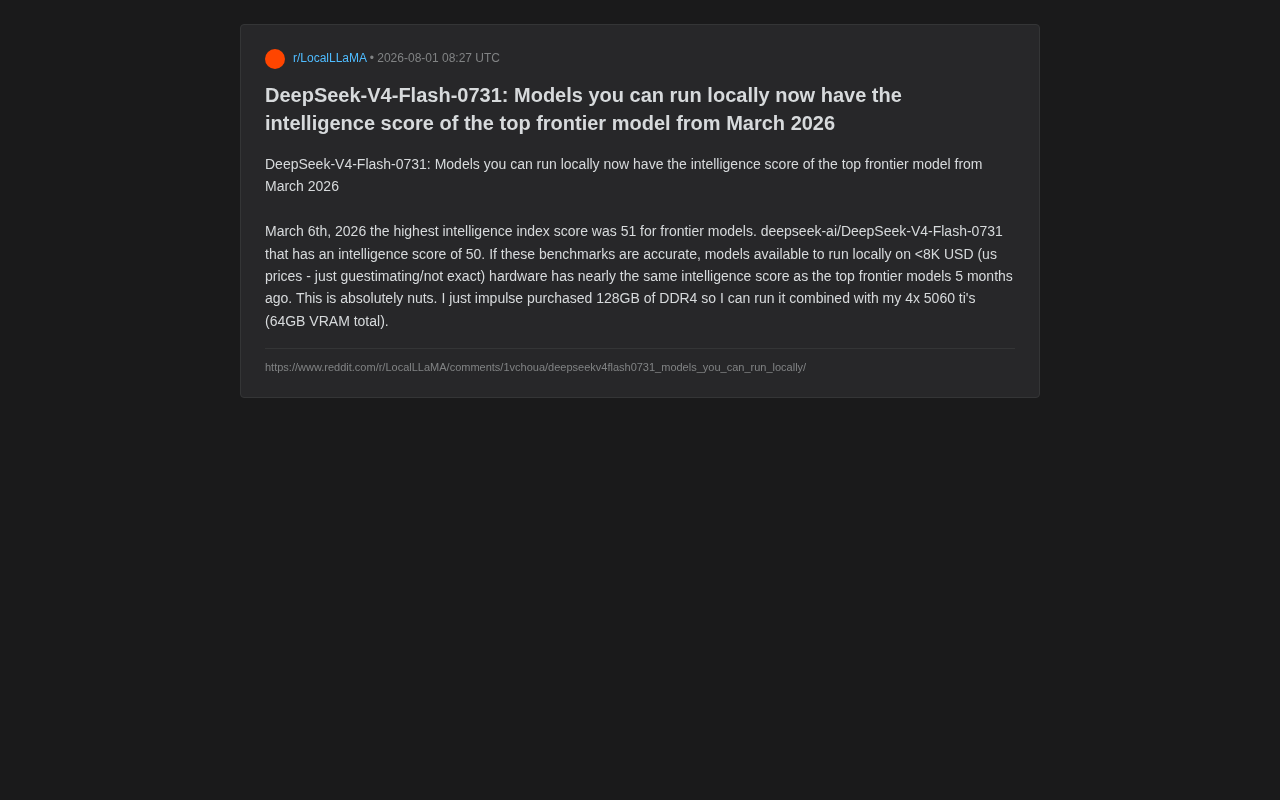
The post sparked extensive discussion, with the original poster exclaiming "this is absolutely nuts" and impulse-buying 128GB of DDR4 RAM on the spot, planning to pair it with their existing four 5060 Ti GPUs (totaling 64GB of VRAM) to run the model.
50 vs 51: The Deeper Meaning Behind the Numbers
The Gap Between Open-Source and Closed-Source Compressed to Just Months
Over the past few years, there has been a clear "generational gap" between open-source models and closed-source frontier models. But this 50 vs 51 comparison quantifies that gap into a stunning time scale—approximately five months.
This means the open-source ecosystem's catch-up pace is accelerating. Top-tier capabilities that once took a year or more to replicate have now been compressed to a single quarter. For those who care about the democratization of technology, this is a landmark signal: the most powerful intelligence is no longer the exclusive domain of a handful of tech giants.
The democratization of AI technology didn't happen overnight. Starting with Meta's release of the LLaMA series open weights in 2023, the open-source LLM ecosystem experienced explosive growth. Subsequently, teams like Mistral, Qwen, and DeepSeek continued to release high-quality open-source models, and combined with the maturation of inference frameworks like llama.cpp, vLLM, and Ollama, the technical barriers to local deployment were progressively lowered. The deep driving forces behind this trend include: the collaborative effects of the open-source community, the rapid public dissemination of training technique papers, and decreased training costs from algorithmic efficiency improvements (e.g., DeepSeek-V3 completed training for approximately $5.5 million, far below the expected cost for models of comparable capability).
A Critical Breakthrough in Local Deployment Hardware Requirements
Even more noteworthy is the barrier to entry for running these models. The poster estimated that the hardware cost to run this class of model is roughly under $8,000 (based on approximate U.S. market prices).
The configuration they described is highly representative:
- 128GB DDR4 system RAM — to accommodate model weights exceeding VRAM capacity
- 4× RTX 5060 Ti — approximately 64GB total VRAM
This "multiple consumer-grade GPUs + large system memory" combination is the typical approach for local LLM enthusiasts today. It sidesteps expensive professional-grade GPUs (like A100/H100) and instead stacks consumer cards for their superior price-to-performance ratio in VRAM and compute.
The role of DDR4 RAM in this setup requires further explanation: when deploying large models locally, if model weights exceed GPU VRAM capacity, the excess portion is offloaded to system main memory. During inference, data needs to shuttle back and forth between RAM and VRAM, and DDR4 memory bandwidth is approximately 25-50GB/s—far below GPU memory (such as GDDR6X at ~500-900GB/s or HBM at several TB/s). Therefore, the significance of 128GB DDR4 isn't providing high-speed computation, but rather providing sufficient capacity to load the complete model, working alongside 64GB of VRAM to achieve "runnable" rather than "high-speed" operation. In practice, the higher the offload ratio, the slower the generation speed, but for personal research and lightweight application scenarios, this compromise is already practically viable.
The RTX 5060 Ti is a consumer-grade GPU launched by NVIDIA in 2025, based on the Blackwell architecture, with 16GB of GDDR7 VRAM per card. Compared to professional-grade GPUs (such as the H100 with 80GB HBM3, priced at over $25,000 per card), the 5060 Ti costs approximately $400-500 per card, offering a clear price-performance advantage. A common community strategy is to distribute model layers across multiple consumer cards via multi-GPU parallelism (tensor parallelism or pipeline parallelism). While inter-card bandwidth via PCIe is far inferior to NVLink, for personal use scenarios where latency requirements aren't extremely demanding, this approach is already sufficiently practical.
Why the Flash Architecture Is Key to Local Deployment
From its naming, DeepSeek-V4-Flash-0731 is positioned as a "lightweight/efficient" variant. Such models typically achieve significantly reduced inference overhead while retaining most of their intelligence through distillation, quantization, or more efficient architectural design.
Specifically, Knowledge Distillation refers to training a smaller student model using the output distribution of a large teacher model, allowing the student to retain as much of the teacher's capability as possible despite drastically fewer parameters. Quantization compresses model weights from high-precision floating point (such as FP16/BF16, 16 bits per parameter) to lower-precision representations (such as INT8, INT4, or even lower), shrinking model size by 2-4x while reducing the memory bandwidth required for computation. Common quantization schemes include GPTQ, AWQ, and GGUF format, each making different tradeoffs between precision loss and inference efficiency. The Flash series likely employs multiple optimization strategies including architectural streamlining, distillation, and quantization-friendly design.
Additionally, DeepSeek models broadly adopt the Mixture-of-Experts (MoE) architecture. This design distributes model parameters across multiple expert sub-networks, with only a small subset of experts activated for each input token during inference (routing typically determined by a gating network). Therefore, while the total parameter count may be enormous (tens of billions or even trillions), the actual computation required per inference pass is far less than that of a dense model with equivalent parameters. MoE architecture is naturally suited for deploying ultra-large parameter models on limited hardware, and is the core technical foundation enabling DeepSeek to balance intelligence level with deployment efficiency.
This is precisely why the Flash version can run on consumer-grade hardware. Frontier models tend to be parameter-heavy and expensive to deploy, while the Flash series philosophy is: trade an acceptable small loss in capability for an order-of-magnitude reduction in deployment cost.
If a Flash version can already approach frontier model Intelligence Index scores, then the full (non-Flash) version's capability ceiling is likely even higher—further demonstrating DeepSeek's technical depth in efficiency optimization.
A Sober Perspective: Key Caveats for Local Deployment
While this data is exciting, rational judgment is still warranted.
Benchmark Scores Don't Equal Real-World Performance
The original poster themselves emphasized the caveat—"if these benchmarks are accurate." A single "Intelligence Index" score cannot cover all aspects of model performance in real-world scenarios, such as long-context stability, multilingual capability, tool calling, code generation quality, and other dimensions. Similar scores don't mean the actual experience is perfectly aligned.
It's worth noting that benchmarks carry the risk of "score gaming"—models may overfit to the distribution of specific evaluation sets during training, resulting in inflated benchmark scores while actual generalization capability falls short. Additionally, different evaluations have varying difficulty calibration standards, and the actual capability difference between 50 and 51 points may be larger or smaller than what the numbers suggest on the surface.
Hidden Costs of Local Operation Cannot Be Ignored
Beyond the $8,000 hardware budget, there are electricity consumption, cooling, maintenance, and the time cost of configuration and debugging. The actual throughput of multi-GPU inference and precision loss from quantization will both affect the final user experience. For average users, cloud APIs still hold advantages in terms of convenience.
Taking power consumption as an example, four RTX 5060 Ti cards under full inference load may draw 600-700W total, and with the CPU and other components, total system power consumption could approach 1000W. Prolonged operation means not only significant electricity costs but also higher demands on cooling and power supply. In comparison, cloud API calls may cost only a few dollars per million tokens—for infrequent use scenarios, the economics don't necessarily favor local deployment.
Frontier Models Continue to Evolve
What local models have matched is the frontier from "five months ago." Today's latest closed-source frontier models are still continuously evolving, and this gap exists dynamically. The open-source ecosystem is catching up rapidly, but top closed-source labs haven't stopped either.
This dynamic of "catch up—pull ahead—catch up again" is known in the AI field as the "open-source vs. closed-source race." Closed-source labs possess larger training compute budgets and proprietary data advantages, while the open-source community relies on collective wisdom, rapid iteration, and algorithmic innovation to narrow the gap. Based on historical trends, the time lag between the two is shrinking, but completely eliminating this gap still requires sustained breakthroughs across multiple dimensions including data, compute, and talent.
Conclusion: AI Intelligence Democratization Is Accelerating
Regardless of the details, the trend represented by DeepSeek-V4-Flash-0731 is clear: high-level AI capabilities are moving toward localization and democratization at an unprecedented pace.
For developers, researchers, and enterprises that prioritize data privacy, this means more choices—you can have a near-frontier-level intelligence engine running on your own machine, without relying on external APIs or worrying about data leakage.
When an ordinary enthusiast can run what was "the industry's best" just months ago on less than $8,000 worth of hardware, we may be standing at a new inflection point: intelligence is no longer scarce—what will be scarce is the imagination to use it well.
Related articles

DeepSeek Plans Significant Price Hikes: Is the Era of Cheap AI Coming to an End?
DeepSeek plans significant API price hikes, signaling the end of ultra-cheap AI. We analyze the drivers, developer impact, and industry shift from price wars to rational pricing.

Mistral's Patent Application for Code-Based Tool Calling Sparks Controversy: The Open Source vs. Patent Paradox
Mistral AI's patent filing for "code-based tool calling" sparks developer debate. Analysis of the technology, how it differs from JSON Function Calling, and its potential impact on the AI Agent open-source ecosystem.

How to Become a Stronger Engineer in the AI Era: Neither Surrendering Nor Rejecting
How can engineers avoid skill atrophy from over-relying on AI coding tools? This article provides an actionable growth path covering system design, debugging, and code review to build core competitiveness.