DeepSeek Plans Significant Price Hikes: Is the Era of Cheap AI Coming to an End?

DeepSeek's planned API price hike signals the AI industry's shift from unsustainable price wars to rational pricing.
DeepSeek, the Chinese AI company known for disrupting the market with ultra-low API prices, is reportedly planning significant price increases. This article examines the driving factors — including rising compute costs, chip export restrictions, and the need for sustainable business models — along with the impact on cost-sensitive developers and the broader industry trend away from subsidized pricing toward value-based competition.
DeepSeek Price Hike Rumors Draw Industry Attention
Recently, news that Chinese AI company DeepSeekAd is planning to significantly raise its API prices has sparked heated discussion on the Hacker News community. As the disruptor that shook up the global large language model market over the past year with its extreme cost-effectiveness, any pricing strategy adjustment by DeepSeek would not only affect its own user ecosystem but could also trigger a chain reaction in the pricing logic of the entire AI infrastructure landscape.
Although the company has yet to officially announce specific price increase amounts or timelines, the industry trends reflected behind this news deserve deep consideration from every AI practitioner and developer. DeepSeek previously attracted a large number of cost-sensitive developers and enterprise clients precisely by offering prices far below those of leading providers like OpenAI and Anthropic. Now, if prices are raised, whether its core competitive advantage will be weakened has become a focal point of community discussion.
From Price Slasher to Rational Pricing: Why DeepSeek Is Raising Prices
The Business Logic Behind Ultra-Low Pricing
DeepSeek's past pricing strategy attracted attention because it pushed large model API costs down to extremely low levels within the industry. This aggressive pricing helped it rapidly capture market share and build brand recognition on one hand, while on the other, it made many developers realize for the first time that high-quality reasoning capabilities don't necessarily come with exorbitant costs.
To understand the disruptive nature of this pricing, you need to understand how large model APIs are billed. Large model APIs typically charge by the token — the basic unit of text processing for models. One English word corresponds to roughly 1-1.5 tokens, while Chinese characters typically map to 1-2 tokens each. Fees are split into input tokens and output tokens, with output tokens usually priced higher because the generation process requires step-by-step autoregressive decoding, which demands significantly more computation than encoding input text in a single pass. DeepSeek's previous pricing was approximately one-tenth or even less than that of OpenAI models with comparable capabilities — a magnitude of price difference that quickly earned it widespread attention in the global developer community.
However, behind the low prices lies enormous computational cost pressure. Both training and inference for large models require massive GPU resources, and the procurement, deployment, and operation of this hardware is extremely expensive. Taking the current mainstream NVIDIA H100 GPU as an example, a single card's market price ranges from $25,000 to $40,000, and deploying a model with hundreds of billions of parameters often requires dozens or even hundreds of GPUs forming clusters for parallel computation. Inference costs encompass not just hardware depreciation but also power consumption (a single large AI data center can consume hundreds of megawatts annually — equivalent to the electricity usage of a mid-sized city), high-speed network interconnect bandwidth, precision cooling system maintenance, and other comprehensive operational expenses. When the user base grows rapidly, maintaining ultra-low prices over the long term means continuous subsidization. From a business sustainability perspective, prices returning to levels that cover costs or even generate profit may be an inevitable choice.
The Technical Foundation of DeepSeek's Low-Cost Inference
The core reason DeepSeek was able to maintain extremely low API prices for an extended period lies in its architectural-level technical innovations. In its V2 and V3 series models, DeepSeek adopted the MoE (Mixture of Experts) architecture — a technical approach that divides model parameters into multiple "expert" sub-networks, activating only the experts most relevant to the current input during inference. For example, DeepSeek-V3 has approximately 671 billion total parameters, but only about 37 billion are activated per inference call, dramatically reducing actual computational overhead.
Additionally, DeepSeek employs innovative techniques like Multi-head Latent Attention (MLA) in its attention mechanism, significantly reducing KV Cache (key-value cache — a data structure that stores previously computed attention information during inference) memory usage through low-rank compression, enabling more concurrent users to be served on the same hardware. These architectural innovations form the technical foundation of DeepSeek's low-cost inference. However, even so, facing exponential user growth, technical optimization alone cannot fully offset the continuous rise in total computational demand.
Multiple Drivers Behind DeepSeek's Price Increase
Based on community discussions, DeepSeek's planned price increase is likely driven by multiple factors:
- Computational cost pressure: As model capabilities improve and user volumes surge, inference costs cannot be fully amortized through economies of scale. This is especially true given the ongoing tightening of U.S. chip export controls to China, which increases both the cost and difficulty of acquiring high-end GPUs
- Consolidated market position: Once a product has established sufficient user stickiness and technical reputation, moderate price increases have relatively manageable impact on retention. The "switching cost" effect in economics — the learning, adaptation, and risk costs users must bear to migrate to a new platform — provides a buffer for moderate price increases
- Strategic capital reserves: The company wants to improve unit economics and accumulate funds for future R&D investment. Training the next generation of more powerful models may require hundreds of millions of dollars in computational resources
Potential Impact of DeepSeek's Price Hike on the Developer Ecosystem
Cost-Sensitive Users Face Tough Choices
For the many small and medium developers and startup teams that rely on DeepSeek's low-price advantage, a price increase undoubtedly means a direct rise in operational costs. Many applications built on the DeepSeek API have business models fundamentally predicated on low API costs — for example, AI writing assistants, intelligent customer service, code completion tools, and other high-frequency use cases consume enormous volumes of tokens, with API costs often being the single largest item in their operational expenses. After a price adjustment, these teams may have to reassess their technical choices or pass cost pressures on to end users.
In the Hacker News discussion, some users expressed concerns about the price increase, suggesting it might push them toward other more cost-effective alternatives, including self-deployment of open-source models. This reminds us that in the fiercely competitive AI infrastructure market, user loyalty is often highly correlated with price.
Open-Source Self-Deployment: An Alternative Path Around API Price Hikes
You may not have noticed, but DeepSeek also provides open-source model weights, meaning capable teams can choose to deploy models themselves, bypassing API fees entirely. For enterprise users with high call volumes, once API prices rise above a certain threshold, building your own inference infrastructure may actually become more cost-effective.
However, self-deploying open-source models is far from a simple download-and-run process, and the technical barrier should not be underestimated. Teams need capabilities in model quantization (compressing high-precision floating-point parameters to lower-precision formats like INT8 or even INT4 to reduce memory usage), inference optimization (using high-performance inference frameworks like vLLM, TensorRT-LLM, or SGLang to improve throughput and reduce latency), load balancing, fault recovery, model version management, and a whole series of engineering competencies. Additionally, teams must consider the costs of purchasing GPU servers or renting cloud instances, the human resource investment in dedicated operations teams, and the ongoing adaptation work when models are updated.
The industry generally considers self-deployment to become economically advantageous only when monthly API costs consistently exceed several thousand to tens of thousands of dollars. For teams with lower call volumes, the pay-as-you-go API model remains the more economical and hassle-free choice. This coexistence of open-source and commercial API models also preserves flexible options for users facing price increases. Developers can weigh the convenience of APIs against the cost advantages of self-deployment based on their own call volumes and technical capabilities.
Broader AI Model Industry Pricing Trends
The Price War Is Unsustainable
DeepSeek's pricing move, to some extent, confirms a long-held industry judgment: relying solely on low-price subsidies to capture market share is not a sustainable long-term model. The AI large model industry is experiencing a cycle similar to those previously seen in cloud computing, ride-sharing, and other industries — first using subsidies and low prices to rapidly acquire customers, then gradually returning to commercial rationality once market share is secured. 2024 was dubbed the "price war year" for China's AI large models, with multiple vendors slashing API prices to near-cost or even below-cost levels, with giants like Alibaba Cloud, ByteDance, and Baidu all following suit with price cuts.
But entering 2025, investor and management attention to profitability timelines has noticeably increased, and the "burn cash for growth" model faces mounting pressure. Even OpenAI — the fastest-growing AI company globally by revenue (with annualized revenue projected to exceed $3.5 billion in 2024) — remains deeply unprofitable, which underscores the difficulty of large model commercialization. As the industry transitions from its early land-grab phase to a more mature stage focused on profitability, a rational return to sustainable pricing is virtually inevitable. This is not a challenge for DeepSeek alone but one shared by all large model service providers.
Rebalancing Value and Price
For the industry as a whole, price adjustments are actually a process of the market rediscovering the true value of models. Excessively low prices can distort users' perception of AI service costs — when developers become accustomed to near-free API calls, they may not optimize prompt efficiency in their product designs, may not implement response caching, and may not consider whether model calls are truly necessary. This in turn drives up overall computational consumption. A moderate price correction helps establish a healthier, more sustainable commercial ecosystem and guides developers toward more refined management of AI call costs.
Future competition will likely shift gradually from pure price comparisons toward comprehensive dimensions including model capability, inference speed, service reliability (SLA guarantees), context window length, multimodal capabilities, fine-tuning support, and more. In this new competitive landscape, providers with genuine technical moats will command greater pricing power.
Conclusion
While the news about DeepSeek's planned price increase is still at the rumor stage and lacks official specifics, the discussion it has triggered touches on a core question for the AI industry — whether low prices can serve as a sustainable competitive moat. For developers, this is an opportunity to reassess technical choices and cost structures. For the industry as a whole, it may mark a turning point as large model services transition from unbridled growth to rational development.
Regardless of the ultimate price increase magnitude, the pricing logic of AI infrastructure is quietly evolving and deserves continued attention.
Related articles

M&M's Spent Millions Replacing Artificial Blue Dye — Why Is It So Hard?
Mars spent millions trying to replace artificial blue dye in M&M's with spirulina, but thick material clogs pipes and residue risks mold, forcing a full production-line rebuild. Here's the engineering behind the reformulation.
Teammate Wanted for Meta Global AI Developer Hackathon: Computer Vision & Medical AI
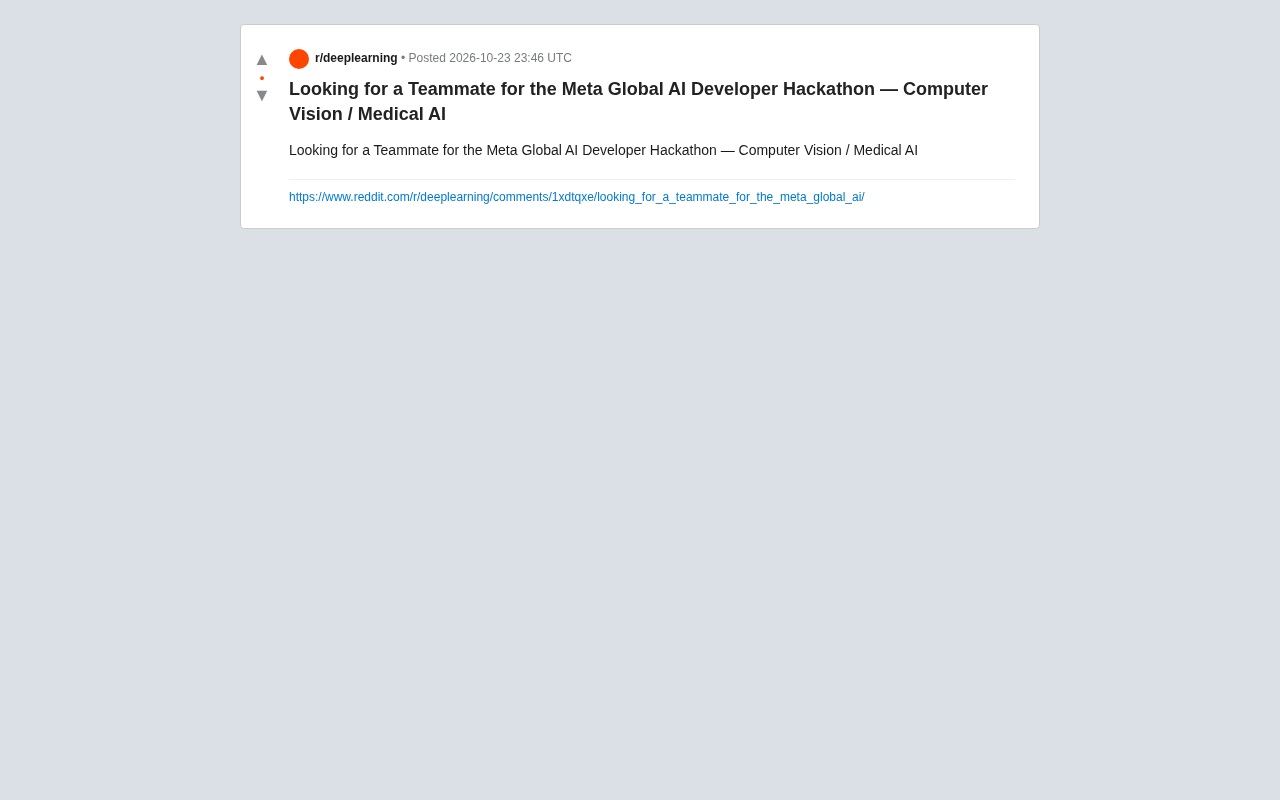
A Reddit developer seeks teammates for the Meta Global AI Developer Hackathon, focusing on computer vision and medical AI. This article analyzes the track logic, skills-complementarity needs, and topic selection strategy behind this teaming signal.
Multiple Claude Models Hit by Errors: A Postmortem of Fable 5.1, Sonnet 5.5, and Haiku 5.5
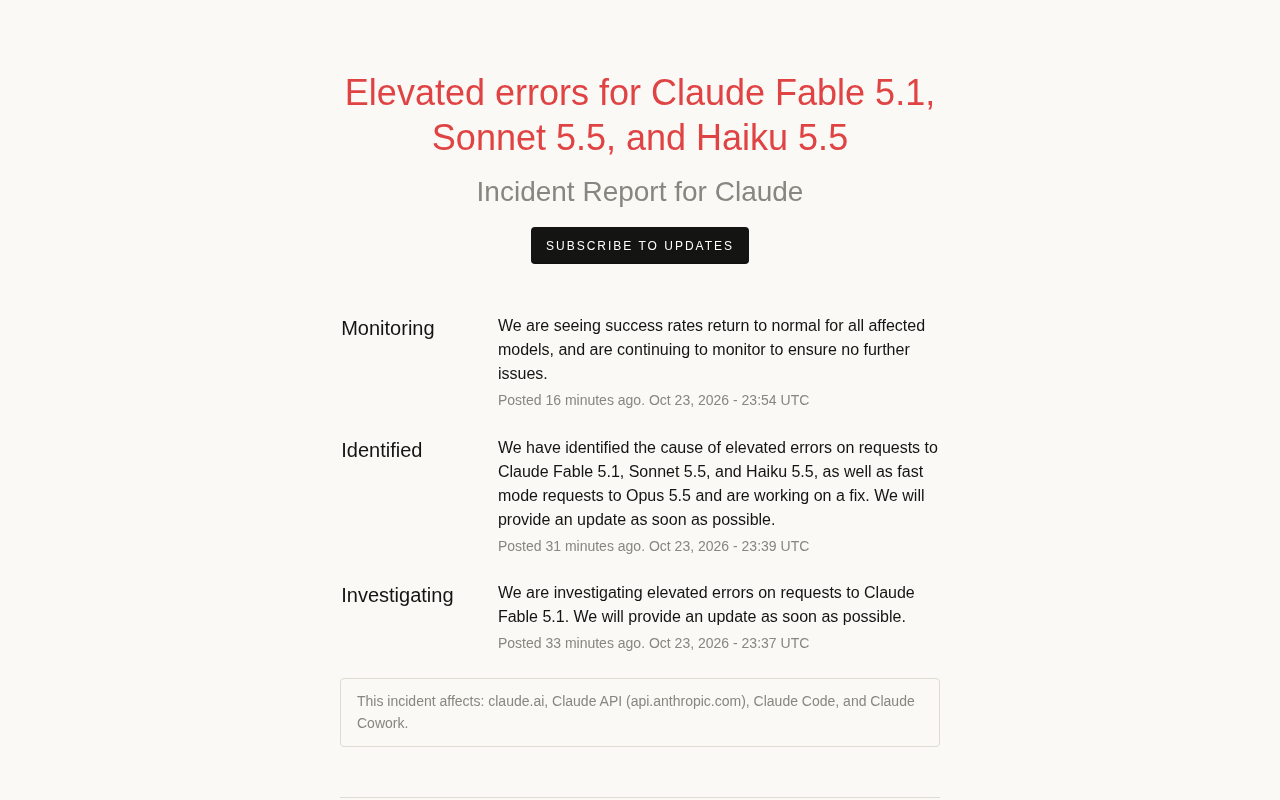
Claude Fable 5.1, Sonnet 5.5, Haiku 5.5, and Opus 5.5 fast mode saw elevated errors; Anthropic identified and resolved the issue in 17 minutes. This postmortem covers the timeline, the technical reasons for the multi-model cascading failure, and practical lessons for retry and degradation strategies.