DeepSeek V4 Flash Tool Calling Doom Loop: Analysis and Solutions

DeepSeek V4 Flash enters doom loops on Ollama Cloud when tool calls inside think blocks fail to parse correctly.
Developers report DeepSeek V4 Flash (0731) on Ollama Cloud entering "doom loops" where the model cannot properly execute tool calls and gets stuck repeating output. The issue likely stems from conflicts between the model's think block reasoning and the platform's tool call parsing. The article analyzes root causes at both deployment and model layers, and provides practical solutions including loop detection, timeout strategies, and format compatibility verification.
A "Doom Loop" That's Driving Developers Crazy
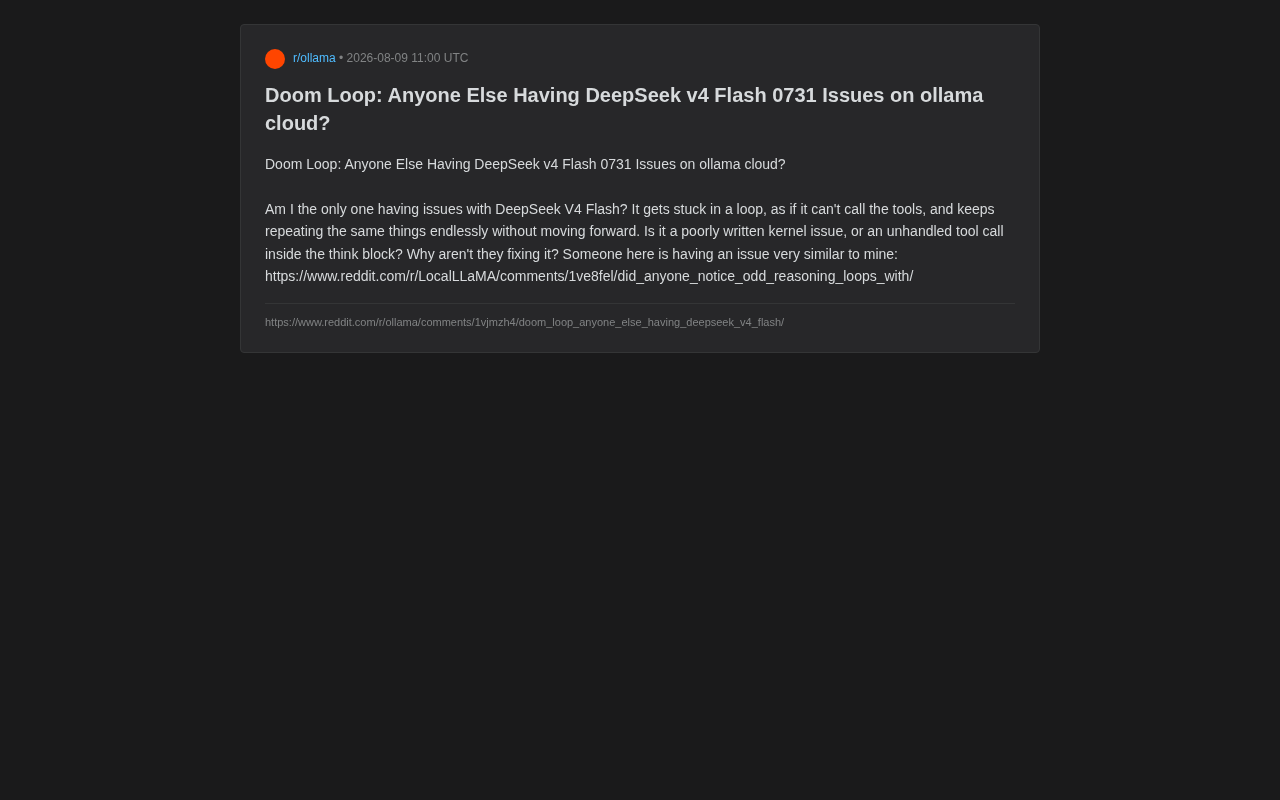
Recently, in Reddit's LocalLLaMA community, a developer using Ollama Cloud to deploy DeepSeek V4 Flash (version 0731) posted a plea for help: the model kept falling into an abnormal state known as a "Doom Loop" — it seemed unable to properly call external tools, instead repeatedly outputting the same content and failing to make any progress on tasks.
Ollama is an open-source tool focused on simplifying local deployment of large language models, allowing developers to run various open-source models locally or in the cloud through simple command-line operations. Ollama Cloud is its cloud hosting service, letting users call models without managing GPU hardware. Unlike the closed APIs from OpenAI or Anthropic, the Ollama ecosystem emphasizes convenient deployment of open-source models — but this also means that when new models are released, the platform needs to quickly adapt to model-specific inference formats, stop tokens, and tool-calling protocols. As the latest reasoning model from DeepSeek, the 0731 version of DeepSeek V4 Flash may have introduced new reasoning architectures or tool-calling specifications that Ollama Cloud hasn't fully caught up with yet.
The developer raised a pointed question: Is this a problem with poorly written underlying kernels, or is the model generating tool calls inside the "think block" that aren't being properly handled? Even more concerning, this person wasn't alone — another community member reported an almost identical "strange reasoning loop" phenomenon, suggesting the issue may be widespread rather than an isolated environmental glitch.
What Is a Reasoning Loop, and Why Does It Happen?
A reasoning loop refers to a situation where a reasoning-capable large language model gets stuck in a self-repeating dead end while generating its Chain-of-Thought. The model continuously produces similar or identical reasoning fragments, unable to either deliver a final answer or trigger the next action.
Chain-of-Thought reasoning is a prompting technique proposed by a Google research team in 2022, which was later deeply integrated into model training pipelines. Traditional language models jump directly from question to answer, while Chain-of-Thought lets the model explicitly show intermediate reasoning steps, similar to how humans think step by step. In reasoning models like DeepSeek V4 Flash, this capability is internalized as inherent model behavior — the model performs extended reasoning within regions wrapped by special tokens (such as <think> and </think>), known as "think blocks." Content within think blocks is typically not shown directly to end users, but consumes large amounts of tokens. When the reasoning process requires external information (such as querying a database or executing code), the model needs to generate structured tool call requests within the think block, then pause generation and wait for the tool to return results before continuing reasoning.
The Conflict Between Think Blocks and Tool Calling
The core feature of reasoning models like DeepSeek V4 Flash is performing chain reasoning in a hidden "think block" before providing a formal answer. Meanwhile, modern Agent applications often require models to call external tools (such as search, code execution, API requests) during the reasoning process. This creates a critical technical challenge: When tool call instructions appear inside the think block, can the inference engine correctly parse them and interrupt the current generation to execute the tool?
Tool calling in modern large language models typically follows specific structured formats. Taking OpenAI's function calling as an example, the model needs to output specific structures containing function names and JSON-formatted parameters. Different model families may adopt different calling protocols: some use XML tags (like <tool_call>), some use JSON blocks, and others use special token markers. The DeepSeek model family has its own unique tool-calling format specification. Deployment platforms need to correctly identify these format markers, interrupt the model's text generation upon detecting tool call intent, execute the corresponding tool, and then inject the results back into the context to continue generation. If the platform's parser cannot correctly identify these markers — for example, treating tool call instructions as plain text — the model enters a waiting state, because it "believes" it has issued a request, but in reality nothing has happened.
If the parsing logic is flawed, the model may have generated tool call intent, but due to format parsing failures or state management errors, the tool is never actually executed. The model waits for a tool response that will never come, and can only keep repeating its reasoning, forming a doom loop.
Root Cause: Deployment Layer or Model Layer?
Based on the developer's description, there are two possible diagnoses:
- Deployment kernel issue: Ollama Cloud may have incomplete support for DeepSeek V4 Flash's specific tool call schema, leading to parsing failures.
- Model behavior itself: It's also possible that the model's handling of the boundary between tool calling and reasoning isn't robust enough during training, making it prone to getting stuck under certain prompts.
Since multiple users have encountered similar phenomena in different scenarios, the issue is more likely in the deployment engine's adaptation to the new model rather than purely individual configuration errors.
Why Reasoning Doom Loops Deserve Attention
As reasoning models become mainstream, the combination of "reasoning + tool calling" is becoming standard for Agent applications. But the engineering complexity of this combination far exceeds traditional single-turn Q&A.
Think blocks in reasoning models are typically very long and consume enormous amounts of tokens. Once trapped in a loop, not only does the task fail to complete, but it continues to consume compute resources and costs — for pay-per-use cloud services, this means real money wasted. Taking OpenAI's o1 series as an example, a simple question might consume thousands of reasoning tokens, and while not all of these tokens are necessarily visible to users, they all count toward billing. Although DeepSeek V4 Flash's "Flash" name implies faster inference speed, its think blocks can still produce large volumes of intermediate tokens. In pay-per-token cloud environments, a reasoning process trapped in a loop could burn through quota meant to last days in just minutes. More critically, many monitoring systems only check whether requests timeout or return error codes, without examining whether output content is making substantive progress — meaning loop issues may not be discovered until significant costs have accumulated. Worse still, loops are often "silent": the system appears to be running normally and continuously outputting, but is actually making no progress, easily escaping notice from monitoring systems.
Practical Solutions for Developers
For teams currently deploying or planning to deploy DeepSeek V4 Flash, this case offers several practical takeaways:
- Set output length limits and loop detection mechanisms: Set a maximum token cap for reasoning processes, and add duplicate content detection to interrupt generation as soon as consecutive repeated fragments are detected.
- Verify tool call format compatibility: Confirm whether the deployment platform has official support documentation for the model's tool call format to avoid format mismatches causing parsing failures.
- Follow community feedback and patch updates: Issues like this are often discovered and discussed first in communities like Reddit and GitHub Issues — staying up to date can help you avoid pitfalls.
- Add timeout and abnormal exit strategies: Set reasonable timeout thresholds in Agent call chains to prevent doom loops from causing sustained resource consumption.
Modern AI Agents typically adopt the ReAct (Reasoning + Acting) framework, where the model alternates between reasoning and acting. A typical Agent call chain includes: receiving user input → model reasoning → generating tool call → executing tool → getting results → continuing reasoning → generating final answer. At each link in this chain, failure points can occur. Mature Agent frameworks (such as LangChain, AutoGen, CrewAI) usually have built-in multi-layer fault tolerance mechanisms including retry logic, fallback strategies, max iterations limits, and loop detection. This incident reminds developers that even when using seemingly reliable cloud services, these defensive programming practices cannot be skipped.
A Mirror Reflecting the Maturity of the Open-Source LLM Ecosystem
This "Doom Loop" incident fundamentally reflects the growing pains of the open-source LLM ecosystem during rapid iteration. New models emerge constantly, deployment platforms must constantly catch up with adaptation, and the enhancement of model capabilities (such as stronger reasoning and tool use) also introduces new engineering boundary issues.
You might not have noticed, but the user's post also revealed frustration with official response speed — "Why don't they fix it?" Behind this statement lies the community's higher expectations for open-source and cloud service providers regarding issue response. When a model is pushed into production environments, users need not only powerful capabilities but also stable, predictable behavior and timely problem resolution channels.
As reasoning models and Agent technology accelerate in adoption, how to seamlessly connect "thinking" with "acting" while preventing models from falling into futile self-repetition will be a challenge that both model developers and infrastructure providers must continuously tackle.
Key Takeaways
Related articles

The AI Alignment Dilemma Behind Gemini's Excessive Sycophancy
Google Gemini compared to The Stepford Wives sparks debate on AI sycophancy — exploring how RLHF training makes LLMs compliant rather than honest.

OpenAI Launches GPT-5.6-Cyber: How the Daybreak Initiative Is Reshaping the AI Cybersecurity Landscape
OpenAI releases GPT-5.6-Cyber, a dedicated cybersecurity model expanding the Daybreak initiative to arm trusted defenders with frontier AI capabilities against evolving threats.

How Claude Marks AI-Generated Content: Watermarking Technology and Content Provenance Mechanisms Explained
In-depth analysis of how Anthropic's Claude marks AI-generated content, covering metadata marking, implicit watermarking, C2PA integration, and the core technical challenges between robustness and imperceptibility.