DeepSeek V4's First Multimodal Model Goes Open Source: 305B Weights Fully Released Under MIT License

DeepSeek open-sources its first V4 multimodal model with 305B parameters under the MIT license.
DeepSeek has released V4-Flash-Vision-Exp, its first multimodal vision model in the V4 series, with 305B parameters fully open-sourced under the MIT license. Built on the V4-Flash architecture with added vision modules, the model supports screenshot parsing, chart understanding, and tool calling. It surpasses Anthropic's Opus 4.8 on Agent's Last Exam, ZeroBench, and DeepSWE benchmarks while maintaining text capabilities on par with V4-Flash.
DeepSeek Drops Another Late-Night Bombshell
On the night of August 31, DeepSeekAd quietly uploaded DeepSeek V4-Flash-Vision-Exp to Hugging Face — the first experimental multimodal vision model in the V4 series. Unlike previous releases, this one brings not only architectural breakthroughs but also full openness under the MIT license — all 305B parameters of model weights are freely available for use, modification, and commercial deployment. This is particularly noteworthy at a time when leading AI labs are generally tightening their open-source policies.
The MIT License, created by the Massachusetts Institute of Technology, is an extremely permissive open-source license. Its core terms only require that the original copyright notice and license statement be retained in redistribution — beyond that, it places virtually no restrictions on use, copying, modification, merging, publishing, distribution, sublicensing, or selling. By comparison, the GPL requires derivative works to also be open-sourced (the so-called "copyleft" clause), while Apache 2.0 adds provisions related to patent grants and trademark usage. In the large model space, many companies tout "open source" but actually use custom licenses — for example, Meta's Llama series restricts commercial use for applications with over 700 million monthly active users. DeepSeek's choice of the MIT license means any company or individual can unconditionally use this 305B model in commercial products — an extreme rarity among today's leading models.
As the name suggests, this is a version tagged with "Exp" (Experimental). DeepSeek's decision to directly open-source an experimental model reflects its "research-and-share-simultaneously" approach — rather than waiting until the product is fully mature, the community is invited to participate in iteration and validation early on.
305B Parameters and 48 Weight Shards
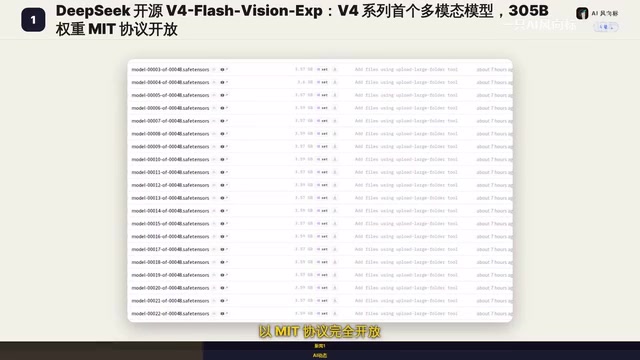
The open-sourced model totals 305B parameters, distributed across 48 weight shards. Weight sharding refers to the technique of splitting a large neural network's parameter files into multiple smaller files for storage and distribution. For a model at the 305B parameter scale, storing weights in FP16 precision results in a total file size of approximately 610GB — clearly impractical to transfer and load as a single file. By splitting into 48 shards of roughly 12-13GB each, this not only facilitates resumable and parallel downloads but, more critically, enables distributed inference strategies such as Tensor Parallelism and Pipeline Parallelism. In practice, different shards can be assigned to different GPUs, with each card only needing to load a portion of the weights to participate in inference, allowing high-end multi-GPU servers (such as 8×H100 clusters) to efficiently run the full model.
Notably, DeepSeek also included a minimal PyTorch inference implementation covering the vision encoder and MoE structure alongside the weights. MoE (Mixture of Experts) is a sparsely-activated neural network architecture whose core idea is to replace the model's feed-forward network layers with multiple "expert" sub-networks, using a Gating Network to dynamically select a small number of experts for computation during each inference pass. For example, an MoE model with 256 experts might only activate 8 of them when processing each token, meaning that although the model's total parameter count reaches 305B, the active parameters during inference may be only a fraction of the total — typically around 30-60B. This design allows MoE models to maintain the knowledge capacity advantages of large parameter counts while keeping inference costs far below those of equivalently-sized dense models. DeepSeek has been deeply invested in MoE architecture research since its V2 version, and its DeepSeekMoE architecture introduced fine-grained expert segmentation and shared expert mechanisms, making it one of the most efficient MoE implementations available today.
This reference code enables researchers to quickly understand the model's internal mechanisms while providing a clear starting point for secondary development and customization. Compared to the "semi-open-source" approach of releasing only weights without inference code, DeepSeek's move demonstrates considerably more sincerity.
Vision Capabilities Built on the V4-Flash Architecture
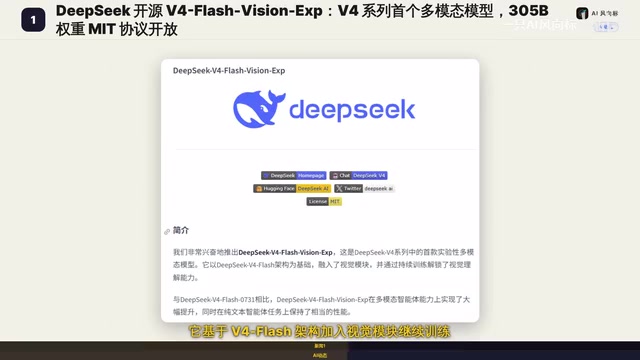
From a technical standpoint, V4-Flash-Vision-Exp is not a completely new model trained from scratch, but rather a product of adding vision modules to the V4-Flash architecture and continuing training. This approach of stacking visual capabilities onto a mature text foundation both reuses existing language understanding and reasoning abilities and acquires multimodal perception at relatively low cost.
The core component enabling a multimodal large model to "understand images" is the Vision Encoder. Current mainstream approaches typically use a pretrained ViT (Vision Transformer) as the vision encoder, which splits input images into fixed-size patches, extracts visual features through Transformer layers, and then maps visual tokens into the same embedding space as text tokens via a Projection Layer, enabling the language model to process visual information just as it does text. This "stacking visual capabilities onto a mature text foundation" approach was validated by early work like LLaVA, with the advantage that the language model's existing knowledge and reasoning capabilities remain largely unaffected while visual capabilities are introduced incrementally. However, the challenge lies in carefully balancing learning rates and data proportions between the visual and language modalities during training — otherwise, "catastrophic forgetting" can easily occur, where acquiring new capabilities causes old ones to degrade.
Specifically, the model can read screenshots, parse charts, and further combine these with tool calling to complete multimodal Agent tasks. AI Agents are a major direction in current large model applications, with the core idea being that models not only generate text answers but can autonomously plan task steps, call external tools, observe execution results, and iteratively adjust. Tool Calling (or Function Calling) is the key infrastructure for Agent capabilities, with models triggering external operations like API calls, code execution, and web browsing through structured outputs. In multimodal Agent scenarios, visual capabilities introduce an entirely new dimension of interaction: models can understand the current interface state through screenshots (e.g., GUI Agents), read charts to obtain data for analysis, or observe physical environments to plan operations.
This means the model doesn't just "understand images" — it can integrate visual information into complex task execution chains. For instance, it can autonomously operate after observing interface screenshots, or analyze and make decisions after reading data charts. This ability to integrate visual information into the Agent's "perceive-think-act" loop is a critical piece in making AI Agents practically useful.
Benchmark Performance: Surpassing Opus 4.8 on Three Tests
On the performance front, the official benchmark data is quite impressive. On Agent's Last Exam, ZeroBench, and DeepSWE, V4-Flash-Vision-Exp's scores surpassed those of Opus 4.8.
These three benchmarks each focus on different aspects: Agent's Last Exam is a comprehensive Agent capability evaluation requiring models to complete multi-step, cross-tool complex tasks; ZeroBench focuses on zero-shot visual reasoning ability, testing model generalization on previously unseen task types; and DeepSWE targets software engineering scenarios, evaluating models' ability to understand code repositories, locate bugs, and generate fixes. Opus 4.8 is the highest-tier model in Anthropic's Claude series, renowned for its powerful long-context understanding and complex reasoning capabilities, with API pricing among the highest in the industry. For an open-source model to surpass a top closed-source model on these three benchmarks signals that the capability gap between open and closed source is rapidly narrowing — especially in the Agent domain, which has been considered a "moat" for closed-source models.
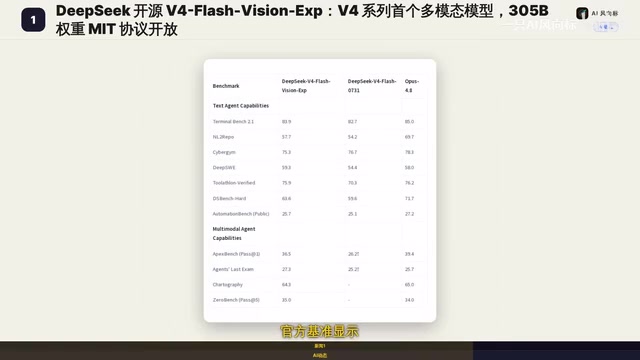
On the other hand, the team also noted that the model's pure text Agent capabilities remain on par with V4-Flash. This is a noteworthy detail: after adding the vision module and continuing training, the model's original text capabilities showed no significant degradation. This indicates that visual capability was introduced in an "incremental" manner rather than at the expense of language abilities. From a technical perspective, this means DeepSeek successfully avoided the "catastrophic forgetting" problem during training — where a model loses existing abilities while learning new tasks. This typically requires maintaining a certain proportion of pure text data in the training set (i.e., data replay) and applying differentiated learning rate strategies for vision-related modules versus the language backbone. For teams looking to deploy a single unified model for both text and multimodal tasks, this is a highly desirable characteristic.
The Far-Reaching Significance of MIT-Licensed Open Source
DeepSeek's release of 305B multimodal weights under the MIT license may have implications that extend well beyond the model's own technical benchmarks. As one of the most permissive open-source licenses, MIT imposes virtually no restrictions on commercial use, opening up enormous possibilities for downstream vendors, research institutions, and individual developers alike. In practical terms along the industry chain, this means cloud service providers can directly package it as an API product, hardware vendors can adapt it to their own chip platforms, startups can train specialized vertical-domain models on top of it — all without any form of licensing negotiation with DeepSeek.
That said, a measured perspective is warranted: on one hand, the "Exp" tag reminds us this is still an experimental version, and its stability, robustness, and performance in real production environments still await broad community validation; on the other hand, the 305B parameter scale poses significant compute requirements for local deployment — even though MoE's sparse activation reduces actual computation, the full model weights still need to be loaded into GPU memory, meaning at minimum a cluster of multiple high-end GPUs is required for inference, presenting a barrier for ordinary users trying to run the complete model.
Regardless, DeepSeek continues to push forward model iteration at a high intensity and high openness cadence, injecting fresh vitality into the entire open-source large model ecosystem. The release of V4-Flash-Vision-Exp may well be the opening chapter in the full-scale rollout of multimodal capabilities for the V4 series.
Related articles

Chain of Thought Isn't Just for AI: How Humans Can Use CoT to Improve Thinking Quality
Chain of Thought isn't just a prompt trick for large models. Starting from a Hacker News discussion, this article analyzes why CoT works for human thinking too, breaks down actionable ways to transfer it, and highlights the key differences between human CoT and machine CoT.
Cloudflare Teams Up with OpenAI: Closi…
Cloudflare Teams Up with OpenAI: Closing the Loop from Vulnerability Discovery to Defense with AI
Cloudflare uses OpenAI Daybreak to investigate security vulnerabilities and generate reviewable remediation plans, while developers use Codex to boost coding efficiency and quality.

Orca Multi-Agent Orchestration in Practice: A Guide to Parallel Collaboration with Claude and Codex
Orca is Stable AI's free open-source agent workbench supporting 34 agents like Claude Code and Codex in parallel. Learn its Git worktree isolation, multi-model orchestration, and mobile management.