DeepSeek V4 Vision Open-Sourced, Zhipu Revenue Surges 400%
DeepSeek V4 Vision goes open-source, Zhipu revenue surges 400%, ChatGPT Apps ARR tops $1B.
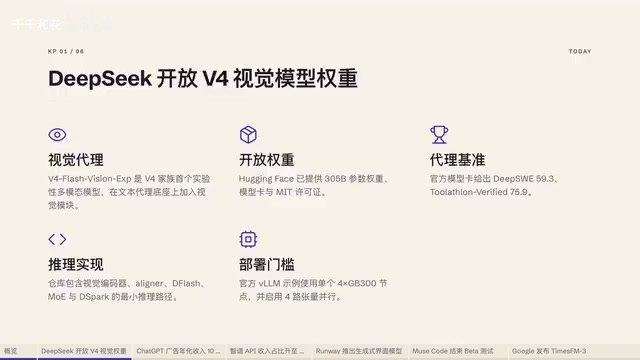
DeepSeek open-sourced its V4 Vision 305B multimodal model weights, requiring 4 NVIDIA GB300 GPUs for deployment. Zhipu reported 954M yuan in H1 revenue (up 400% YoY) with API business at 86.5%, though losses reached 2.07B yuan. ChatGPT Apps hit $1B ARR in under 200 days. Runway launched Solaris for AI-driven interface generation, and Google released TimesFM 3, a 330M-parameter time series foundation model.
DeepSeek V4 Vision Weights Open-Sourced: 305B Multimodal Model Officially Arrives
September 1st was an eventful day in the AI world. On the open-source front, DeepSeek released the first vision version weights for V4, with a model scale of 305B (approximately 305 billion parameters), along with a minimal inference implementation to help developers get started with experimentation and secondary development. This parameter scale places it among the world's largest open-source multimodal models. Multimodal models refer to AI models capable of simultaneously processing and understanding multiple forms of information such as text, images, and audio — offering richer perception and reasoning capabilities compared to text-only large language models. Open-sourcing the vision weights means that the parameter matrices responsible for image understanding and visual reasoning have been fully released, allowing community developers to directly adapt and optimize for downstream tasks.
However, the massive scale also means the deployment threshold is high. The official deployment requirement is 4 GB300 GPUs to support full inference services. The GB300 is NVIDIA's latest-generation data center GPU, equipped with ultra-large-scale memory and extremely high computational throughput. Four GB300 cards mean the total memory required for inference likely exceeds 1TB — a typical enterprise-grade configuration under current hardware conditions. This isn't friendly for individual developers or small teams, and is primarily aimed at enterprises and research institutions with ample computing resources. DeepSeek's decision to open-source its vision capabilities marks its official expansion from pure text models into the multimodal domain, injecting new vitality into China's open-source multimodal ecosystem.
Notably, DeepSeek's commitment to the open-source strategy aligns with its consistent philosophy of making technology accessible. The release of vision weights means the community can fine-tune and distill the model (i.e., using knowledge distillation techniques to compress a large model's capabilities into smaller ones), creating more lightweight, deployable application versions that partially mitigate the barriers posed by high deployment requirements. This "open-source large model, community distillation" pathway has already been proven effective as a technology diffusion method in open-source ecosystems like LLaMA.
ChatGPT Apps Annualized Revenue Exceeds $1 Billion, OpenAI Accelerates Commercialization
On the commercialization front, OpenAI delivered impressive results. Less than 200 days after launch, ChatGPT Apps has already reached an annualized revenue run rate (ARR) of $1 billion — a remarkable growth trajectory. ARR (Annual Recurring Revenue) is one of the most critical financial metrics for SaaS and subscription-based businesses, projecting current revenue levels on an annualized basis to measure sustainable growth capacity and revenue predictability. ChatGPT Apps is OpenAI's application ecosystem platform that allows third-party developers to build standalone applications powered by GPT models and distribute them to users — similar to Apple's App Store model, but with AI models driving the underlying capabilities.
Meanwhile, OpenAI's advertising business now covers over 40 countries, with self-serve advertising expanding to emerging markets including India, Europe, the Middle East, and North Africa. The global rollout of advertising signals that OpenAI is borrowing from the proven monetization playbooks of Google and Meta — generating scalable revenue through AI-driven precision advertising. These moves indicate that OpenAI is rapidly transforming from a single technology provider into a platform company with a diversified commercial flywheel encompassing "technology platform + advertising monetization + subscription revenue." The global expansion of advertising and self-serve tools also signals that AI application business models are maturing, transitioning from a cash-burning phase dependent on fundraising to a new stage of self-sustaining revenue generation.
Zhipu Revenue Surges 400%, API Business Exceeds 80% of Revenue but Losses Remain a Concern
Turning to the domestic Chinese market, Zhipu's financial data is equally noteworthy. In the first half of the year, Zhipu generated 954 million yuan in revenue, a year-over-year increase of approximately 400% — a staggering growth rate. API (Application Programming Interface) business accounted for 86.5% of revenue, making it the dominant revenue driver. The API business model is currently the primary B2B monetization approach for large model companies, where enterprise clients access model inference capabilities through API calls, typically billed by token (the basic unit of text processed by models) usage. The 86.5% share indicates that Zhipu's revenue structure is heavily reliant on enterprise model calling demand, reflecting how the strong demand from Chinese enterprises for large model integration is rapidly converting into actual purchasing power.
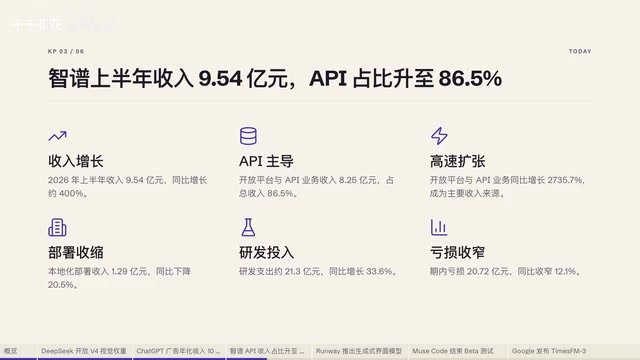
However, behind the high growth lurks a concern. During the same period, Zhipu's losses reached 2.072 billion yuan — far exceeding its revenue, with the loss amount approximately 2.2 times the revenue. This data reflects a structural challenge prevalent across the large model industry: training a frontier model costs hundreds of millions of yuan or more in computing power alone, compounded by ongoing inference server operating costs, premium AI talent compensation, and pricing pressure on APIs driven by fierce industry price wars — making it difficult for revenue growth to cover total costs in the short term. This "trading losses for scale" strategy isn't unusual in the internet industry, but the capital intensity of the large model sector is significantly higher. Finding the balance between rapid expansion and financial health will be a long-term challenge for Zhipu and indeed all Chinese large model companies.
Runway Solaris Interface Generation and Meta MuseCode Developer Tool Upgrades
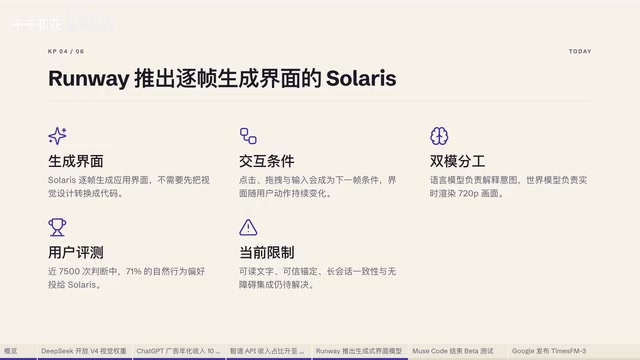
Two notable developments emerged on the product front. First, Runway launched Solaris, an interface model that generates the next screen frame-by-frame based on user clicks and drag operations — without requiring code to be written first. This interactive interface generation approach represents an entirely new human-computer interaction paradigm: rather than humans describing interfaces through code or design tools, AI infers and generates the next interface state in real-time based on natural interaction actions. From a technical standpoint, Solaris transforms UI design into a visual sequence prediction problem, similar to how video generation models predict the next frame, dramatically lowering the barriers to prototyping and interface development.
In official evaluations, 71% of natural behavior preferences went to Solaris, meaning that in comparative tests, most users found Solaris-generated interface responses more aligned with intuitive expectations — demonstrating a significant advantage in interaction experience. However, text handling remains a weakness. This is actually a common bottleneck for current visual generation models — text rendering requires pixel-level precision, while generative models excel at semantic-level content creation. The precision gap between the two indicates that current interface generation models still have room for improvement in fine-grained detail accuracy.
On the development tools front, Meta's MuseCode officially exited Beta and began targeting more complex engineering tasks, opening up a developer preview SDK (Software Development Kit). The SDK supports custom tools, streaming progress feedback, and resume painting functionality, while the product also added reading packages. Streaming progress feedback means developers can monitor the intermediate states of AI task execution in real-time, rather than waiting for the final result to be returned all at once — particularly important when handling time-consuming complex engineering tasks. These upgrades indicate that Meta is pushing its AI development tools from the experimental stage toward production-grade applications, providing developers with more complete engineering support and entering more direct competition with AI coding tools like GitHub Copilot and Cursor.
Google TimesFM 3 Released: 330M Parameter Time Series Forecasting Foundation Model
On the research frontier, Google released TimesFM 3, a multivariate forecasting model with 330M parameters. It was trained on over 1 trillion time points of data, can jointly predict multiple targets in a single forward pass, and outputs 9 probability quantiles.
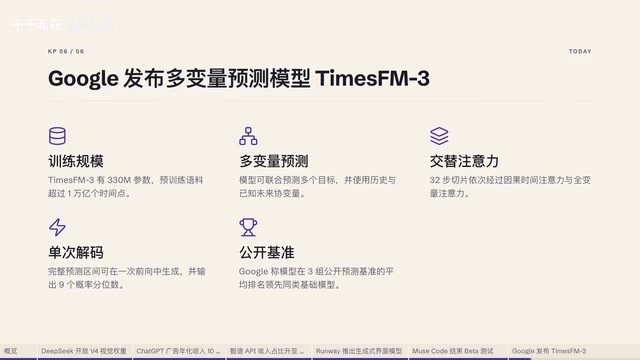
Time series forecasting has broad applications in finance, energy, supply chain, meteorology, and more. Traditional time series methods include statistical models like ARIMA and Prophet, as well as deep learning approaches like LSTM, but these models typically require separate training and hyperparameter tuning for each specific dataset. TimesFM 3's innovation lies in adopting the foundation model approach — pretraining on over 1 trillion time points of large-scale heterogeneous data to develop cross-domain general time series understanding capabilities, eliminating the need to train from scratch for each new scenario.
Its multivariate joint forecasting capability means it can simultaneously predict multiple correlated indicators (such as simultaneously forecasting a product's price, sales volume, and inventory), capturing co-movement relationships between variables rather than processing each variable in isolation. The 9 probability quantile outputs (such as the 5th, 10th, 25th, 50th, 75th, 90th, 95th percentiles, etc.) provide a complete confidence interval for predictions, enabling decision-makers to assess both optimistic and pessimistic scenarios — invaluable for risk management and resource planning. For example, supply chain managers can set safety stock strategies based on different quantiles. Notably, at 330M parameters, the model is very lightweight compared to large language models with tens of billions of parameters, making it more feasible for edge deployment and real-time prediction scenarios. It is becoming a new paradigm in time series forecasting.
Summary
From DeepSeek V4's vision weights going open-source, to Zhipu's explosive revenue growth, to OpenAI's accelerating commercialization — September 1st's AI developments clearly outline two main industry threads. On one hand, technological capabilities continue to break through, with multimodal, interface generation, and time series prediction advancing on multiple fronts. On the other hand, commercialization exploration is accelerating across the board, though the coexistence of high growth and high losses reminds industry participants that the path to profitable AI at scale still needs time to be validated. Open-source and closed-source approaches each have their advantages and disadvantages in technology diffusion and commercial monetization. How to balance the long-term value of technology investment against short-term financial pressure will continue to test the strategic resolve of every AI company.
Related articles

A World First in Australia: Delivery Riders to Receive Minimum Wage Guarantee
Australia introduces the world's first minimum wage guarantee for delivery riders, balancing gig flexibility with income protection. Explore the agreement's details, platform impacts, and global regulatory trends.
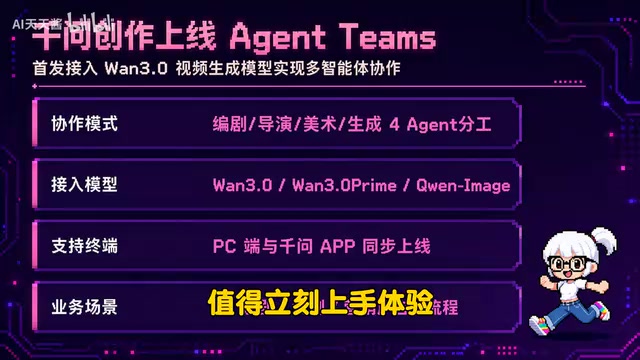
DeepSeek Open-Sources Its First Vision Model, Dramatically Lowering the Bar for Multimodal Agents
DeepSeek open-sources V-Flash-Vision-XP, its first vision model rivaling top closed-source models; Alibaba launches multi-agent video creation; sub-$400 bipedal robot goes open-source.
ReactOS 0.4.16 Released: Graphical Installer, 3D Hardware Acceleration, and Broader Hardware Support
ReactOS 0.4.16 ships with a new graphical installer, real hardware GPU 3D acceleration, and broader hardware compatibility for this Windows NT-compatible open-source OS.