DeepSeek V5 Leaked: Open-Source Model Takes Aim at Astra as Multi-Front Model Battle Looms

DeepSeek V5, Kimi K3.1, and Opus 5.5 leaked as AI flagship model competition hits weekly release pace.
Leaks from bloggers and beta testers point to DeepSeek V5, Kimi K3.1, and Anthropic Opus 5.5 all arriving in rapid succession. DeepSeek V5 allegedly targets GPT-6 Astra with 3 trillion parameters; Kimi K3.1 is hinted via official channels and expected to surpass Opus 5; Opus 5.5 is rumored for September 22 at ~20% lower pricing, strategically timed ahead of OpenAI's Dev Day on September 29. None are officially confirmed except Kimi.
AI Model Releases Enter the Weekly Release Era
Overseas AI bloggers are reporting that DeepSeekAd is preparing its next-generation large model, DeepSeek V5, with rumors suggesting it will go head-to-head with GPT-6 Astra and aim to match the performance of Fable 5.1. Meanwhile, news about Moonshot AI's Kimi K3.1 and Anthropic's Opus 5.5 has also been surfacing, with new models from both frontier labs and open-source vendors set to land in rapid succession.
According to these bloggers, the pace of model releases has noticeably accelerated — new models are emerging almost every week, from frontier labs like OpenAI and Anthropic to newer players like Grok and MuseSpark, as well as a growing number of open-source labs capable of producing powerful models. This intense iteration frequency has pushed the entire industry into an unprecedented high-speed competition.
A word of caution: most of the information in this article comes from social media leaks and beta tester opinions. Aside from Kimi, none of it has been officially confirmed. Please approach it with appropriate skepticism.
DeepSeek V5: Open Source's Next "Punching Up" Moment
DeepSeek has consistently surprised the industry with a "smaller, stronger, cheaper" strategy. The latest leak claims DeepSeek V5 is on the way — and that it will beat GPT-6 Astra.
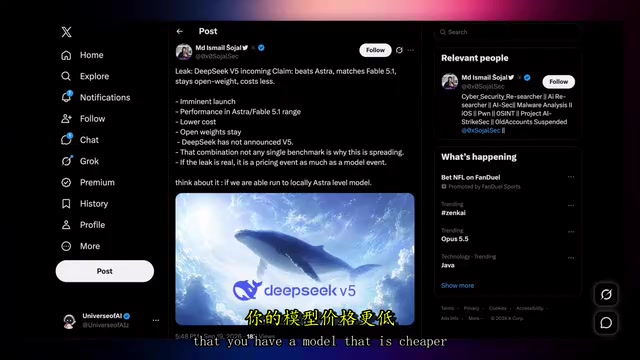
Bloggers are taking this claim with a grain of salt. They look back at the release of DeepSeek V4 Flash: while that model didn't match the top tier from OpenAI or Anthropic, it held its own against the models most people actually use day-to-day. For average users, flagship models at the Fable level are simply too expensive — most rely on mainstream products like Opus instead. If DeepSeek V5 can genuinely beat Anthropic's latest Opus model, that would be a major milestone.
The leak also mentions that DeepSeek V5 may retain a 1 million token context window and feature a parameter count as high as 3 trillion. A scale that massive raises obvious questions about whether regular users could run it locally at all. Bloggers admit they have low confidence in the "releasing within weeks" timeline — an open-source, low-cost model that can beat both Astra and Fable 5.1 in the short term is a tall order. The more realistic scenario, they suggest, is that DeepSeek first releases a V4.1 Pro (targeting GPT-5.6 or Opus 5 performance), with the true V5 coming later.
DeepSeek's previously released V3 and R1 series generated widespread industry attention primarily because their training costs were far lower than comparable closed-source models — the company disclosed that DeepSeek V3's training cost was approximately $6 million, while GPT-4-class models at the time were generally estimated to cost hundreds of millions of dollars to train. If the 3 trillion parameter count is accurate, this would be one of the largest open-source models ever (GPT-4's parameter count is estimated at around 1.8 trillion by comparison), but such a scale would require hundreds of gigabytes of VRAM to run even with 4-bit quantization — far beyond consumer hardware limits. The 1 million token context window would be comparable to Google Gemini 1.5 Pro's long-context capabilities, enabling use cases like ultra-long document analysis and large codebase comprehension.
Kimi K3.1: Moonshot AI's Signal Is More Credible
Compared to the pure speculation around DeepSeek, the Kimi clues are more substantive. Bloggers note that Moonshot AI posted a cryptic string of numbers on Chinese social media, which when decoded points to the mathematical constant Pi — widely interpreted as a hint that Kimi K3.1 is coming soon.
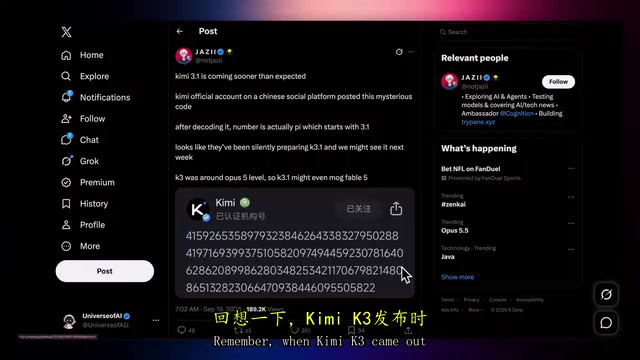
Bloggers regard Kimi K3 as Moonshot AI's most powerful model and one of the key products reshaping the open-source landscape in 2026. After K3 launched, numerous open-source labs followed suit with increasingly powerful models. Since the hint came from an official account, confidence in Kimi K3.1's imminent arrival is relatively high, with predictions that it could surpass Opus 5 and approach Fable 5 in performance. Whether it can truly "crush" Fable 5 is another matter — the more realistic expectation is parity rather than dominance.
Opus 5.5: Anthropic Wants to Steal the Spotlight Before Dev Day
The most information-dense part of this round of leaks concerns Anthropic. Bloggers originally expected the next model to be Opus 5.2, but news received just two hours before recording suggested Anthropic is actually planning to release Opus 5.5, with an internal test codename of "Cloud1."
The model is reportedly planned for release on a Tuesday (around September 22), while OpenAI's Dev Day is scheduled for September 29 — the timing is widely interpreted as Anthropic trying to outpace OpenAI's release cadence and recapture momentum lost to GPT-6 Astra.
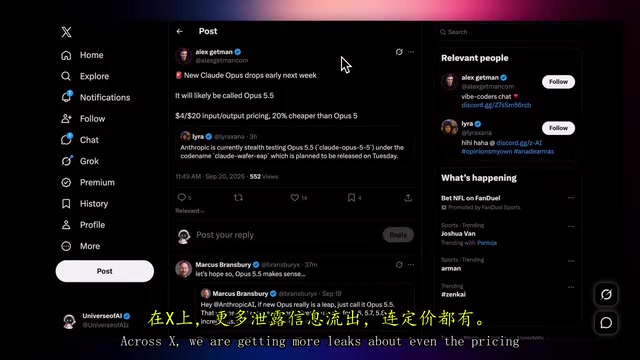
More critical is the pricing. Multiple leaks on X suggest Opus 5.5 will be priced at approximately $4 per million input tokens and $20 per million output tokens — about 20% cheaper than the current Opus 5 lineup. Bloggers consider this a smart move: if Anthropic can improve capabilities while cutting prices, user sentiment could swing back in their favor within a day or two. After all, the Opus product line — not the stratospherically priced Fable series — is what most users actually pay for on a daily basis.
That said, concerns remain. Anthropic's rate limits have historically been a pain point, burning through quickly. The new model will need efficiency improvements, or the user experience won't meaningfully change.
Per-million-token pricing is a core competitive dimension in the large model API market. At the rumored $4 input / $20 output, Opus 5.5's cost structure sits close to current mainstream flagship models: OpenAI GPT-4o is priced at roughly $2.50 input / $10 output, while Anthropic's existing Opus 5 is estimated in the $15 input / $75 output range. If the rumors are accurate, Opus 5.5's dramatic price cut would suggest Anthropic is compressing unit compute costs through scale and model efficiency improvements — such as MoE architecture or inference optimization. Rate limits refer to the maximum number of requests or token consumption allowed per unit of time in an API, and Anthropic has long drawn complaints from enterprise users for tightening these limits. This directly affects usability in high-frequency calling scenarios and is a key factor in user choice beyond pricing alone.
Beta Tester Opinions Divided: Can Opus 5.5 Actually Beat Astra?
A clear divide has emerged around comparisons between Opus 5.5 and GPT-6 Astra.
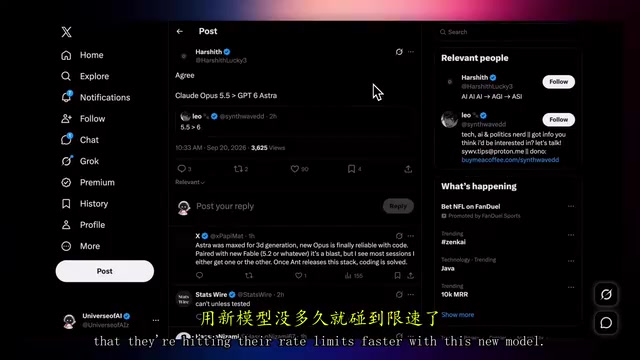
Some testers routed to the new model have changed their view on Opus, now believing Opus 5.5 will outperform GPT-6 Astra. Looking at initial outputs, bloggers personally find Opus 5.5 slightly behind Astra — but they understand why long-term users are more satisfied. Many have complained that GPT-6 Astra's rate limits run out too quickly, and if Opus 5.5 can deliver comparable quality without that frustration, the experience advantage becomes obvious. The general lean is optimistic about Opus 5.5, but with the caveat that conclusions should wait until the model is officially live and running stably in production — Anthropic's models have sometimes shown performance regression a few days after launch.
Meanwhile, OpenAI is reportedly confident. Sam Altman and others have been building hype around Dev Day, hinting at a large volume of new content. The more interesting comparison to watch, bloggers suggest, isn't Opus 5.5 vs. GPT-6 Astra — it's Opus 5.5 vs. the upcoming GPT-6 Sol, which is positioned as a fast, efficient, and powerful model. That's where the real competitive showdown lies.
GPT-6 Sol is another key model mentioned here, and its positioning is worth noting. Based on OpenAI's historical naming patterns, "Sol" likely corresponds to a version that strikes a better balance between speed and capability — similar to how GPT-4 Turbo related to GPT-4: lower latency, higher throughput, while maintaining near-flagship reasoning ability. These "efficient flagship" models often have more commercial value than top-tier versions, because they're better suited for real-time applications, multi-turn conversations, and enterprise batch-calling scenarios. If GPT-6 Sol also comes with a lower price point, it will compete directly head-to-head with Opus 5.5 — rather than fighting over the niche user base for ultra-premium models like the Fable series.
Final Thoughts
This wave of leaks paints a picture of fierce competition: the open-source camp's DeepSeek V5 and Kimi K3.1 are closing in fast, frontier lab Anthropic is hitting back with Opus 5.5 and a pricing strategy, and OpenAI is standing ready with Dev Day. For users, simultaneous improvements in model capability and cost are unambiguously good news. But most of this information remains rumor — aside from Kimi, none of it has official confirmation. Final performance and pricing must be judged when products actually ship.
Related articles

Gaussian Process Bandit Optimization: Exploration Strategies and Inference Regret Guarantees
Cumulative regret guarantees in Bayesian optimization fail to reflect final recommendation quality. This article examines a new study that provides inference regret guarantees for Gaussian process bandit optimization through exploration query strategies and fill distance analysis, validated on hyperparameter optimization and control tasks.

The Most Detailed Codex Guide on Bilibili: From Installation to Real-World Practice
The most detailed Codex guide on Bilibili: from app store installation to daily work mode configuration, with a real coffee shop project demonstrating file organization, data extraction, dashboard creation, and other practical tasks. Learn to use Plan Mode and desktop pets to leverage Codex efficiently.

Appearance Compensation in Volume Rendering: Why RGB Accuracy Cannot Guarantee Density Correctness
Volume rendering research reveals that volumetric data perfectly reproducing external RGB views may still contain density errors: appearance compensation can double central density and keep external rays unchanged even when L2 error exceeds 14.52%. Density recovery depends on appearance capacity, spatial resolution, and measurement design.