DeepSeek vs Claude Hands-On Comparison: Is the 80x API Price Gap Actually Worth It?

DeepSeek matches Claude's quality at 1/80th the API cost, but data privacy and writing nuance still favor Claude.
A hands-on comparison of DeepSeek and Claude reveals surprisingly close performance in copywriting and structured business analysis, despite an 80x API pricing gap ($0.28 vs $15–25 per million tokens). While DeepSeek offers unbeatable cost efficiency and open-source self-hosting flexibility, Claude maintains an edge in writing quality, instruction-following, and data privacy. The smartest approach: use both strategically based on task sensitivity and quality requirements.
Introduction: When the API Price Gap Reaches 80x
When it comes to choosing AI tools, pricing is often the decisive factor. Recently, a tech blogger conducted a multi-dimensional head-to-head comparison of DeepSeekAd and Claude, revealing an astonishing 80x gap in API pricing — DeepSeek costs just $0.28 per million tokens, while Claude charges $15–25.
It's worth explaining the concept of tokens here: A token is the basic unit that large language models use to process text, and it's not simply equivalent to a single word or character. In English, one token corresponds to roughly 4 characters or 0.75 words; in Chinese, a single character typically maps to 1–2 tokens. API pricing by token means that every time you call the model, both the input prompt and the generated response count toward your consumption. For enterprise applications, a mid-sized customer service bot might consume millions of tokens per day, so even tiny differences in unit price get dramatically amplified at scale.
What does this staggering price gap really mean? Can the budget-friendly DeepSeek truly replace Claude at dozens of times the cost? Let's walk through the hands-on test results.
DeepSeek vs Claude Test 1: LinkedIn Copywriting
The blogger started by giving both models the same prompt: Write a LinkedIn post about "most people are using AI wrong" — concise, punchy, under 150 words, no hashtags.
DeepSeek's response focused on the fundamental problem with how people use AI: "Most people use AI like Google — ask a question, get an answer, move on. That's not intelligence, that's just a fast shortcut to mediocre answers. The real leverage is in conversation — treat AI like a junior partner, push back, ask why, make it argue the opposite side."
Claude's response took a different angle: "Most solopreneurs work 60-hour weeks doing tasks AI could handle in six minutes — scheduling, writing, research, follow-ups, proposals."
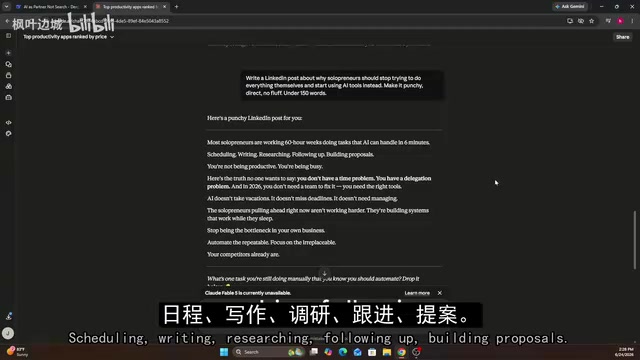
Different styles, but both solid. DeepSeek leaned more philosophical, while Claude was more practical and scenario-driven. Round one: too close to call.
DeepSeek vs Claude Test 2: Structured Business Analysis
The second test was more challenging: As a solopreneur, analyze the top three risks of migrating from Notion to a custom-built tool for managing client projects, and assess the potential loss and recoverability of each risk.
Some background on this test scenario is worth expanding on: Notion's core advantage as an all-in-one workspace lies in its rich integration ecosystem — through its official API and automation platforms like Zapier and Make, it connects seamlessly with hundreds of third-party services. A custom-built tool offers complete customization freedom but requires the developer to handle database design, user authentication, permission management, data backups, SSL certificates, server monitoring, and a host of other infrastructure concerns. Understanding this technical context helps us better evaluate the quality of each model's analysis.
DeepSeek's three risks:
- Time Black Hole: Building vs. Billing — Notion works out of the box; a custom tool requires building everything from scratch. Recoverable, but lost time can never be reclaimed.
- Data Loss and Migration Chaos — Data risks during the migration process.
- You Become the Single Point of Failure — Notion handles everything for you; going custom means hosting, backups, security patches, and uptime are all on you.
Claude's three risks:
- You Become the IT Department — Similar to DeepSeek's third point: all infrastructure maintenance falls on your shoulders.
- Losing the Ecosystem Overnight — Loss of integrations and plugin ecosystem; tools like Zapier can only partially compensate.
- Client Onboarding Gets Harder Before It Gets Easier — Short-term client experience will suffer.

Claude also offered an honest bottom-line recommendation: "Migration only makes sense when you've genuinely hit Notion's ceiling." This kind of pragmatic judgment showcases Claude's edge in structured analysis — it didn't just answer "what are the risks" but proactively offered a decision recommendation on "whether the risks are worth taking." This ability to think beyond instruction-following is something Claude has specifically optimized through RLHF (Reinforcement Learning from Human Feedback) and Constitutional AI training methods, designed to make the model not just execute instructions but provide judgment-driven advice like a real consultant.
That said, overall both models' analyses overlapped in some areas and complemented each other in others — the quality was remarkably close.
The Core Gap: A World of Difference in API Pricing
This is the most striking part of the DeepSeek vs Claude comparison.
| Model | Price per Million Tokens | Relative Multiple |
|---|---|---|
| DeepSeek | $0.28 | 1x |
| Claude Sonnet | $15 | ~54x |
| Claude Opus | $25 | ~89x |

The blogger stated bluntly: "Among all AI large language models, including ChatGPT and Gemini, DeepSeek is far and away the leader in token cost efficiency — the gap isn't even in the same league."
To put this in real numbers: An application consuming 100 million tokens per month would cost just $28 with DeepSeek versus $2,500 with Claude Opus. For developers and businesses making high-frequency API calls, this represents enormous cost savings.
Multiple factors drive this pricing disparity. First, there's the difference in training and inference costs — DeepSeek employs a Mixture of Experts (MoE) architecture that activates only a subset of parameters during inference, dramatically reducing the computational cost per call. Second, the commercial strategies differ — Anthropic, a U.S. AI company valued at over $60 billion, needs API revenue to cover substantial R&D and safety research investments. DeepSeek, backed by the quantitative hedge fund High-Flyer, faces relatively less commercial pressure, and its low-price strategy is more about rapidly capturing market share and building a developer ecosystem.
The Unavoidable Topic: DeepSeek's Data Privacy and Security Concerns
The blogger specifically called out a critical issue that many comparison videos avoid: data privacy.
DeepSeek is a Chinese company, and data sent through its API passes through Chinese servers and falls under Chinese legal jurisdiction. China's national security laws may require companies to provide data to the government upon request — a legitimate concern.
Specifically, this involves multiple Chinese laws and regulations, including the Cybersecurity Law (effective 2017), the Data Security Law, and the Personal Information Protection Law (both effective 2021). The Data Security Law establishes a tiered data classification and protection system, while Article 28 of the Cybersecurity Law requires network operators to provide technical support and assistance to public security agencies for national security and criminal investigations. Notably, these legal frameworks share certain similarities with the U.S. CLOUD Act, which likewise allows American law enforcement to compel U.S. tech companies to produce data stored on overseas servers. Data sovereignty, therefore, is not a China-specific issue but a universal challenge in globalized AI services.
However, the blogger also offered an important nuanced distinction:
DeepSeek's model weights are open-sourced under the MIT license, which means you can download the model and run it on your own computer or server — your data never leaves your device. The API and the model itself are two completely different things. If you choose to self-host, the data concerns about a Chinese company disappear entirely.
This deserves further explanation regarding the MIT license and self-hosting. The MIT license is one of the most permissive open-source licenses, allowing anyone to freely use, modify, distribute, and commercialize the code — the only requirement is retaining the original copyright notice. Self-hosting does require certain hardware — running a full DeepSeek-V3-level model typically requires multiple high-end GPUs (such as NVIDIA A100 or H100). However, through techniques like GGUF quantization, the model can be compressed to run on consumer-grade hardware, making it feasible for small teams or even individual developers to deploy locally at relatively low cost, fundamentally eliminating the risk of data leakage.

Practical recommendations summary:
- ❌ Don't send confidential client data, passwords, financial records, or other sensitive information through the DeepSeek API
- ✅ For general research, content creation, and non-sensitive work, the risk is comparable to any cloud-based AI service
- ✅ For sensitive data scenarios, prioritize Claude
- ✅ Want low cost without data concerns? Self-hosting DeepSeek is an increasingly viable option
Final Verdict: Who Should Use DeepSeek vs Claude?
The blogger offered a well-balanced conclusion:
Where DeepSeek excels:
- Matches Claude in structured reasoning and coding tests
- Incredibly low API costs
- Best value for non-sensitive, high-frequency use cases
- Open-source and self-hostable, offering maximum flexibility
Where Claude still leads:
- Superior writing quality and tone control
- Stronger instruction-following — particularly noticeable in complex multi-constraint tasks, such as simultaneously requiring specific format, tone, length, and content boundaries, where Claude demonstrates notably higher compliance and consistency
- More robust data privacy protections
- Remains the safer default choice for content creation and business information processing
For most users, this isn't an either/or decision. The smarter strategy is to mix and match based on the scenario — use DeepSeek for high-volume, non-sensitive structured tasks to save costs, and use Claude for core business needs requiring high-quality writing and data security. This "Router Strategy" is becoming increasingly common in enterprise AI applications. Some teams even build intelligent routing layers that automatically assign different models based on task type, sensitivity level, and quality requirements, achieving an optimal balance between cost and quality.
An 80x price gap doesn't mean an 80x quality gap — but it also doesn't mean one can fully replace the other. Finding the right balance for your workflow is the true art of using AI wisely.
Key Takeaways
Related articles

Is the AI Black Box Actually Transparent? Interpretability Research Upends Conventional Wisdom
Goodfire's research "Neural Networks Are Already Clean" challenges the AI black box myth: polysemanticity may be an illusion from visualization tools and the SwiGLU double-negative flaw. Neural networks self-organize via recursive generalization and are inherently readable. This deep dive explores implications for AI interpretability and alignment.

Automate Job Search with AI Agents and Residential Proxies for Precise Matching
Build an AI Agent with MCP and residential proxies to bypass recruitment site anti-scraping and geo-restrictions, scrape thousands of DevOps jobs, then have Claude score and rank each against your resume. Includes proxy comparison experiments, project structure, and cost analysis—filtering only, no auto-submission.

The AI Task Assistant That Knows When to Back Off: A Cure for Activation Struggles
One Small Step is an AI assistant for task initiation struggles, using agentic decisions for guilt-free reminders, timely retreat, and cross-platform task management. The developer shares real test results on 13 tasks and architectural trade-offs.