Delayed for Nearly a Decade: Is the Tesla Roadster Finally Going into Production?

After nearly a decade of delays, the Tesla Roadster may finally enter production, reflecting Tesla's spec-driven hype strategy and its diminishing returns.
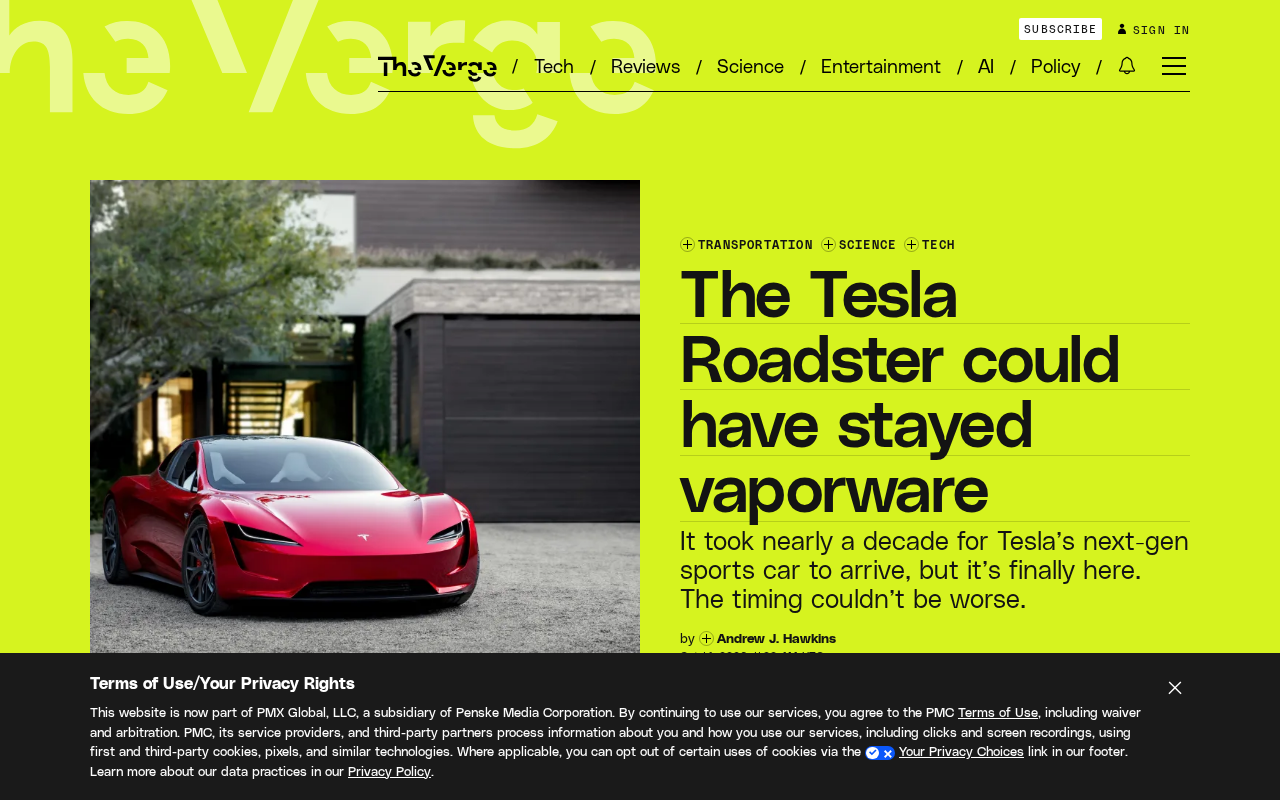
The Tesla Roadster, unveiled in 2017, has been delayed for nearly a decade due to shifting priorities toward Model 3/Y, the engineering difficulty of rocket thrusters, and battery/supply chain challenges — leading many to label it 'vaporware.' With production now imminent, it carries major implications for Tesla's brand credibility and high-performance market position. However, even if it arrives, the market is vastly different from 2017. The Roadster's story reflects Tesla's product philosophy of using extreme specs to generate buzz and long waits to test patience — a strategy whose marginal returns are declining amid growing competition and maturing users.
From Stunning Debut to Endless Wait
In 2017, Elon Musk unexpectedly unveiled the next-generation Tesla Roadster at a launch event. The reveal was nothing short of stunning: claimed 0-100 km/h acceleration in under 2 seconds, range exceeding 1,000 kilometers, and a top speed of over 400 km/h. If those figures held true, it would be one of the fastest production cars ever built.
Yet from that day forward, the car fell into a long cycle of delays. The originally planned 2020 production date was pushed back repeatedly, and Musk himself gave new timelines on social media time and again — only to break his promises each time. Nearly a decade later, the Roadster has practically become a meme in Tesla fan circles — a car that's forever "coming next year."
Why It Nearly Became "Permanent Vaporware"
The term "vaporware" in the tech industry refers to products that are hyped up but never ship — or are eventually cancelled altogether. Over the past few years, the Roadster has increasingly fit that definition.
The problems span multiple levels. First, there's the question of priority. During this period, Tesla's focus clearly shifted to mass production of the Model 3 and Model Y, as well as the development and delivery of the Cybertruck. As a low-volume, high-cost halo car, the Roadster naturally got pushed to the back of the line.
Second, there's the technical difficulty. The performance targets Musk promised — especially the rocket thruster option package claimed to achieve "0-60 mph in 1.1 seconds" — are extraordinarily challenging from an engineering standpoint. Making such a system street-legal, reliable, and durable is far more complicated than putting together a few slides for a launch event.
Third, there are battery and supply chain challenges. A 1,000-kilometer range requires battery packs with extremely high energy density, which demands a difficult balancing act between cost, weight, and safety. Tesla clearly wasn't in a hurry to pour excessive resources into a niche sports car.
Halo car is an automotive industry term referring to vehicles that aren't aimed at volume sales, but rather at elevating brand image and drawing media and consumer attention to flagship models. These cars typically have very low production numbers, high price tags, and may even sell at a loss. Their core value lies in the "halo effect" — radiating the prestige of high performance and cutting-edge technology onto the brand's mass-market vehicles. The Tesla Roadster is a textbook halo car: it doesn't need to sell in large numbers; it just needs to make people remember that Tesla can build the fastest electric car. This is also why it was pushed behind the Model 3 and Model Y — the latter are the products that actually sustain the company's cash flow.
The 1.1-second 0-60 mph rocket thruster option package refers to the "SpaceX option package" Musk mentioned at the 2017 launch event. The plan was to install cold gas thrusters at the rear of the vehicle, using high-pressure gas jets to generate additional thrust, compressing the 0-60 mph acceleration time to an astonishing 1.1 seconds. Cold gas thrusters are common in spacecraft attitude control, but making them street-legal on a consumer vehicle requires solving a whole series of engineering and regulatory challenges: high-pressure gas storage, crash safety, regulatory certification, and routine refueling. This is one of the key reasons behind the Roadster's delays — it's not just about building a fast car, but about redefining the physical limits of production vehicles.
What It Means Now That Production Is Finally Imminent
According to the latest reports, the Tesla Roadster is finally expected to make its official debut in production form. For Tesla, the significance goes beyond simply fulfilling a promise made years late.
On one hand, it's about brand credibility. Musk has long been known for "over-promising and under-delivering." If the Roadster finally materializes, it would at least prove that those wild numbers weren't pure fantasy. On the other hand, the high-end sports car market is changing. Rivian, Lucid, and several Chinese brands are all pushing high-performance electric vehicles, and Tesla needs the Roadster to re-establish its position at the pinnacle of the performance pyramid.
That said, even if the production version does arrive, it will face a market completely different from 2017. What was once "unbeatable" may now merely be "top tier," and consumer expectations have been raised across the board.
A 1,000-kilometer range places extremely high demands on the battery system. Based on the energy density of Tesla's 18650/21700 cells at the time, achieving 1,000 kilometers of range under WLTP or EPA standards would require a battery pack capacity of around 200 kWh, potentially weighing over 500 kilograms — significantly increasing vehicle weight and affecting handling. At the same time, high-energy-density cells pose greater challenges in fast charging, thermal management, and crash safety, with costs remaining high. For a low-volume sports car, amortizing R&D and manufacturing costs is extremely difficult. Therefore, a 1,000-kilometer range isn't just a technical problem — it's a question of commercial viability. Tesla must find a balance between performance, weight, safety, and price.
A Product Philosophy Reflected in a Single Car
The Roadster's story is essentially a microcosm of Tesla's product strategy: use extreme specs to create buzz, use buzz to maintain attention, then use a long wait to test users' patience. This playbook worked well in the early days, but as competition intensifies and users mature, its marginal returns are diminishing.
For the average consumer, the Roadster most likely won't be a volume seller. But whether it can transform from "vaporware" into a "real car" is, to some extent, a litmus test of whether Tesla can turn grand narratives into engineering reality.
This time, let's hope it's no longer just a string of numbers at a launch event.
Related articles

Amphibious Transforming Drone: Beyond 100x Power Savings, What Are the Real Needs?
Is the amphibious transforming drone just a gimmick? Starting from the 100x power difference of the M4 Morphobot, explore real application scenarios and thesis topic ideas, analyzing boundary conditions where pure drones and pure ground robots both fail.

Warhound Raises $200 Million: Genetically Engineered "War Dogs" Paired with Anduril Gear
Warhound raises $200M, backed by Ben Lamm and Palmer Luckey, to genetically engineer dogs for military and law enforcement use and equip them with Anduril gear. This article analyzes its technology direction, funding logic, and ethical controversy.

Claude API Comes to Google Cloud: IAM Integration and SDK Access Guide
Anthropic hosts the full Claude API on Google Cloud with IAM-controlled permissions and unified billing. This guide covers the Vertex AI and Anthropic-hosted entry points, IAM role configuration, and SDK access.