Democrats Investigate Nvidia Again: Questions Mount Over Jensen Huang's 'Secret Deal' with Trump
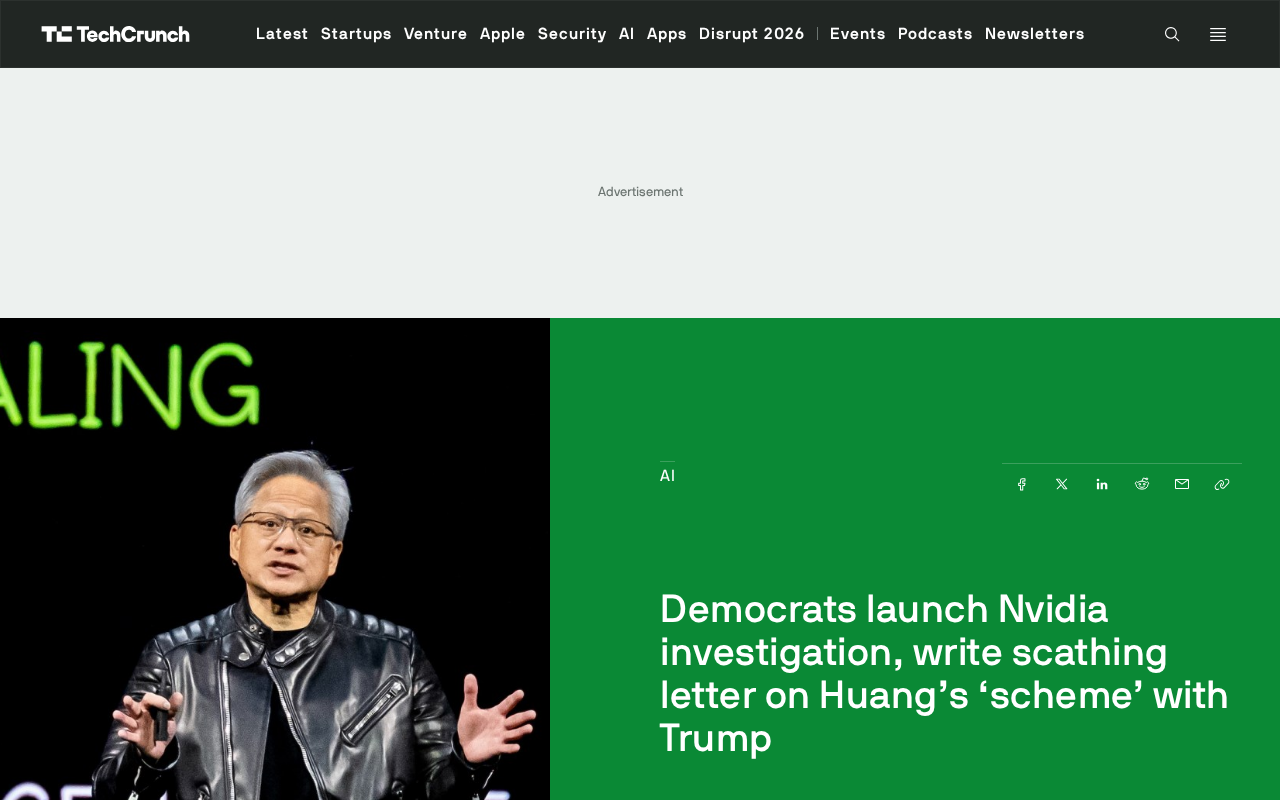
Democratic lawmakers investigate Nvidia for a second time, focusing on China sales and Jensen Huang's ties to Trump.
U.S. congressional Democrats have launched another investigation into Nvidia—the second since the so-called "spy affair" surfaced. A scathing letter alleges a "scheme" between CEO Jensen Huang and Trump, examining China sales alongside political connections. The article outlines two focal points: whether Nvidia's China business crosses export control red lines, and whether Huang's interactions with Trump's team influenced business decisions. Democrats' timing leverages the political momentum of the "spy affair" and carries partisan overtones. For Nvidia, consecutive investigations mean rising compliance costs and political risks, but without full details, the substantive impact remains to be seen.
Background: A Second Congressional Investigation
According to RSS sources, Democrats in the U.S. Congress have once again launched an investigation into Nvidia, focusing on its sales to China and the company's dealings with Trump. This marks the second congressional investigation into Nvidia since the exposure of the so-called "spy affair."
This investigation is led by Democratic lawmakers and is accompanied by a scathing letter that directly points to a "scheme" between Nvidia CEO Jensen Huang and Trump. Although the original report did not disclose the full text of the letter, the phrase "scathing letter" suggests deep dissatisfaction among Democrats with the interactions between Nvidia and Trump's team.
Interestingly, this is not the first time Nvidia has faced congressional scrutiny. A previous investigation centered on Nvidia's sales to China, and this new investigation expands its scope to include the relationship between Jensen Huang and Trump. The two consecutive investigations reflect continuing concern in U.S. political circles about Nvidia's role at the intersection of business and politics.
Focus of the Investigation: China Sales and Political Connections
Based on available information, this investigation involves at least two dimensions.
The China Sales Issue
Nvidia's sales to China have long been a sensitive topic of concern in the U.S. Congress. Although the original report did not provide specific sales figures or product models involved, given the context of the previous investigation, it can be inferred that lawmakers' core concern is whether Nvidia's China business touches upon U.S. export control or national security red lines.
The "Scheme" Between Jensen Huang and Trump
The word "scheme" used in the letter carries distinctly negative connotations, suggesting that Democrats believe there is some opaque arrangement or tacit understanding between Jensen Huang and Trump. The original report did not elaborate on the specific content of this "scheme," but by raising it alongside the China sales investigation, it appears Democrats may be attempting to link the two and construct a narrative of "business interests intertwined with political influence."
U.S. semiconductor export controls toward China constitute a multi-layered regulatory system. Since 2018, the Bureau of Industry and Security (BIS) of the U.S. Department of Commerce has gradually added specific chips, manufacturing equipment, and technologies to the control lists under the Export Administration Regulations (EAR), and has restricted purchases by specific Chinese companies through the "Entity List." In October 2022 and October 2023, BIS significantly tightened controls on exports of advanced computing chips to China twice, setting performance thresholds based on computing density and interconnect bandwidth. Nvidia specifically launched "downspec" special models that complied with these thresholds. Congress's role on this issue is primarily legislative and oversight-oriented: lawmakers can exert pressure by writing letters to companies, requesting Government Accountability Office (GAO) reviews, pushing new legislation, or holding hearings. Therefore, a "congressional investigation" differs in nature from judicial or administrative investigations—it is more of a political and public opinion tool with limited direct legal consequences, but it may influence subsequent legislative directions and regulatory agencies' enforcement priorities.
On the issue of chip controls toward China, there are policy differences between the Trump camp and the Biden administration. Around 2024, Trump and his advisors publicly criticized the subsidy model of the CHIPS and Science Act, advocating instead for tariffs and stricter technological decoupling; there were also discussions about relaxing some AI chip export restrictions in exchange for trade negotiation leverage. This policy uncertainty makes private contacts between corporate executives and Trump's team particularly sensitive—critics would question whether such contacts are aimed at obtaining regulatory leniency or favorable treatment on export licenses. Jensen Huang, as the head of a leading AI chip company, has always attracted attention for his interactions with political figures from both parties; in Washington's context, the word "scheme" typically implies undisclosed exchanges of interest or operations that circumvent normal procedures, but the term itself is an accusatory expression and does not equate to established fact.
Political Context: Why Now?
The timing of Democrats' decision to launch a second investigation at this moment is noteworthy. The original report mentioned that this investigation came after news of the "alleged spy affair" was exposed. Although the report did not elaborate on the details of that incident, the "spy affair" clearly provided political momentum for congressional action.
From a partisan perspective, a Democrat-led investigation combined with a letter related to Trump naturally carries connotations of political confrontation. As a core company in the global AI chip sector, any interaction between Nvidia's CEO and Trump is easily subjected to intense scrutiny. Jensen Huang has previously had contacts with the Trump administration in public settings, and Democrats clearly want to clarify whether these contacts influenced Nvidia's business decisions, particularly its China sales policies.
The "spy affair" was not elaborated upon in the original text, but within the narrative framework of U.S.-China tech competition, such allegations typically involve issues such as technology theft, supply chain infiltration, or personnel recruitment, and often become triggers for congressional hearings, legislation, and investigations. Historically, similar incidents have directly led to congressional actions targeting specific companies and heightened export controls. It is worth noting that the timing of congressional investigations is often highly correlated with political agendas: election cycles, partisan maneuvering, and key junctures in government policy toward China all influence when lawmakers choose to publicly send letters. Therefore, attributing the timing of the investigation solely to a single event may underestimate partisan political calculations; a more reasonable interpretation is that the incident provided a usable public rationale, while Democratic motivations also include competing with Republicans for influence over AI chip policy discourse.
Nvidia's Position and Industry Impact
For Nvidia, two consecutive congressional investigations mean rising compliance costs and political risks. As a key node in the AI chip supply chain, any adjustment to Nvidia's China business could affect downstream customers and partners.
From an industry perspective, the congressional investigation itself may not directly change Nvidia's operations, but the public opinion pressure and potential legislative follow-up may prompt Nvidia to be more cautious in external communications and business planning. Particularly against the backdrop of continuously tightening AI chip export controls, Nvidia needs to find a balance between commercial interests and political compliance, and this letter from Democrats undoubtedly makes that balance more difficult to achieve.
Unknowns and Follow-up Observations
Currently available information is quite limited. The original report only confirmed the launch of the investigation and the existence of the letter, without disclosing the specific content of the letter, details of the investigation's scope, or Nvidia's response.
Areas worth watching going forward include: whether Nvidia will make a public response to the investigation; whether Democrats will push for further hearings or legislative action; and whether subsequent developments in the "spy affair" will provide more material for the investigation. Until more information comes to light, judgment on the substantive impact of this investigation should remain cautious.
One-line Summary
Democratic lawmakers investigate Nvidia for a second time, focusing on China sales and Jensen Huang's connections to Trump.
Paragraph Summary
Democrats in the U.S. Congress have once again launched an investigation into Nvidia—the second congressional review since the exposure of the so-called "spy affair." The investigation is accompanied by a scathing letter that directly points to a "scheme" between CEO Jensen Huang and Trump, and examines the China sales issue alongside political connections. The article outlines two focal points of the investigation: whether Nvidia's China business crosses export control red lines, and whether interactions between Jensen Huang and Trump's team influenced business decisions. Democrats' timing leverages the political momentum of the "spy affair" while also carrying partisan confrontation overtones. For Nvidia, consecutive investigations mean rising compliance costs and political risks; however, the original report did not disclose the full letter or investigation details, so the substantive impact still requires cautious assessment.
Related articles
DevWorkflow 5.0: From Idea to Launch with the AI Five-Step Method
DevWorkflow 5.0 is a Claude Code plugin that uses a five-step process to take AI-assisted development from idea to launch. It asks you before every decision, preventing AI from adding tables and fields on its own, keeping docs and code consistent, and stopping merges before tests are written. Supports multiple platforms and languages, for individual developers and small teams.

How Do Hermes Agent's .md Files Work? A Breakdown of the Core Mechanism
Explaining Hermes Agent's .hermes directory mechanism: user.md stores personal info, memory.md records details worth remembering, soul.md defines the Agent's personality. Learn how these pure Markdown files keep the Agent consistent across sessions.

UN "Killer Robot" Talks Stall Again: Why Autonomous Weapons Regulation Is Hard to Break Through
UN Geneva talks on autonomous weapons ("killer robots") ended a week of consultations with little progress; delegates only agreed to "begin discussing options." This article analyzes the definitional disputes, conflicting security demands, and limits of multilateral mechanisms behind the stalemate.