DemoTV: A 24-Hour Product Demo Channel Ranked by Audience Votes
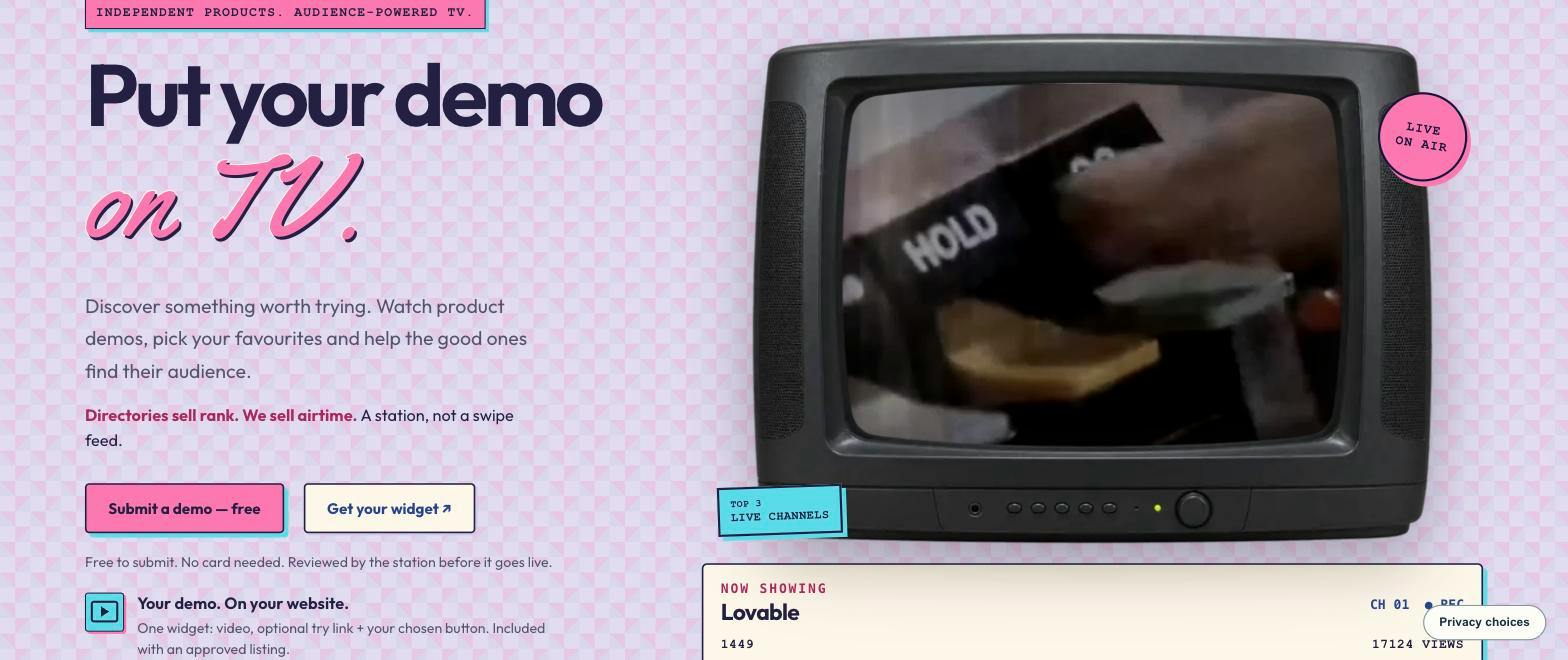
DemoTV uses Elo-based audience voting to rank product demos — money buys airtime, not position.
DemoTV is a new product discovery platform shaped like a 24-hour demo channel. Anyone can submit a demo for free; products compete in head-to-head Channel Battles judged by live viewers via an Elo scoring system, with the top three earning prime channel slots. Companies can buy clearly labeled airtime for exposure, but payment has zero influence on rankings. This mechanism directly addresses user frustration with pay-to-win discovery platforms and gives small teams a shot at the top based purely on product quality — though cold start, vote manipulation, and audience retention remain key hurdles to clear.
A Product Demo Platform Where Audiences Decide the Rankings
DemoTV is a new product that recently launched on Product Hunt, positioning itself as a "24-hour non-stop product demo channel." Unlike traditional ad placements or app stores, DemoTV's core mechanism is this: the rankings of product demos are determined by the viewers who are actually watching. This approach sets it apart from most marketing tools — and explains how it earned 92 upvotes and landed at #7 on the Product Hunt daily chart.
In short, anyone can submit a short product demo video for free. These demos then compete head-to-head in "Channel Battles." Viewers watch and vote for the products they'd genuinely want to try, and an Elo-style audience scoring system — the same algorithm used in chess rating — determines which products earn the coveted Channel 1, 2, and 3 spots.
"Money Buys Airtime, Not Rankings"
One of DemoTV's most noteworthy design principles is its strict separation between "paying" and "ranking." The platform is explicit: companies can purchase clearly labeled advertising airtime, and money can buy exposure, full views, and clicks — but it can never influence the rankings themselves.
This directly addresses a long-standing trust problem in digital advertising and product discovery platforms — users increasingly struggle to tell whether what they're seeing reflects genuine quality or the result of deep pockets. By completely decoupling paid traffic from algorithmic ranking, DemoTV aims to keep its rankings relatively pure: no matter how much you spend on ad slots, if viewers won't vote for your product, you won't make it to the top channels.
This model — where payment equals transparent labeling, and rankings belong to the audience — is essentially using mechanism design to maintain platform credibility. For users tired of having their feeds manipulated by algorithms and advertisers, it's a genuinely compelling value proposition.
The Clever Design Behind Elo Scoring
Choosing an Elo-style scoring system is one of DemoTV's smarter product design decisions. The Elo algorithm was originally developed for rating chess players, and works by dynamically adjusting each participant's score based on a series of head-to-head results — beating a stronger opponent earns more points, while losing to a weaker one costs more.
Applied to product demos, "Channel Battles" put two products directly against each other, with viewers voting to back one side. This head-to-head comparison reflects a product's real competitive strength more accurately than a simple star rating or like count — and is much harder to game. Because scores are relative and dynamic, a single product can't simply ride its own traffic to the top; it has to keep winning against other products in direct competition.
For product creators, the low barrier of free submission combined with purely audience-driven rankings means a small, unknown team theoretically has a shot at beating a well-funded competitor to the top channels — purely on the strength of their product.
The Elo system was invented in the 1960s by Hungarian-American physicist Arpad Elo, originally designed for chess rankings and later adopted by FIDE as its official rating standard. Its core formula calculates score gains and losses based on "expected win probability": beating a higher-rated opponent when you're rated lower earns far more points than beating someone at your level, while losing to a weaker opponent costs you disproportionately. This "expected value correction" mechanism makes scores converge to true skill levels much faster than simple cumulative scoring. In DemoTV's context, a newly submitted product starts with a low score but can climb rapidly with consistent wins — while a top-ranked product that starts losing to "weaker" entrants will see its ranking drop quickly. This creates ongoing competitive pressure and prevents early frontrunners from permanently locking up top channel positions.
Target Use Cases and Potential Challenges
DemoTV is categorized under marketing, advertising, and SaaS, and was built by Steffan Winstanley. It targets the massive and fiercely competitive market of product discovery. For founders, indie developers, and early-stage teams, it offers a channel to get seen by real users without relying on a massive ad budget.
That said, the mechanics still face some real-world challenges to work at scale. The first is the cold start problem: a platform driven by audience votes needs a critical mass of active viewers to produce meaningful rankings, but viewers are drawn by quality content — a classic chicken-and-egg dilemma. The second is vote manipulation: while the Elo mechanism is more resistant to gaming than simple likes, preventing organized fake voting remains an ongoing challenge for any crowdsourced ranking platform.
There's also the "24-hour TV channel" format itself — novel as it is, it asks viewers to invest passive watching time. Whether the "lean back and watch" experience of product discovery can be made engaging and sticky enough will directly determine whether the platform can retain its audience — and audience activity is the very foundation the entire ranking system depends on.
The product discovery market includes competitors like Product Hunt, AppSumo, and community-driven channels like Reddit and Hacker News. These platforms share a common pain point: as they scale, the line between genuine quality content and paid or gamed rankings blurs, eroding user trust. DemoTV's choice to use a "TV channel" format rather than a list is essentially using linear playback to reduce decision fatigue — viewers don't need to actively filter; they just sit down, watch, and vote in battles. This shares some logic with TikTok's algorithmic feed, but shifts the decision-making power from the algorithm back to human voters. Whether this format can build consistent viewing habits in today's hyper-fragmented attention economy is a critical variable in whether the platform can accumulate a stable audience base.
Summary
DemoTV's core innovation isn't technical — it's in mechanism design: replacing paid bidding with audience votes and Elo scoring, while preserving clearly labeled ad slots as a business model. This "rankings cannot be bought" transparency directly addresses widespread user frustration with the blurred line between advertising and genuine word-of-mouth.
Whether it grows into an influential product discovery platform depends on whether it can clear two key hurdles: building audience scale and preventing manipulation. But from a design philosophy standpoint, DemoTV offers a compelling new idea — letting the market (the audience), rather than capital, decide who deserves to be seen.
Related articles
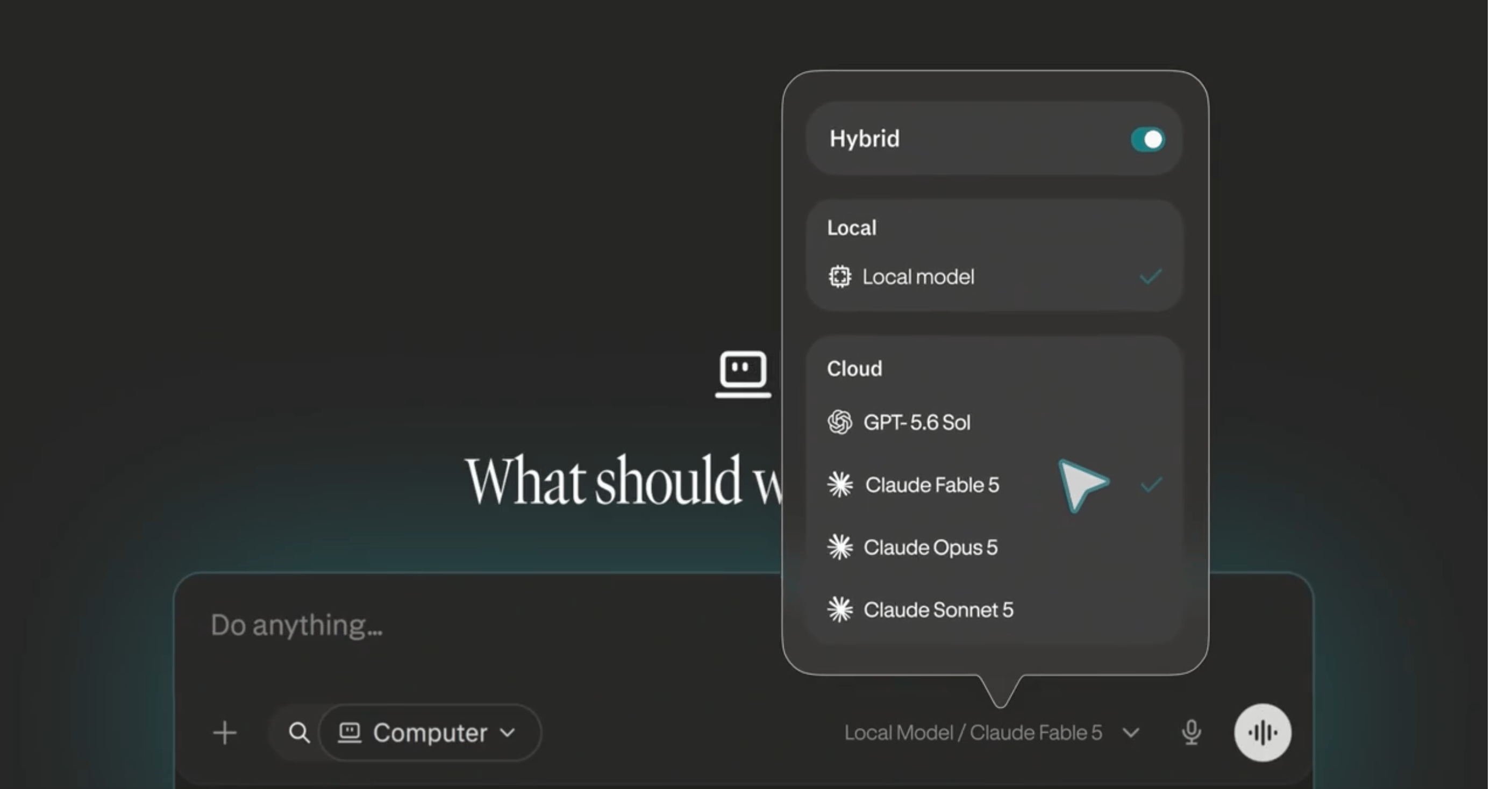
Perplexity Hybrid Compute: Cloud Research, Local Mac Privacy Protection
Perplexity's Hybrid Compute splits AI tasks by data sensitivity: cloud handles research, local Mac handles private files. Requires Apple Silicon, 24GB RAM, Pro/Max/Enterprise plan.
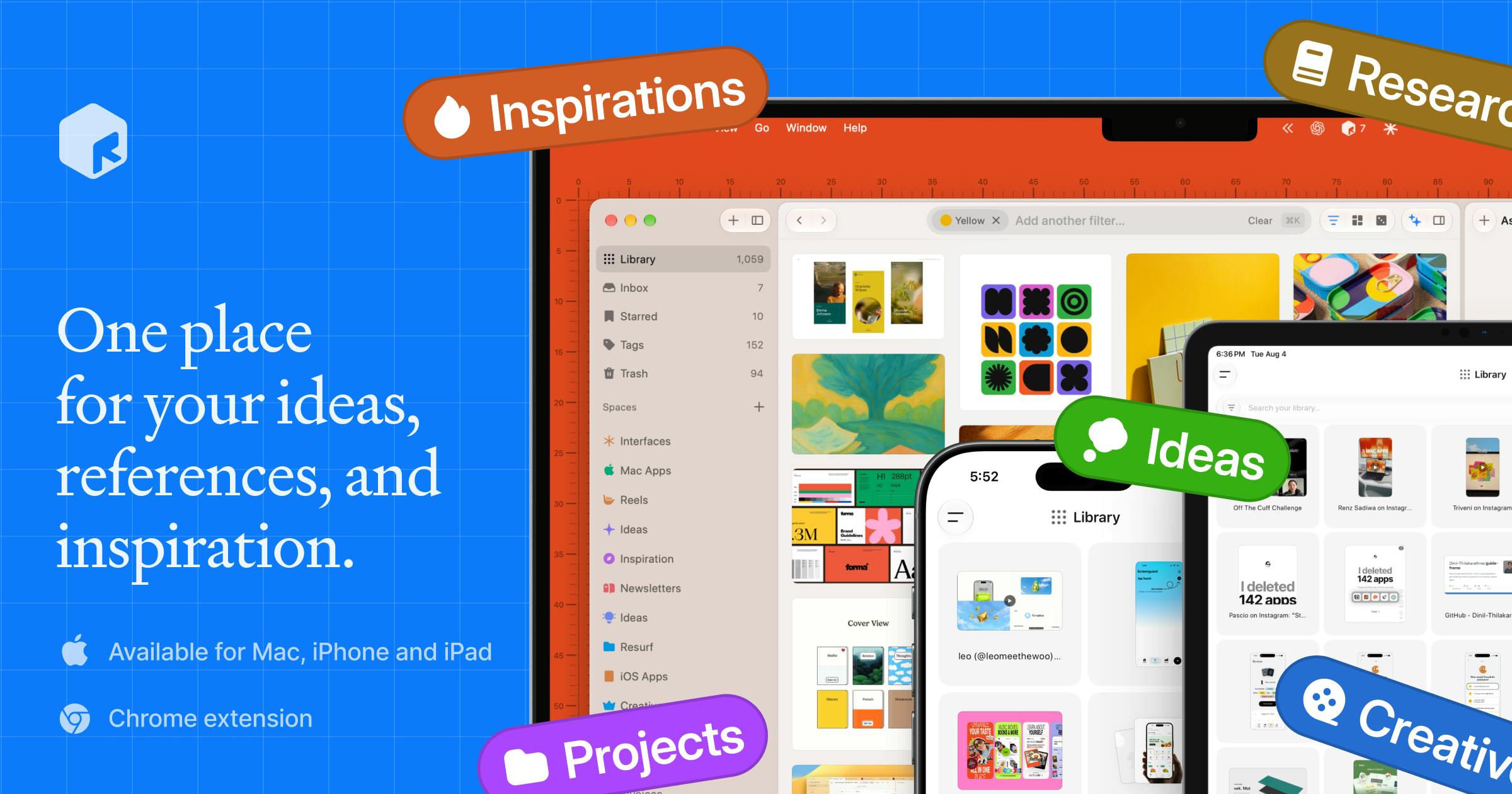
Resurf: The Personal Context Manager That Feeds Your Data to AI
Resurf is a personal context app for Apple devices that saves notes, links, images, and PDFs, then feeds them to AI via MCP and CLI. Local storage with iCloud sync keeps your data private.

Cognition Launches SWE-2 Coding Model: Near Top-Tier Performance at 64% Lower Cost
Cognition releases SWE-2, a coding model post-trained on Kimi K3 with RL. Scores 50% on FrontierCode, nearly matching Fable 5.1 at 64% lower cost and 1/4 the price of GPT-6 Astra.