Dense-Armor: A Safety Protection Python Library Built for AI and Robotics

Dense-Armor unifies online learning, drift detection, uncertainty estimation, and runtime protection in a Python library for safer AI and robotics.
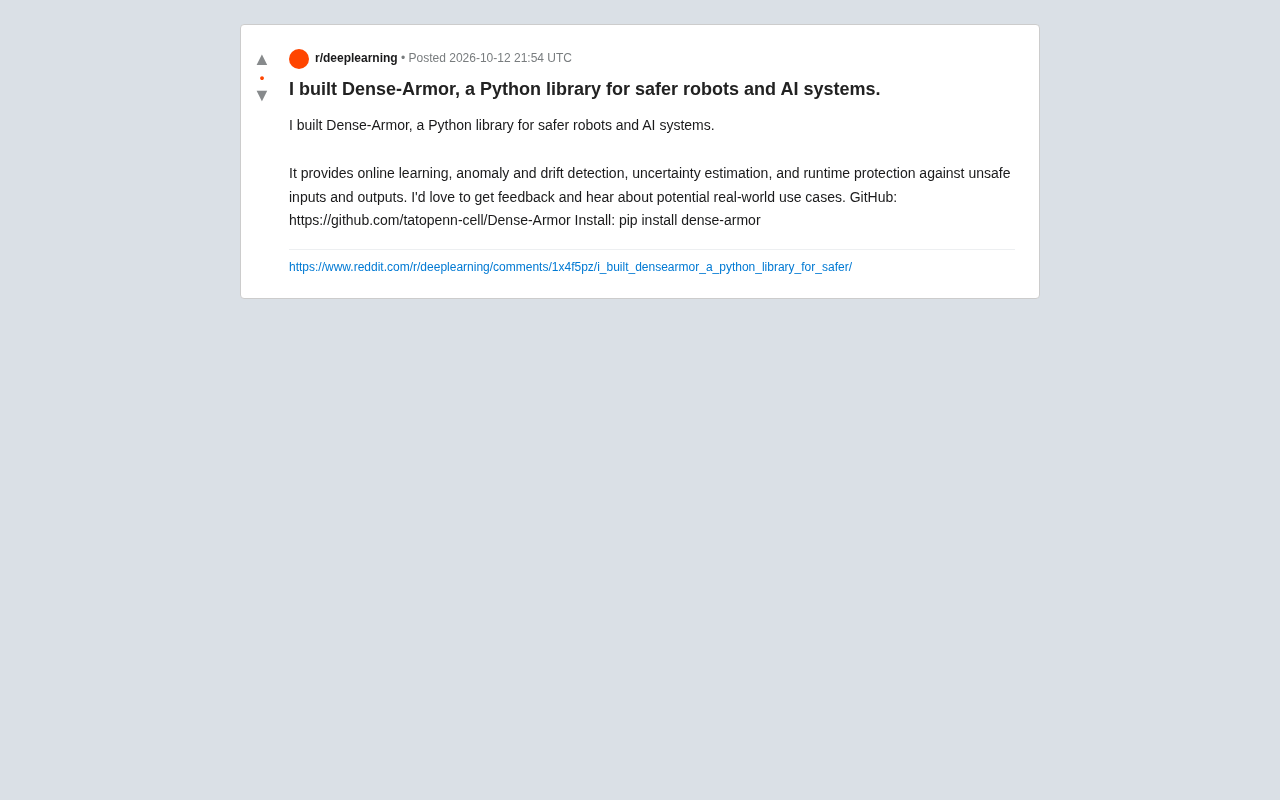
Dense-Armor is a Python safety library from the Reddit community, positioned to provide runtime protection for robots and AI systems. It integrates four core capabilities: online learning for post-deployment adaptation, anomaly and drift detection for monitoring data distribution shifts, uncertainty estimation for confidence-aware degradation decisions, and runtime protection for intercepting unsafe inputs and outputs. This "detect-decide-execute" closed loop distinguishes it from purely academic toolkits, bringing it closer to deployable safety middleware. Installable via pip with minimal setup, the project is still early-stage and lacks performance benchmarks and comparisons with frameworks like Guardrails AI and NeMo Guardrails. Its emergence reflects the industry trend of AI safety tools moving from scattered research code toward standardized integration.
As AI systems increasingly permeate the physical world, safety has shifted from an academic topic to a hard engineering constraint. Whether it's autonomous vehicles, industrial robotic arms, or large language models deployed in production environments, they all need a mechanism to identify anomalies, resist malicious inputs, and gracefully degrade under uncertainty. A Python library called Dense-Armor recently appeared in the Reddit community, attempting to address these issues with a unified interface.
One Library Solving Four Categories of Safety Problems
Dense-Armor's positioning is very clear: providing runtime safety protection for robots and AI systems. According to the author's description on GitHub, the library integrates four core capabilities—online learning, anomaly and drift detection, uncertainty estimation, and runtime protection against unsafe inputs and outputs.
These four capabilities aren't simply stacked together. Online learning allows models to continuously adapt to new data after deployment, rather than relying on static weights from offline training. Anomaly and drift detection monitors changes in data distribution and raises alarms when inputs deviate from the training distribution. Uncertainty estimation attaches confidence information to model outputs, helping upper-layer systems judge whether current predictions are trustworthy. Runtime protection is the last line of defense, directly intercepting unsafe inputs or outputs.
Installation is minimal: pip install dense-armor, with source code hosted on GitHub. This low-barrier distribution strategy reduces the cost for developers to try and integrate it.
Why Online Learning and Drift Detection Are Critical for AI Safety
Traditional AI safety solutions often rely on offline evaluation and static rules, but real-world data distributions are constantly changing. A vision model that performs perfectly in a laboratory environment may produce catastrophic misjudgments in a field environment with different lighting conditions and aging sensors.
The value of drift detection lies in its ability to issue early warnings before model performance actually degrades. Combined with online learning capabilities, systems can gradually adjust their own behavior during operation, rather than waiting for the next firmware update. For robotic systems, this adaptive capability is directly tied to physical safety—a robotic arm that cannot recognize its own state anomalies could cause personnel injury or equipment damage.
Uncertainty estimation provides protection from another dimension. When a model gives low-confidence predictions for a certain input, the system can choose to pause operations, request human intervention, or switch to a more conservative strategy. This mechanism is especially critical in medical AI and autonomous driving.
Concept Drift is a key prerequisite for understanding drift detection. It refers to the mapping relationship between input data and target labels changing over time, rather than merely a change in input distribution (the latter is called Data Drift). For example, for a model used to predict equipment failures, after equipment aging, the same vibration spectrum may correspond to completely different failure types—this is concept drift. Concept drift is typically divided into three categories: sudden (such as policy changes causing abrupt user behavior shifts), gradual (such as slow equipment wear), and periodic (such as seasonal changes). Drift detection algorithms generally monitor these changes through statistical tests (such as ADWIN, Page-Hinkley test) or distribution distance metrics (such as KL divergence, Wasserstein distance). Whether a system can distinguish data drift from concept drift directly determines whether it should trigger retraining or merely adjust input preprocessing.
Runtime Protection: The Last Line of Defense for AI Safety
Runtime protection is a distinctive feature that sets Dense-Armor apart from many academic toolkits. Most safety research stays at the detection and alerting level, but actually deployed systems need the ability to actively block dangerous behavior.
Imagine a scenario: an LLM-based customer service system receives a carefully crafted prompt injection attack attempting to induce the model to output sensitive information. Runtime protection can intercept and filter before the output reaches the user. Similarly, for robotic systems, if sensor data indicates an imminent collision, the protection layer can directly override control commands and execute an emergency stop.
This "detect-decide-execute" closed-loop design makes Dense-Armor closer to deployable safety middleware rather than a mere research prototype.
Uncertainty Estimation in deep learning is typically divided into two categories: Epistemic Uncertainty and Aleatoric Uncertainty. Epistemic uncertainty stems from the model lacking sufficient training experience with the current input and can be reduced by adding data; aleatoric uncertainty comes from noise in the data itself and cannot be eliminated with more data. Common implementation methods include Monte Carlo Dropout (enabling Dropout multiple times during inference and taking prediction variance), deep ensembles (training multiple models and comparing output differences), and Bayesian neural networks. These methods provide quantitative basis for the "detect-decide-execute" closed loop—only when uncertainty exceeds a preset threshold can the system reliably trigger actions such as rejection, degradation, or human takeover, rather than relying on arbitrary empirical values.
Developer Community Response and Potential Application Scenarios
When the author posted on Reddit, they explicitly expressed a desire for feedback and to learn about actual use cases. This open attitude is especially important in the open-source safety tool space, because safety requirements are highly dependent on specific application scenarios.
From a tech stack perspective, Dense-Armor's potential application scenarios are quite broad. In industrial automation, it can serve as a safety layer between PLCs and upper-layer AI systems. In service robotics, it can monitor anomalous behavior during human-robot interaction. In AI content generation, it can serve as part of output filtering and risk control.
However, the library is still in its early stages. The author has not yet published detailed performance benchmarks, supported model types, or comparison data with other safety frameworks (such as Guardrails AI or NVIDIA's NeMo Guardrails). The absence of this information means developers need to evaluate its applicability in specific scenarios themselves.
The article mentions Guardrails AI and NVIDIA NeMo Guardrails, two AI safety frameworks commonly compared. Guardrails AI primarily targets output validation for large language models, defining output formats, content boundaries, and risk categories through declarative rules (RAIL specifications), supporting real-time validation and correction of generated results. NeMo Guardrails focuses on controllability of dialogue flows, using Colang to model dialogue state machines, constraining LLM behavior trajectories in multi-turn conversations, and preventing topic drift and jailbreaking. What both share is a focus on software-layer input-output constraints, while Dense-Armor, if it can truly cover online learning and uncertainty estimation at the robotic physical layer, would have a differentiated positioning leaning more toward "embodied AI safety" rather than a mere text safety gateway. Understanding this distinction helps developers judge Dense-Armor's actual position in their own tech stack.
Fragmentation and Integration Trends in the Safety Tool Ecosystem
Dense-Armor's emergence reflects a larger trend: AI safety tools are moving from scattered research code toward standardized libraries and frameworks. Over the past few years, we've seen the emergence of LangChain's safety modules, OWASP's LLM Top 10, and various model evaluation tools.
But fragmentation also brings problems. Developers need to switch between multiple tools and maintain different configurations and interfaces. Dense-Armor attempts to cover multiple safety dimensions with a unified package, and if this integration approach can mature, it will significantly reduce the complexity of AI safety integration.
Of course, whether a library can truly solve safety problems depends on the robustness of its implementation and sustained community maintenance. For interested developers, the author has opened source code and an issue discussion area on GitHub, which is the best entry point for evaluating its actual value.
One-line Summary
Dense-Armor integrates online learning, drift detection, uncertainty estimation, and runtime protection into a unified Python library, attempting to provide deployable safety middleware for robots and AI systems.
Paragraph Summary
Dense-Armor is a Python safety library that recently appeared in the Reddit community, positioned to provide runtime protection for robots and AI systems. It integrates four core capabilities: online learning enables models to continuously adapt to new data after deployment, anomaly and drift detection monitors data distribution changes and provides early warnings, uncertainty estimation attaches confidence to predictions to support degradation decisions, and runtime protection directly intercepts unsafe inputs and outputs. The article emphasizes that this "detect-decide-execute" closed loop distinguishes it from purely academic toolkits, bringing it closer to deployable safety middleware. The library can be installed with a single pip command, lowering the barrier to trial. However, the project is still in its early stages, lacking performance benchmarks and comparison data with frameworks like Guardrails AI and NeMo Guardrails. Its emergence also reflects the industry trend of AI safety tools moving from scattered research code toward standardized integration.
Related articles

Random Pruning of the DPO Computation Graph: 1.4x Training Speedup and Lower Peak Memory
DPO training too slow and memory-hungry? This paper proposes a random pruning framework for the DPO computation graph, sampling independently across position, sequence, and branch dimensions; branch pruning achieves a 1.426x step-time speedup and cuts training time by about 30%, with in-depth attribution of memory and time gains.

Why Does JEPA Underperform MLM in Longitudinal EHR Representation Learning?
New study compares JEPA and MLM for longitudinal EHR representation learning on MIMIC-IV: three JEPA variants train stably without collapse but underperform MLM; target size, not heterogeneity, drives prediction error.

Transfer Learning + Visible Light Communication: A New Approach to Energy-Efficient Indoor Positioning
A study proposes a transfer learning-based visible light communication indoor positioning method, achieving 47% accuracy improvement on the BOSCH factory dataset, 67.5% model efficiency under high noise, and introducing the ME composite metric for energy-efficient positioning in energy-constrained industrial IoT scenarios.