Dense Retrievers Have a 'Search-by-Answer' Bias: Why They Favor Known Answers
Study finds eight dense retrievers exhibit search-by-answer bias, prioritizing known answers over valid evidence.
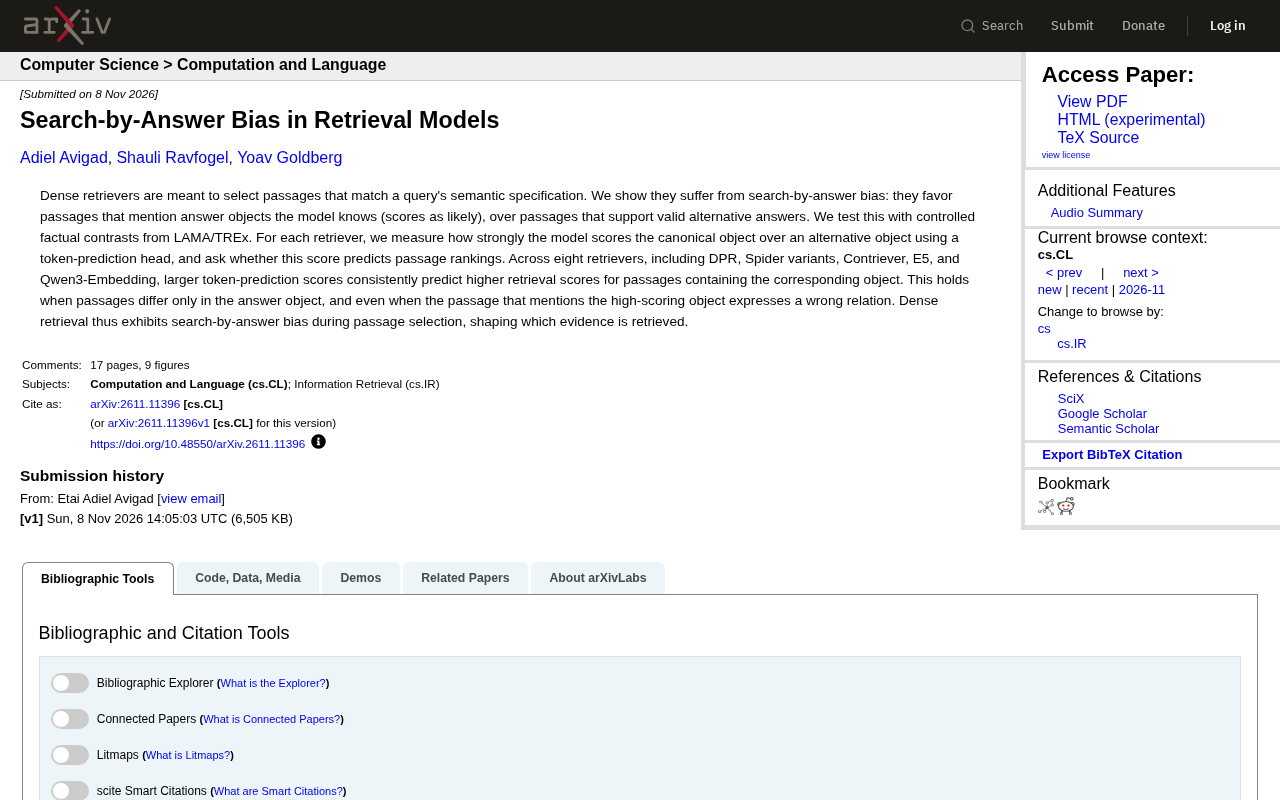
A recent study reveals that dense retrievers exhibit a systematic 'search-by-answer bias': they tend to select passages containing answer objects the model knows with high confidence, rather than passages that genuinely support query semantics. Using LAMA/TREx to build controlled factual contrast samples, the team measured answer-object scores via each retriever's token prediction head. Across eight mainstream retrievers—DPR, Spider variants, Contriever, E5, and Qwen3-Embedding—results consistently show higher-scoring answer objects yield higher passage rankings, even for incorrect relations. The bias stems from pretraining knowledge seeping into contrastive-learning similarity computation, undermining RAG evidence diversity and fairness; researchers call for diversity constraints and adversarial training as debiasing strategies.
Introduction: When Retrievers Start 'Guessing the Answer'
Dense retrievers are supposed to select passages that match the semantics of a query, but a recent study reveals a troubling phenomenon: they exhibit a search-by-answer bias—the model preferentially selects passages that contain answer objects it 'knows,' rather than passages that genuinely support other valid answers. This means the retrieval process may be distorted by the model's internal knowledge preferences instead of faithfully reflecting textual evidence.

The study systematically demonstrates the prevalence of this bias across eight mainstream retrieval models through controlled factual contrast experiments, including DPR, Spider variants, Contriever, E5, and Qwen3-Embedding.
Dense retrievers are a class of retrieval models that encode queries and document passages into dense vectors separately and match them via vector similarity (such as inner product or cosine similarity). Unlike sparse retrieval based on keyword matching (e.g., BM25), dense retrievers rely on pretrained language models (such as BERT and Contriever) to learn semantic representations, enabling them to capture semantic relevance between queries and passages. DPR (Dense Passage Retrieval) is a representative work in this paradigm, using a dual-tower architecture to encode questions and passages separately and training via contrastive learning. Subsequent models such as Contriever and E5 further improved training strategies and pretraining objectives, while Qwen3-Embedding represents a new trend of integrating large language model capabilities into embedding models. What these models share is that their vector representations implicitly encode the broad knowledge accumulated during pretraining—laying the groundwork for knowledge bias to infiltrate the retrieval process.
Experimental Design: How to Measure 'Search-by-Answer' Bias
The research team constructed controlled factual contrast samples from the LAMA/TREx dataset. For each query, they used the retrieval model's own token prediction head to compute the model's prediction scores for the 'canonical answer object' versus 'alternative answer objects,' and observed how these scores affected passage ranking.
The core question is: Can the model's prediction confidence for an answer object predict the ranking of passages containing that object? The answer is yes. Experimental results show that objects with higher token prediction scores correspond to passages with higher retrieval scores, and this pattern holds consistently across all eight retrievers.
Key Finding: Answer Objects Dominate Ranking
Even when the only difference between two passages is the answer object, the retriever still favors the passage containing the model's internally high-scoring answer. More concerning still, this preference persists even when the passage containing the high-scoring answer expresses an incorrect relation—the retriever seems more focused on 'whether the answer object is familiar' than on 'whether the relation holds.'
LAMA (Language Model Analysis) and TREx are standard datasets for probing language models' factual knowledge. LAMA converts facts from knowledge bases (such as 'Paris is the capital of France') into cloze-style queries (such as 'The capital of France is [MASK]') and uses the model's prediction head to assess its grasp of these facts. TREx is a subset of LAMA, automatically constructed by extracting fact triples from Wikipedia. In this study, these datasets were creatively used to construct controlled contrast samples: by substituting the answer object in a query (e.g., replacing 'Paris' with 'Lyon'), researchers could precisely control the only difference between passages, thereby isolating the influence of the model's internal knowledge preferences on retrieval ranking. This experimental design cleverly combines knowledge probing with retrieval evaluation, making 'search-by-answer bias' quantifiable.
Roots and Impact of the Bias
This bias stems from how dense retrievers are trained: they typically map queries and passages into the same vector space through contrastive learning, and knowledge accumulated during pretraining seeps into similarity computation. When a query involves factual questions, the model unconsciously assigns higher implicit scores to 'answers it knows,' distorting retrieval results.
The practical impact is significant: in open-domain question answering, fact-checking, and similar scenarios, retrievers are supposed to provide diverse evidence support, but search-by-answer bias may cause systems to recall only passages that 'fit the model's priors' while ignoring equally valid or even more reliable alternative evidence. This undermines the fairness and robustness of retrieval-augmented generation (RAG) systems.
Contrastive learning is the core paradigm for training dense retrievers; its basic idea is to bring queries and positive passages closer in vector space while pushing negative passages away. Typical training objectives (such as the InfoNCE loss) optimize the model by maximizing the similarity of positive pairs and minimizing that of negative pairs. However, knowledge learned by pretrained language models from large amounts of text is solidified in the encoder's parameters, and this knowledge is not 'forgotten' during contrastive learning—it may instead seep into retrieval decisions through similarity computation. For example, when a query involves a certain entity, the encoder's internal representation of that entity may already carry associations with its common answer objects, causing passages containing those answer objects to receive higher similarity scores. This knowledge seepage is especially insidious when retrievers are fine-tuned using only query-passage relevance signals, because the model is never explicitly told to ignore its internal knowledge.
Implications for Retrieval-Augmented Generation
For AI applications that rely on external knowledge retrieval, this study sounds an alarm. Developers need to recognize that retriever rankings are not neutral—they may already be contaminated by the model's internal knowledge preferences. When building RAG pipelines, consider introducing diversity constraints, adversarial training, or explicit debiasing strategies to ensure that retrieved evidence genuinely serves the query's semantics rather than the model's 'comfort zone.'
The research team emphasizes that search-by-answer bias is a systematic feature of dense retrieval at the passage selection stage, determining which evidence is ultimately presented to downstream models. Understanding and mitigating this bias is a key step toward improving the trustworthiness of retrieval systems.
Retrieval-augmented generation (RAG) is a technical architecture that combines external knowledge retrieval with large language model generation. In a typical RAG pipeline, the retriever first recalls passages relevant to the user query from a large document corpus, then feeds these passages as context to the generative model to produce evidence-based answers. RAG's core advantage is its ability to mitigate knowledge staleness and hallucination in large models, but this advantage presupposes that the retriever can fairly and comprehensively recall relevant evidence. If the retriever has a search-by-answer bias, downstream generative models will only see a 'narrowed' evidence set filtered by the bias, which may not only reduce answer accuracy but also reinforce the model's existing erroneous priors. Therefore, debiasing retrievers is crucial for RAG system trustworthiness; strategies such as diversity constraints and adversarial training proposed by researchers aim to break the inappropriate coupling between the model's internal knowledge and retrieval ranking.
One-line Summary
Study finds eight dense retrievers exhibit search-by-answer bias, preferentially recalling known answers over valid evidence.
Paragraph Summary
A recent study reveals that dense retrievers exhibit a systematic 'search-by-answer bias': they tend to select passages containing answer objects with high internal confidence rather than passages that genuinely support query semantics. The research team used the LAMA/TREx dataset to construct controlled factual contrast samples, computed answer object scores via the retrieval models' token prediction heads, and observed their effects on passage ranking. Experiments covering eight mainstream retrievers—including DPR, Spider variants, Contriever, E5, and Qwen3-Embedding—consistently show that the higher an answer object's prediction score, the higher its passage's retrieval ranking, even when the passage expresses an incorrect relation. This bias stems from pretraining knowledge seeping into contrastive learning's similarity computation and undermines the diversity and fairness of evidence recalled by RAG systems. Researchers call for debiasing strategies such as diversity constraints and adversarial training.
Related articles

Daybreak Red Deployment Guide: A Reference Architecture for Supervised Security Investigation
A breakdown of the Daybreak Red reference architecture: security control design, deployment configuration process, and runtime monitoring for supervised security investigation.

Gemini 4 Neon Tops the Models Engineering Index
Gemini 4 Neon tops the Models Engineering Index, sparking Hacker News debate over ranking credibility and evaluation methods. Here's what it means for developers.

Apple's Self-Developed AI Agent: An Agent That Can Operate Your Mac Is Coming
Apple is reportedly developing an AI agent that can operate a Mac, targeting Meta Muse, Claude, OpenAI Dots, and others. This article analyzes Apple's system-level advantages, the competitive landscape, and likely rollout paths in the agent race.