Depost AI: The LinkedIn Brand Content Agent That Learns

Depost AI benchmarks against your account's own history to provide a learning AI closed loop for LinkedIn content operations.
Depost AI ranked second on Product Hunt. Its core idea is to score published LinkedIn posts first, then generate content—using the account's own historical average as the benchmark rather than industry templates. It covers monthly planning, tone-matched copywriting, visual design, publishing via the LinkedIn official API after human confirmation, and post-publish reply drafting that extends posting into engagement and lead conversion. The product supports MCP for use in Claude and ChatGPT, not just its own app. The article notes its learning effectiveness depends heavily on historical content volume—new or sparse accounts may lack sufficient samples—and tone/visual consistency still needs human oversight. It's best suited for brands and B2B marketing teams with existing content accumulation and a need for stable output.
The Pain Point of LinkedIn Content Operations
The pain point of LinkedIn content operations is clear: posting frequently doesn't guarantee results, viral hits are hard to replicate, and once you've written something you still need to design visuals, monitor metrics, and respond to comments. Depost AI, ranked second on Product Hunt, attempts to run this entire chain through a learning AI agent—using your brand's own historical performance as the benchmark rather than applying generic templates.
What Problem Is It Actually Solving
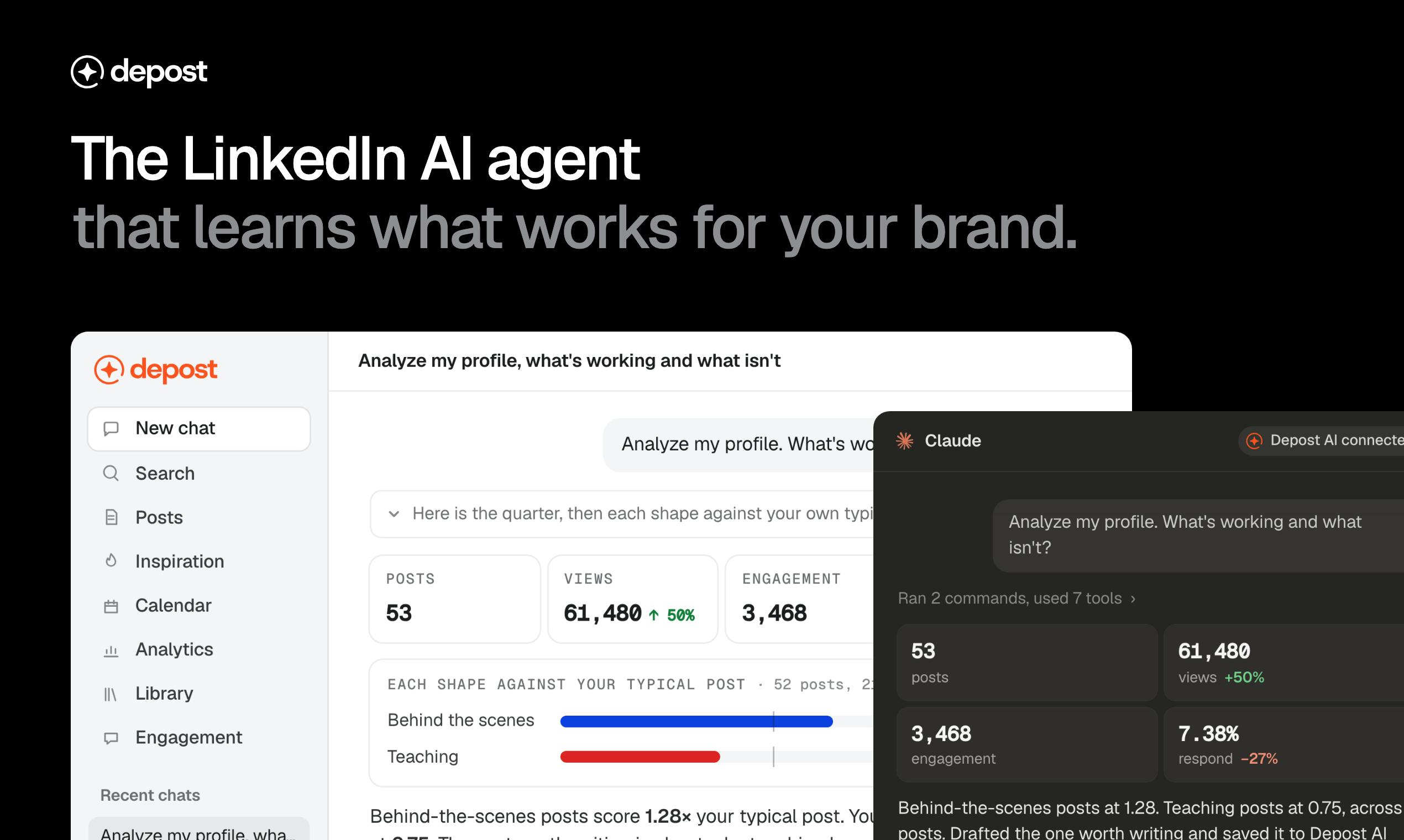
According to the Product Hunt product page, Depost AI's core approach is to "score" first, then "produce": it scores every LinkedIn post you've already published against your own average, while also scanning for content in your niche that is currently outperforming. This sequence is critical—most AI writing tools offer industry-wide best practices, but Depost AI swaps the judgment benchmark to the account's own historical data, with winners and losers measured on the same coordinate system.
This creates a practical difference: judging "what counts as good" no longer relies on abstract platform-level metrics, but on "better than what you normally write." For brand accounts, this relative benchmark is often more instructive than an absolute one.
The repeatedly mentioned "relative benchmark" and "absolute benchmark" are key to understanding the product's positioning. Absolute benchmarks refer to platform-wide metrics, such as industry averages for likes and impressions or so-called best practices; their advantage is cross-account comparability, but they don't account for differences in account size and audience. Relative benchmarks use the account's own historical distribution as reference, measuring a post's performance relative to that account's average level, and typically require a certain amount of historical samples to calculate a meaningful distribution. Relative benchmarks filter out bias caused by an account's inherent scale and are better suited for judging "is this content good or bad for me," but their statistical reliability is directly affected by sample size—which explains why the article later emphasizes the limitations of new accounts.
The Closed Loop from Topic Selection to Publishing
The capability chain listed in the product description is quite complete: it helps you plan a full month of content, writes copy in your tone, designs visuals, and every piece requires your confirmation before publishing via the LinkedIn official API. After publishing, it also drafts replies for conversations worth participating in, extending "posting" into "engagement," with the goal pointing toward lead conversion.
Two design choices in this chain are worth noting. First, the human confirmation step is preserved—the AI doesn't publish content on your behalf directly, which is necessary risk control for brand accounts. Second, it uses the official API rather than automation scripts, which is a more prudent path for product compliance.
MCP Integration: Not Just for Its Own App
Another differentiator for Depost AI is its support for MCP—it can be used within Claude and ChatGPT, not limited to its own application. This means content teams can embed LinkedIn content production into their existing AI workflows rather than opening yet another tool tab. MCP is becoming the de facto interface for AI tool interoperability, and by laying entry points into mainstream conversational products, Depost AI makes a pragmatic judgment about distribution channels.
MCP (Model Context Protocol) is an open protocol proposed by Anthropic in late 2024, designed to provide large language models with a unified way to connect to external tools and data sources. Before this, AI applications integrating third-party services (such as APIs for publishing LinkedIn posts) typically required writing separate adaptation layers for each model and each client; MCP standardizes this adaptation layer, so tool providers only need to implement an MCP server once, and clients supporting the protocol—such as Claude and ChatGPT—can call it directly. It's often compared to "the USB-C port of the AI world." For content tools, this means products don't have to be tied to a single chat interface and can expose themselves as a capability within users' existing conversational workflows—this is also the technical foundation for the "distribution channels" judgment mentioned in the article.
Key Judgment Points Worth Noting
With 123 votes, 18 comments, and a second-place ranking on Product Hunt for the day, it clearly hit a need—but the real watershed for such tools lies in data quality. Depost AI's "learning" effectiveness depends heavily on the quantity and quality of an account's historical posts: for new accounts or accounts that post sparsely, samples are insufficient to support reliable content attribution, and the credibility of scoring and predictions will be compromised.
Additionally, the two capabilities of "writing in your tone" and "designing visuals" often perform impressively in demos, but consistency with actual brand tone still requires human oversight in practice. Treating it as an assistant that saves time on drafts and scheduling is more realistic than treating it as a fully managed content team.
Who Should Try It
For brands and B2B marketing teams that already have some LinkedIn content accumulated and need a stable production cadence, Depost AI's value lies in compressing "review—plan—create—publish—engage" into a single workflow. For accounts just starting out with thin historical data, it's advisable to manually accumulate a period of publishing records first before letting the tool intervene in learning.
Teams wanting to try it out can learn about integration options from the product page, focusing on validating two things: whether its scoring of your historical posts aligns with your own judgment, and how well the generated content captures your tone. These two points determine whether it's ultimately a time-saving tool or a burden requiring repeated revisions.
One-line Summary
Depost AI uses an account's own historical performance as its benchmark, providing a learning AI closed loop for LinkedIn content operations.
Paragraph Summary
Depost AI ranked second on Product Hunt, with its core idea being to first score already-published LinkedIn posts, then generate content—using the account's own historical average as the scoring benchmark rather than industry-standard templates. It covers monthly planning, tone-matched copywriting, visual design, publishing via the LinkedIn official API after human confirmation, and drafting conversation replies after publishing, extending posting into engagement and lead conversion. The product supports MCP and can be used within Claude and ChatGPT, not limited to its own app. The article notes that its learning effectiveness depends heavily on the volume of an account's historical content; new or sparsely-posting accounts may have insufficient samples affecting credibility. Tone reproduction and visual consistency still require human oversight, making it better suited for brands and B2B marketing teams with existing content accumulation and a need for stable output.
Related articles

A 19-Year-Old's Rental Horror Story: Ceiling Collapse, Bug Infestation, and the Lessons It Taught Me
At 19, my first off-campus rental brought bug infestations, no heat, a collapsed ceiling, and a ruined laptop with no renter's insurance. Here are the hard-won lessons for first-time student renters.

Veda Nurse's Cranial Nerve Exam: Why ASMR Role-Play Is Going Viral
Bilibili creator Veda's cranial nerve exam ASMR video goes viral, blending humor and sensory triggers through nurse role-play. This article analyzes its unique appeal and the audience psychology behind ASMR role-play.

LG Cinebeam AI Review: 120-Inch Giant Screen + 3000 Lumens, a New Choice for the Living Room Theater
LG Cinebeam AI projector review: 3000 ANSI lumens, 4K, 100 inches from about 8 cm and 120 inches from about 18 cm. Built-in webOS, AI Concierge voice recommendations, AI Sound Pro 11.1.2 virtual surround, and Game Optimizer—positioned for fixed living room installation, complementing the portable Cinebeam S.