Depth and Data Size of Quantum Classifiers: Why Joint Optimization Fails

Experiments find no predictable scaling law between adaptive quantum circuit growth and training data size, with a valid but very weak generalization bound.
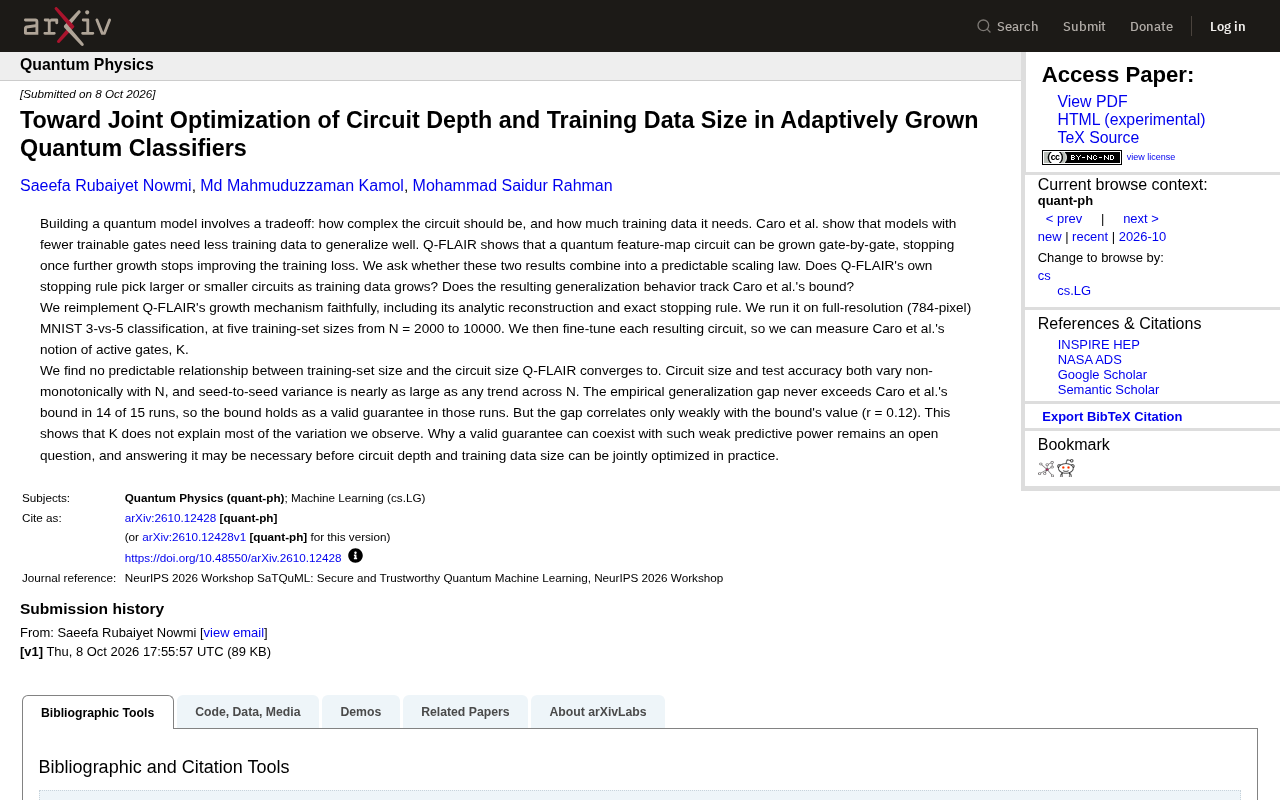
The study reproduces Q-FLAIR adaptive growth on full-resolution MNIST 3-vs-5 with training sizes N=2000 to 10000 and cross-validates with Caro et al.'s generalization bound. It finds no predictable relationship between training set size and final circuit size, non-monotonic changes in circuit size and test accuracy with N, and seed variance almost as large as trends across N. Caro's bound holds in 14 of 15 runs, but its correlation with the actual generalization gap is only r=0.12, indicating very weak predictive power and revealing a gap between theoretical bounds and practical design decisions.
Quantum machine learning is often viewed with high expectations, yet a core tension has always persisted: the more complex the circuit, the stronger its expressivity—but the greater the amount of training data needed to avoid overfitting. Caro et al. provided a theoretical bound: the fewer trainable gates, the less data required for generalization. Q-FLAIR offers an adaptive scheme: letting a quantum feature map circuit grow gate by gate until the training loss stops decreasing.
These two results appear to fit together: use Q-FLAIR to automatically find a suitable circuit size, then use Caro's bound to predict generalization behavior. But a recent study, through a complete reproduction experiment, found that things are far from that simple.
The Intersection of Two Existing Results
The study starts from two published results. According to Caro et al.'s work, there is a trade-off between the number of trainable gates (active gates, denoted K) in a quantum model and the amount of training data needed for generalization: fewer gates mean lower data requirements. This conclusion provides a theoretical basis for circuit design.
Another thread comes from Q-FLAIR. This method allows a quantum feature map circuit to grow gate by gate, checking at each step whether the training loss improves, and stopping once growth no longer yields gains. In other words, it comes with a built-in stopping rule to determine the circuit's final size.
The researchers posed the question: if these two results are combined, can a predictable scaling law be obtained? As the amount of training data N increases, will Q-FLAIR converge to a larger or smaller circuit? Does the resulting generalization performance follow the bound given by Caro et al.?
Generalization gap is a key concept for understanding the experimental metrics in this paper. It is typically defined as the difference between the model's empirical error on the training set and its true error on unseen test data. The smaller the generalization gap, the stronger the model's ability to transfer from training data to new data; an overly large gap implies overfitting. In quantum machine learning, because the number of trainable parameters, circuit entanglement structure, and measurement noise all interact, estimating the generalization gap is often more complex than for classical models. The theoretical bound given by Caro et al. is precisely an upper-bound guarantee on this gap: given a number of trainable gates K and a training sample size N, the generalization gap does not exceed some quantity related to K/N with high probability. This paper's experiments examine whether this bound holds by using the number of active gates after fine-tuning, and further investigate whether the bound value itself can predict the actually observed gap magnitude.
Reproduction Experiment: From MNIST to Five Data Scales
To answer the above questions, the research team faithfully reproduced the Q-FLAIR growth mechanism, including its analytical reconstruction and exact stopping rule. The experimental task was binary classification of 3 versus 5 on the full-resolution (784 pixels) MNIST dataset.
Five training set sizes were set, with N from 2000 to 10000. For each converged circuit, the researchers also performed fine-tuning in order to measure the number of active gates K as defined by Caro et al. This design allows circuit size, test accuracy, generalization gap, and theoretical bound to be compared within the same framework.
No Predictable Scaling Law
The experimental results did not match expectations. The researchers found that there is no predictable relationship between training set size and the circuit size to which Q-FLAIR eventually converges.
Both circuit size and test accuracy vary non-monotonically with N—an increase in data volume does not necessarily lead to a larger or smaller circuit, nor does accuracy rise steadily with it. More crucially, the variance across different random seeds is almost as large as any trend across N. This means that even if some pattern is observed, it may just be random fluctuation.
This finding poses a direct challenge to the intuition that "adaptive growth can automatically match data volume." Q-FLAIR's stopping rule does not exhibit a systematic response when data volume changes.
Random seed variance is of particular importance in quantum machine learning experiments. Quantum circuit training involves multiple sources of randomness, including parameter initialization, data sampling order, optimizer stochasticity, and even hardware noise. When differences in final circuit size or test accuracy caused by different random seeds are of the same order of magnitude as the effects produced by changing the training set size N, any conclusion about "how the circuit changes as N increases" lacks statistical significance. This paper's emphasis that "the variance is almost as large as any trend across N" is in effect pointing out that in quantum training scenarios with limited sample sizes and numerous sources of randomness, it is very difficult to distinguish a true trend from noise based on average results from only a few values of N. This also explains why the researchers used 15 runs to evaluate the frequency with which the bound holds, rather than relying on a single experiment.
Valid Bound Coexists with Weak Predictive Power
Caro et al.'s generalization bound itself still holds in the experiments. In 14 out of 15 runs, the empirical generalization gap did not exceed the bound, indicating that the bound is valid as a guarantee.
But the bound value has weak predictive power for the actual generalization gap. The correlation coefficient between the two is only r = 0.12. In other words, K can explain only a small portion of the observed variation in generalization. A valid theoretical guarantee is accompanied by extremely weak predictive ability.
The researchers point out that this phenomenon of "valid guarantee coexisting with weak predictive power" remains an open problem. Before circuit depth and training data size can be jointly optimized in practice, it may be necessary to answer this question first.
The meaning of correlation coefficient r = 0.12 needs to be understood in context. The correlation coefficient measures the strength and direction of the linear relationship between two variables, ranging from -1 to 1. r = 0.12 indicates only a very weak positive correlation between the generalization bound value and the actual generalization gap; changes in the bound value can hardly explain fluctuations in the actual gap. Measured by the coefficient of determination, the bound value can explain only about 1.4% of the variance in the generalization gap. In machine learning theory, a bound can be "valid"—that is, the true value indeed does not exceed it—while at the same time being "loose" or "non-predictive," because the bound may be far above the actual value, or its trend may be disconnected from the actual value. The findings of this paper belong to the latter case: Caro's bound holds as a safety guarantee, but it cannot be used to guide the selection of a specific circuit size or data volume.
Implications for Quantum Machine Learning Practice
This work does not refute Caro et al.'s theoretical results, nor does it deny the mechanistic value of Q-FLAIR, but it reveals a neglected gap: between theoretical bounds and actual design decisions, an actionable bridge is still missing.
For researchers and engineers in quantum machine learning, this means they cannot simply assume that "automatically grown circuits will automatically adapt to data scale." The choice of circuit size may require clearer prior knowledge or an additional validation process. At the same time, the validity of a generalization bound should not be equated with its predictive power; the two need to be evaluated separately.
As for how to find the law that truly jointly connects circuit depth and training data size, the paper leaves this as an unresolved question.
Related articles

AI Reverse-Engineers Monitor Firmware in 15 Minutes — Has the Hacking Barrier Been Flattened?
A security researcher used AI to reverse-engineer Dell monitor firmware in 15 minutes—entropy analysis, key extraction, MD5 verification—revealing encryption design flaws.

Mistral Voxtral 3: Real-Time Voice at 4 Cents per Minute, Challenging OpenAI
Mistral Voxtral 3 cuts real-time voice agent costs to 4 cents per minute, bundling three speech recognition models, a speech generation model, and a real-time voice toolkit, supporting 50+ languages and self-hosting. This article analyzes its pricing structure, sub-second response performance, and its strategic divergence from OpenAI and Gemini on data privacy versus out-of-the-box convenience.

WebMCP: Every Website as Its Own MCP Server, So AI Agents No Longer Rely on Screenshots
WebMCP lets websites expose tools via the document.modelcontext API, becoming directly callable MCP servers. This article explains its architecture, the Claude Code remote-debugging demo, Chrome's current support stage, and its impact on the agent ecosystem.