DepthMSA: A New Framework for Budget-Aware Modality Depth Allocation in Multimodal Sentiment Analysis

DepthMSA dynamically allocates encoding depth per modality, drastically reducing FLOPs with under 1% accuracy loss.
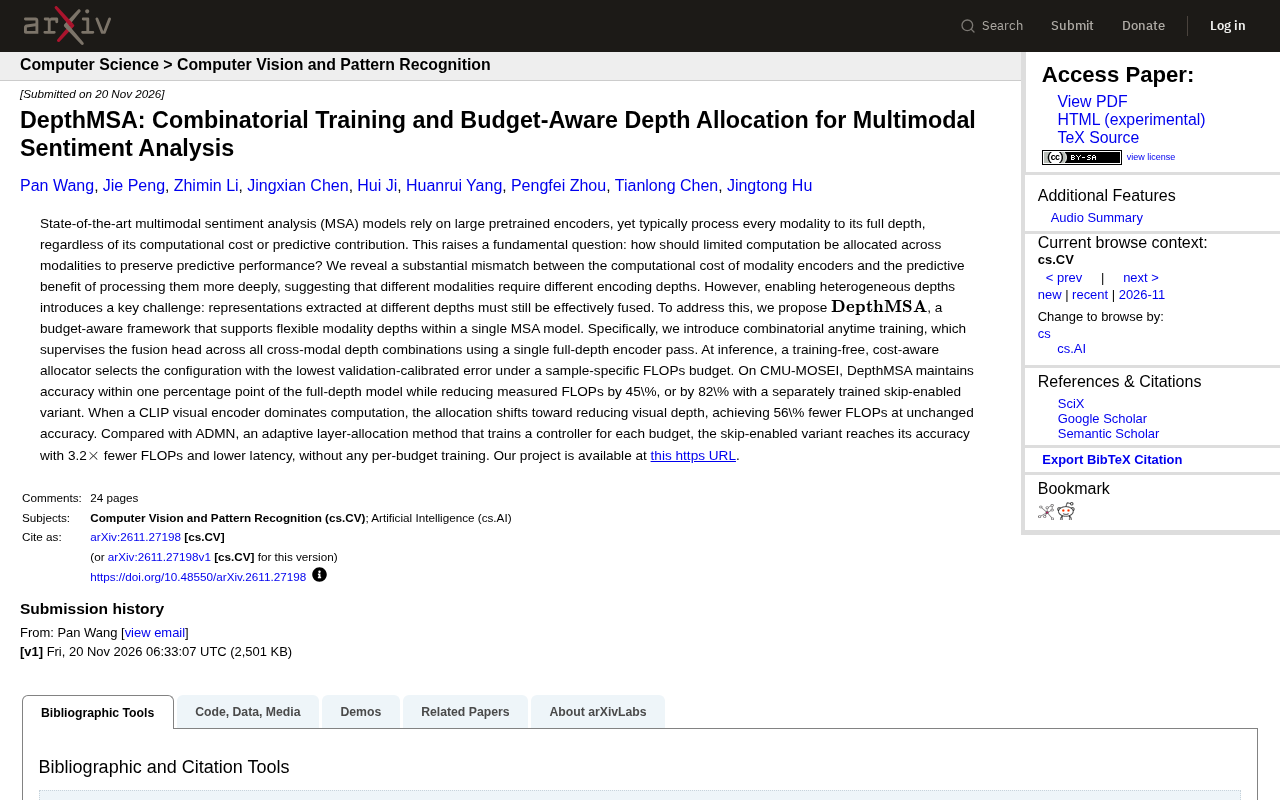
DepthMSA argues that full-depth processing of all modalities in multimodal sentiment analysis is unreasonable due to mismatched computational costs and marginal predictive benefits. The framework allows heterogeneous encoding depths and uses compositional anytime training—one full-depth forward pass supervises fusion heads across all depth combinations—to ensure fusion quality. A training-free, cost-aware allocator selects the lowest-validation-error configuration under a sample-level FLOPs budget. On CMU-MOSEI, it stays within 1% of full-depth accuracy while greatly reducing FLOPs; its skip-enabled variant achieves 3.2× lower FLOPs and lower latency than ADMN, which needs per-budget controller training.
Multimodal sentiment analysis (MSA) models typically rely on large pre-trained encoders, yet almost always process all modalities at full depth, regardless of their computational cost or predictive contribution. Is this "one-size-fits-all" approach reasonable? DepthMSA answers with a resounding no: different modalities have significantly different depth requirements, and dynamically allocating encoding depth based on budget can drastically cut computation with almost no loss in accuracy.
Mismatch Between Modality Depth and Computational Cost
The research team reveals a key contradiction: there is a significant mismatch between the computational cost of modality encoders and the predictive benefit gained from deeper processing. In other words, some modalities already provide sufficient information at shallow layers, and further deepening yields minimal marginal benefit at a high FLOPs cost. This suggests that different modalities should use different encoding depths.
However, heterogeneous depths introduce a new problem: how to effectively fuse representations extracted at different depths? This is the core challenge that DepthMSA aims to solve. The framework allows flexible depth settings for different modalities within a single MSA model while ensuring fusion quality.
Compositional Anytime Training and a Training-Free Allocator
DepthMSA's technical approach includes two key designs.
Compositional anytime training: Through a single full-depth encoder forward pass, it supervises the fusion head across all cross-modal depth combinations. This means the model "sees" various depth configurations during training, enabling stable outputs under different depth settings without needing separate training for each combination.
Cost-aware allocator: At inference time, a training-free, cost-aware allocator selects the configuration with the lowest validation-set calibration error under a sample-level FLOPs budget. The allocation process incurs no additional training overhead and does not require training a controller for each budget.
Comparison with ADMN
ADMN is an adaptive layer allocation method that requires training a controller for each budget. DepthMSA's skip-enabled variant achieves ADMN's accuracy while using significantly fewer FLOPs, with lower latency, and completely eliminates per-budget training. According to the paper, its FLOPs are 3.2× lower than ADMN.
Anytime training borrows from the idea of anytime algorithms: the system can produce a usable result under any computational budget, and result quality monotonically improves with increasing budget. In DepthMSA, this means that the same model can still produce meaningful predictions from the fusion head when encoding depth is truncated at different levels. The key to implementation is that during a single full-depth forward pass, the intermediate representations after each layer are cached and fed to the fusion head for supervision, so that the fusion paths for all depth combinations receive gradient signals. This contrasts with the traditional approach of "training a separate sub-model for each configuration," avoiding the training cost of combinatorial explosion.
ADMN (Adaptive Depth Modulation Network) is a class of dynamic depth allocation methods designed for multimodal tasks: it introduces a lightweight controller that decides, for each input sample, whether each modality continues computation or exits early at each layer. Since the controller itself must learn, ADMN typically trains a separate set of parameters for each target computational budget; switching budgets at deployment means switching models. DepthMSA's training-free allocator transforms "configuration selection" from a training problem into an inference-time search problem—by simply calibrating each configuration's error on the validation set, it can instantly select under any budget, which is the fundamental reason it requires no per-budget training.
Experimental Results: Trade-off Between Accuracy and Efficiency
On the CMU-MOSEI dataset, DepthMSA's accuracy gap from the full-depth model is kept within one percentage point, while measured FLOPs are substantially reduced. With the separately trained skip-enabled variant enabled, the FLOPs reduction is further expanded.
When the CLIP visual encoder dominates computation, the allocator automatically shifts the reduction focus to visual depth, achieving considerable FLOPs savings with unchanged accuracy. This phenomenon validates the framework's adaptivity: the allocation strategy dynamically adjusts to the location of the computational bottleneck rather than applying fixed rules.
FLOPs (floating-point operations) is a common metric for measuring model computation, reflecting the total scale of multiply-add operations in a forward pass. It is highly correlated with latency but not equivalent—actual latency is also affected by memory access, parallelism, and other factors. DepthMSA reports both FLOPs and measured latency precisely to show that its reduction holds not only in theoretical computation but also translates into real deployment gains. CMU-MOSEI is a standard benchmark dataset for multimodal sentiment analysis, containing thousands of videos annotated with sentiment polarity scores, often used alongside CMU-MOSI to evaluate model generalization.
Why It Matters
DepthMSA's value extends beyond the sentiment analysis task itself. It proposes a general idea: in multimodal systems, computational resources should be allocated according to the marginal benefit of each modality, rather than uniformly. Compositional training allows a single model to cover multiple depth configurations, and the training-free allocator makes budget switching at deployment lightweight.
For teams deploying multimodal models on edge devices or in latency-sensitive scenarios, this budget-aware depth allocation mechanism offers a viable path that balances accuracy and efficiency. The project code is publicly available on the project homepage.
One-line Summary
DepthMSA dynamically allocates encoding depth per modality, drastically reducing FLOPs with less than one percentage point accuracy loss.
Paragraph Summary
DepthMSA points out that treating all modalities at full depth in multimodal sentiment analysis is unreasonable: there is a significant mismatch between each modality's computational cost and the predictive benefit of deeper layers. The framework allows heterogeneous encoding depths across modalities and uses compositional anytime training—a single full-depth forward pass supervises the fusion head across all cross-modal depth combinations—to ensure fusion quality at different depths. At inference, a training-free, cost-aware allocator selects the configuration with the lowest validation error under a sample-level FLOPs budget. On CMU-MOSEI, its accuracy gap from the full-depth model is under one percentage point while FLOPs are greatly reduced; the skip-enabled variant achieves 3.2× lower FLOPs and lower latency compared to ADMN, which requires per-budget controller training.
Related articles
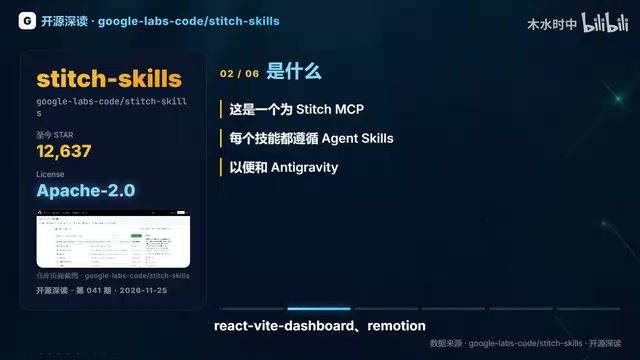
Google Stitch Skills: Connecting Coding Agents to the Design Workflow
Google Stitch Skills is an Agent Skills library following the open standard, adding a design-to-code workflow to the Stitch MCP Server. This article breaks down its three skill groups, SKILL.md directory structure, installation paths, and dependency pitfalls.

40.5-Inch Color E-Paper Art Frame: An Art Display You Charge Once a Year
The Ink Poster Tella 40.5-inch color e-paper art frame uses the E Ink Spectra 6 full-color solution: A1 format, no backlight, no noise, about one charge a year, 2,000+ licensed artworks built in, and automatic adaptation of phone photos.

Jingle Jam Memories: RT's Awkward First Encounter with Lewis
RT shares his awkward first Jingle Jam experience: unexpectedly pushed into the studio, meeting Lewis and Yogg's cast, and Toddy appearing in armor.