Detecting the Persuasive Power of Online Debates with Neuro-symbolic Reasoning: A Look at the NARS Framework

The neuro-symbolic system NARS uses neural extraction of argument structures and symbolic propagation of influence to detect persuasiveness in online discussions.
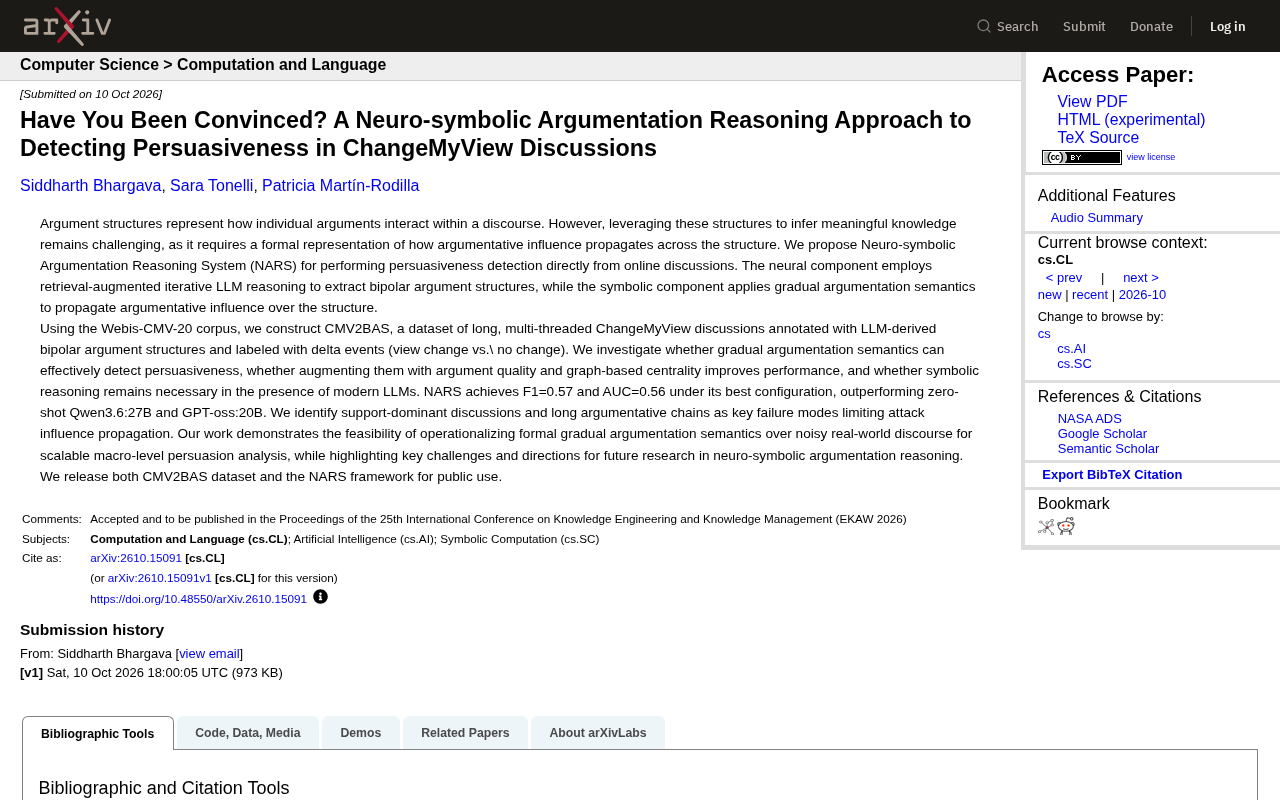
The paper proposes the Neuro-symbolic Argumentation Reasoning System (NARS) to directly detect persuasiveness in Reddit ChangeMyView discussions. The system has two layers: a neural component that extracts bipolar argument structures (support and attack relations) via retrieval-augmented iterative LLM reasoning, and a symbolic component that applies gradual argumentation semantics to propagate argumentative influence over the structure, yielding interpretable reasoning paths. The team built and released the CMV2BAS dataset based on Webis-CMV-20, annotated with bipolar argument structures and delta event labels. In the best configuration, NARS achieves F1=0.57 and AUC=0.56, outperforming zero-shot Qwen3.6:27B and GPT-oss:20B. The paper also identifies two failure modes: support-dominated discussions and overly long argument chains, both of which weaken the influence propagation of attacking arguments. The work validates the feasibility of running formal gradual argumentation semantics on real noisy discourse, though it remains some distance from practical use.
In Reddit's ChangeMyView (CMV) community, countless users try every day to change others' minds through argument. If an AI could automatically judge "which discussion actually persuaded the other side," it could not only help us understand how human argumentation works, but also be applied to public opinion analysis, educational tutoring, and even negotiation assistance. A recent paper proposes the Neuro-symbolic Argumentation Reasoning System (NARS), which attempts to directly detect persuasiveness in online discussions using hybrid neuro-symbolic reasoning.
Why is persuasion detection so hard?
Argument structure describes how individual arguments interact within a discourse. But the real difficulty lies in inferring meaningful knowledge from that structure. This requires a formal representation that specifies how argumentative influence propagates along the structure.
Traditional approaches either perform only text classification, ignoring the graph-structured relationships between arguments, or manually construct argument graphs, which is hard to scale. NARS's starting point is to split "argument structure extraction" and "influence propagation" into two modules that can be optimized separately.
The concept of "bipolarity" in argument structure originates from the Abstract Argumentation Framework (Dung 1995): each argument is a node, and only two types of directed edges exist between arguments—support and attack. In formal semantics, attacking an argument weakens it, supporting an argument strengthens it, and a node's final "acceptability" depends on the attack-and-defense relationships it faces across the entire graph. The Bipolar Argumentation Framework (BAF) explicitly introduces support relations on top of the classic AF, making "who strengthens whom" mathematically characterizable as well. The emphasis on "bipolar" matters because many early works modeled only attack relations, ignoring the many supportive discourse acts that exist in reality, such as positive corroboration and supplementary evidence. In persuasion scenarios, it is precisely the interaction between support and attack that determines whether a viewpoint changes.
NARS's two-layer architecture: neural extraction + symbolic propagation
NARS consists of two core components.
The neural component uses retrieval-augmented iterative LLM reasoning to extract a "bipolar argument structure" from online discussions—that is, an argument graph containing both support and attack relations.
The symbolic component applies gradual argumentation semantics to propagate argumentative influence over the extracted structure. This symbolic reasoning approach lets the system incrementally compute the degree to which each argument is strengthened or weakened along argument chains, rather than treating the entire text as a black box.
The key to this division of labor is that LLMs are good at extracting structure from messy natural language, but reasoning over that structure is better handled with formal methods that guarantee interpretability and consistency.
Gradual argumentation semantics is a class of methods distinguished from classical "extension semantics." Classical semantics assigns each argument a binary verdict of "acceptable/unacceptable," whereas gradual semantics assigns each argument a continuous strength score, typically between 0 and 1, and propagates scores over the graph through iterative update rules: an argument supported by more strong arguments gets a higher score, while one attacked by more strong arguments gets a lower score. Common propagation functions include cardinality-based weighted sums and maximum-based pessimistic strategies. Such continuous scores are especially well suited to persuasion detection, because "persuasion" is inherently a matter of degree rather than a yes/no question, and the score-based output is naturally interpretable—one can directly trace which neighboring nodes contributed how much influence.
The CMV2BAS dataset: turning Reddit discussions into reason-able graphs
The research team built the CMV2BAS dataset based on the Webis-CMV-20 corpus, comprising long, multi-threaded ChangeMyView discussions, each annotated with an LLM-derived bipolar argument structure and a delta event label (view changed vs. not changed).
A natural advantage of the CMV community is that when a user successfully changes someone's view, the other party grants a delta marker. This provides relatively clean labels for supervised learning. The researchers conducted experiments around three questions: whether gradual argumentation semantics can effectively detect persuasiveness; whether adding argument quality and graph centrality features improves performance; and whether symbolic reasoning is still necessary in the face of modern LLMs.
Experimental results: NARS edges out zero-shot large models
Under the best configuration, NARS achieved F1=0.57 and AUC=0.56, outperforming zero-shot Qwen3.6:27B and GPT-oss:20B.
These numbers may not look impressive, but considering the difficulty of the task itself—persuasiveness is a highly contextualized, subjective, and sparse signal—surpassing same-scale zero-shot LLMs is no small feat. More importantly, NARS provides an interpretable reasoning path: researchers can trace which argument nodes contributed most to the final judgment.
Interpreting F1 and AUC: F1 is the harmonic mean of precision and recall, measuring a model's overall accuracy on positive-class judgments; AUC is the area under the ROC curve, measuring a model's ability to rank positive samples ahead of negative ones, with 0.5 equivalent to random guessing. In this task, AUC=0.56 means the model's discriminative power is only slightly above random, reflecting that the "persuasiveness" signal is extremely weak and highly context-dependent. Delta events themselves suffer from class imbalance—the vast majority of discussions do not lead to a change of view, so positive samples are sparse, which is also an important reason why F1 tends to be low. When evaluating such tasks, besides comparing against zero-shot LLMs, one usually also needs to report random baselines, majority-class baselines, and human annotation agreement, in order to judge the true magnitude of improvement represented by 0.57.
Key failure modes: support dominance and long argument chains
The paper identifies two key failure modes that attack influence propagation:
- Support-dominated discussions: When a discussion contains far more supportive arguments than attacking ones, the symbolic propagation mechanism is easily overwhelmed by support signals, making it hard for the system to capture the true drivers of viewpoint change.
- Long argument chains: The longer the argument chain, the more severe the attenuation and noise accumulation during propagation, diluting the effect of attacking arguments.
These two findings are valuable for understanding the dynamics of online debate: what truly changes someone's mind in reality is often not the longest argument chain, but a single key attack point raised at the right moment.
The significance and limitations of the neuro-symbolic route
NARS demonstrates that it is feasible to operate formal gradual argumentation semantics on noisy real-world discourse, offering a path toward scalable macro-level persuasion analysis. The team has also released the CMV2BAS dataset and the NARS framework.
That said, F1=0.57 also shows that neuro-symbolic argumentation reasoning at this stage is still some distance from practical use. How to better handle support/attack imbalance and how to maintain fidelity of influence propagation over long chains are directions future research needs to tackle. For readers interested in AI argument analysis, interpretable reasoning, and computational social science, this work provides a baseline worth following.
Related articles

uGAP: An AI Platform Unifying 100+ African Geospatial Datasets
uGAP is an African geospatial AI platform by a University of Cape Town team, unifying 120+ African datasets with a Python SDK for discovery, processing, and model training, already used in cyclone flood mapping.

Cursor Can Now Control Your Computer: AI Agents Can Drive Desktop Apps for Testing
Cursor adds desktop control: AI agents can drive desktop apps like the iOS Simulator to test their own features. We analyze the impact on dev workflows, possible technical approaches, and reliability concerns.

Vibecoding a Custom Inference Engine: High Hopes, Harsh Reality
A Reddit developer shares the real experience of vibecoding a custom inference engine: running GGUF Q4 models in the browser with WebGL2 and GLSL, only to fall into tokenizer debugging hell. This article analyzes the engineering challenges of browser-side LLM inference and why cloning llama.cpp is the more rational choice.