Detonating a Large Pile of Lead Azide: A Dangerous Chemical Experiment

Science blog documents detonating a large amount of lead azide, sparking Hacker News discussion on safety and communication boundaries of high-risk experiments.
A Science magazine blog documented an experiment detonating a large amount of lead azide, earning 349 points and 222 comments on Hacker News. Lead azide is an extremely sensitive primary explosive responding to friction, impact, and static electricity; handling it in bulk carries far higher risk than small samples. The blog presents the experiment as a record rather than an operating guide, drawing a clear line between narrating the process and providing actionable details. Hacker News discussion extended to historical cases, laboratory safety culture, and public cognitive biases, showing the technical community's multi-angle scrutiny. The core is understanding safety logic and communication responsibility, not seeking novelty.
An Explosive Experiment That Sparked Heated Discussion on Hacker News
A blog post from Science magazine documented an experiment on "detonating a large pile of lead azide," which subsequently sparked widespread discussion on Hacker News, earning 349 points and 222 comments. The level of engagement shows that this seemingly niche chemistry topic touches on multiple interests: high-risk experiments, safety boundaries, and how science is communicated.
Lead azide is a typical primary explosive, commonly used in detonators and other initiation devices. It is extremely sensitive and can respond to friction, impact, and static electricity, making it a dangerous material subject to strict controls in both industrial and military contexts.
Why This Matters
The value of this article lies not in the "explosion scene" but in the serious questions it raises: when researchers work with substances known to be extremely sensitive, how do they design experiments, assess risk, and present such content in public communication?
Judging from the density of discussion on Hacker News, readers' interests were quite diverse—some focused on chemical details, some on safety protocols, and others on the responsibility boundaries of science blogs when reporting dangerous experiments. This multi-angle discussion itself constitutes a supplementary scrutiny of science communication.
Where Does the Danger of Lead Azide Come From
The sensitivity of lead azide stems from the instability of its molecular structure. Under external energy input, it readily decomposes rapidly, releasing large amounts of gas and heat to form a detonation. This is precisely why it is used as a primary explosive rather than a main charge—a small amount is sufficient to initiate a subsequent larger-scale reaction.
This also explains a core difficulty in the experiment: handling "a large pile" of lead azide is on a completely different order of risk compared to handling a small sample. In a piled state, the pathways for heat and shock transmission are more complex, and any localized reaction can rapidly propagate to the entire mass.
Primary vs. Main Charge Explosives: In explosive systems, primary explosives (such as lead azide) are responsible for producing initial detonation under extremely small external stimuli, with energy output sufficient to initiate subsequent main charges (such as TNT, RDX). Main charges are relatively insensitive and require stronger shock waves to detonate. This division of labor means primary explosives must be extremely sensitive while main charges must be sufficiently stable—their sensitivity designs are diametrically opposed. Detonation vs. Deflagration: Detonation is supersonic shock wave propagation accompanied by extreme pressure and temperature; deflagration is a subsonic combustion reaction. Lead azide tends toward detonation upon decomposition, which makes its energy release extremely rapid and is the core source of its danger. Understanding this distinction helps grasp why localized reactions in a piled state instantly propagate to the whole.
Boundary Issues in Science Communication
This Science blog post is presented as an experimental record rather than an operating guide. This positioning difference is important: it describes "what happened," not "how you should replicate it." In the Hacker News comments, this distinction was repeatedly mentioned, reflecting readers' sensitivity to the dissemination of dangerous content.
For content creators, this provides a reference sample: when dealing with high-risk topics, there should be a clear line between narrating the experimental process and providing actionable details.
Dual-use dilemma: Refers to the fact that the same scientific information can be used for legitimate beneficial purposes or misused to cause harm. In chemical experiment communication, detailed operational parameters (such as quantities, steps, equipment) may constitute "actionable details," while merely describing phenomena and risks is relatively safe. Science blogs often adopt the latter, but there is still no unified standard for defining "sufficiently abstract." This dilemma is one of the core issues in the ethics of science communication.
Additional Perspectives from Reader Discussion
Among the 222 comments on Hacker News, discussion extended to broader areas, including historical cases of similar experiments, the evolution of laboratory safety culture, and public cognitive biases about chemical experiments. These discussions do not constitute verification of the original article's conclusions but demonstrate the diverse interpretations of the same material by the technical community.
It should be noted that the above summary of comment content is based on general judgments about discussion intensity and topic direction; specific views should be based on the original discussion page.
Summary
"Detonating a large pile of lead azide" attracted attention because it combines scientific interest with risk tension. Understanding such experiments is not about seeking novelty but about recognizing the safety logic and communication responsibility involved.
One-line Summary
A Science blog documented an experiment detonating a large amount of lead azide, sparking Hacker News discussion on safety and communication boundaries of high-risk experiments.
Paragraph Summary
A Science magazine blog documented an experiment detonating a large amount of lead azide, earning 349 points and 222 comments on Hacker News and sparking widespread discussion. Lead azide is an extremely sensitive primary explosive that responds to friction, impact, and static electricity, and handling it in bulk carries a risk level far higher than small samples. The article notes that the blog presents the experiment as a record rather than an operating guide, drawing a clear line between narrating the process and providing actionable details. Hacker News discussion extended to historical cases, laboratory safety culture, and public cognitive biases, demonstrating the technical community's multi-angle scrutiny of high-risk experiment topics. The core is understanding safety logic and communication responsibility, not seeking novelty.
Related articles
US SEC Investigates Nvidia: Possible A…
US SEC Investigates Nvidia: Possible Accounting Issues
The US SEC's investigation into Nvidia focuses on potential accounting issues, not products. The news sparked heated discussion on Hacker News, with the market watching the AI chip giant's financial disclosure quality and regulatory signals.

FBI Crime Database Reportedly Hit by Hackers; Trump Says 'Not Good'
FBI's NCIC reportedly hit by hackers; FBI has launched an investigation and Trump said it's 'not good.' This article covers the incident, NCIC's importance, and law enforcement data security challenges.
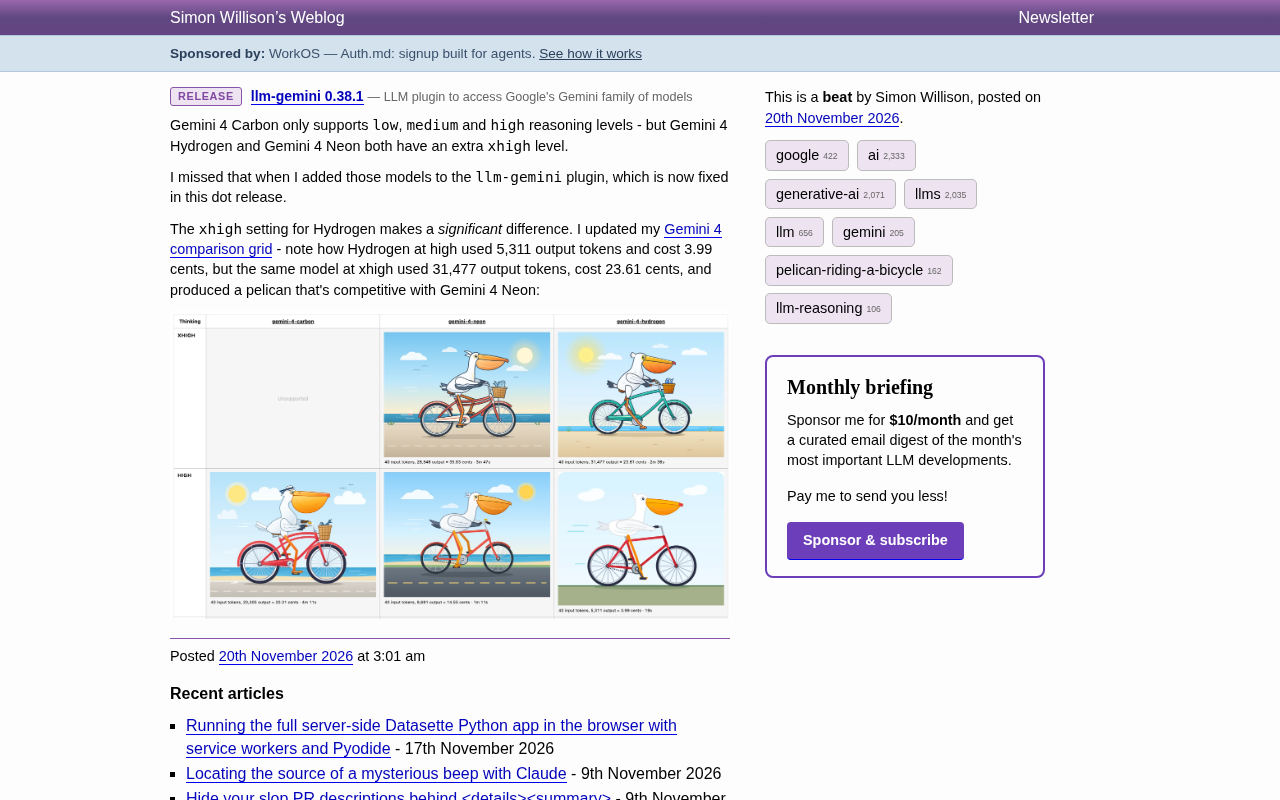
llm-gemini 0.38.1 Fix: Gemini 4 Hydrogen and Neon Gain xhigh Reasoning Level
llm-gemini 0.38.1 fixes the missing xhigh reasoning level for Gemini 4 Hydrogen and Neon. Comparison data shows xhigh sharply raises Hydrogen's output tokens and cost while clearly improving image quality to a level competitive with Neon.