/dev/null: A Developer-Only Social Network Built from Scratch in 48 Hours

The JetBrains team built /dev/null, a developer-only social network, from scratch in a 48-hour livestream.
This article introduces `/dev/null`, a social network designed specifically for web developers. Built from scratch by Nuno Maduro, Brent Roose, Matthieu Napoli, and Pauline Vos over a 48-hour livestream from the JetBrains office, its core features include GitHub login, code snippet sharing, likes, and replies, with a minimalist design deeply integrated into the developer toolchain. During the livestream, hundreds of viewers submitted PRs to participate, and Laravel founder Taylor Otwell and Vercel's Guillermo Rauch gave positive reviews. It ranked first on Product Hunt with 220 votes and 28 comments. However, the project's features are currently basic, and long-term retention will depend on whether it can spin off deeper collaboration scenarios.
A Developer Social Experiment Born from a Livestream
While most social networks are still designed for general users, a project called /dev/null has chosen a completely different path: built exclusively for developers. The project began as a livestream from the JetBrains office—on October 15, 2026, Nuno Maduro, Brent Roose, Matthieu Napoli, and Pauline Vos started from scratch and, over 48 hours, built a social network for web developers in a fully public way.
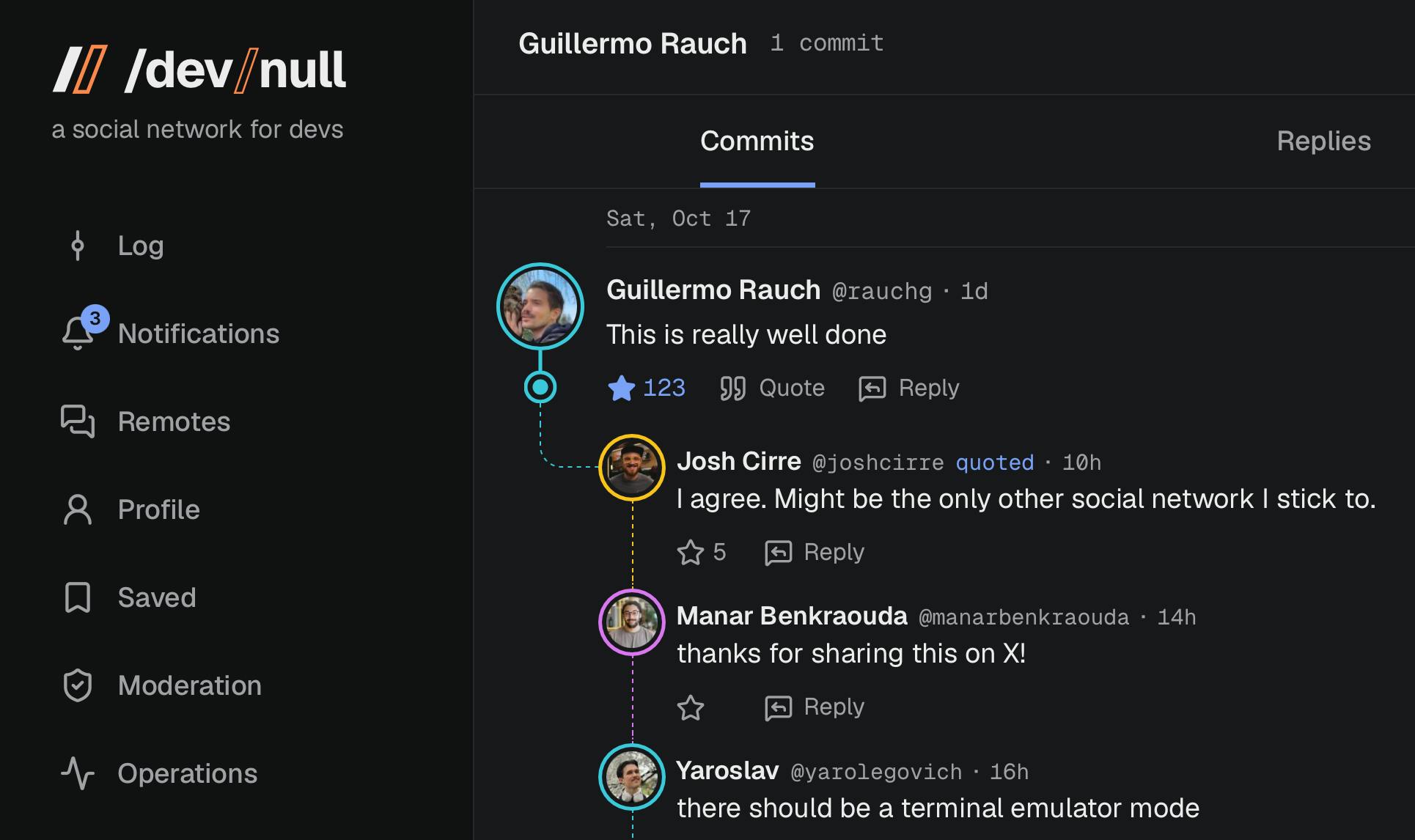
Its core logic is remarkably simple: log in with a GitHub account, share code snippets, like, and reply. There's no flashy algorithmic recommendation, no complicated privacy settings—everything revolves around the toolchain developers know best. This "minimalism" is precisely its charm—as described on the project page, hundreds of viewers submitted pull requests directly during the livestream, collectively participating in this open-source build.
Why Do Developers Need Their Own Social Network?
Technical discussions on general-purpose social platforms are often drowned out by noise. Algorithms push emotional content, code snippets become unreadable after image compression, and technical debates often devolve into factional flame wars. /dev/null's entry point targets exactly these pain points:
- Native GitHub login: identity is code contribution; no need to maintain a separate profile
- Code snippets first: shared content centers on readable, copyable code blocks
- Lightweight interaction: the interaction design for likes and replies is restrained, avoiding information overload
This design approach evokes the purity of early Hacker News, but focuses more on the specific act of "sharing code." For developers who work with GitHub every day, the friction of logging in and sharing is nearly zero.
Hacker News is a technology news aggregation and discussion community launched in 2007 by the venture capital firm Y Combinator. It does not rely on algorithmic recommendation; instead, content ranking is determined by user votes. Its interface is extremely plain, and it has long been regarded as a representative of "high signal-to-noise" discussion in the tech world. The purity of early Hacker News came from strict community norms and user self-governance, but in recent years it has also faced issues of content dilution and fluctuating comment quality. The article compares /dev/null to early Hacker News to emphasize that both attempt to counter information noise with minimalist product design, but /dev/null goes a step further by making "sharing code" rather than "sharing links" the core behavior.
The Open-Source Philosophy Behind the Livestreamed Build
Going from zero to launch in 48 hours sounds like a hackathon, but the significance of /dev/null goes far beyond that. The entire build process was completed on livestream, meaning every line of code and every architectural decision was public. Viewers could not only watch but also directly submit PRs to participate in the build.
This "building as content" model attracted attention from industry heavyweights. Laravel founder Taylor Otwell appeared midway through the livestream and left the comment "Laravel forever," while Vercel's Guillermo Rauch called it "really well done." These endorsements are not only recognition of the project's quality but also show the developer community's hunger for such tools.
You may not have noticed that the project team comes from different tech stack backgrounds: Nuno Maduro and Brent Roose are closely tied to the Laravel ecosystem, while Matthieu Napoli and Pauline Vos each have their own specialties. This combination helped /dev/null avoid a single-framework bias in its design.
Taylor Otwell is the founder of the PHP framework Laravel and the head of Laravel LLC, the company behind the Laravel ecosystem. Since its release in 2011, Laravel has become one of the most popular PHP web frameworks thanks to its elegant syntax and rich official tools (such as Eloquent ORM and the Blade template engine). Otwell has enormous influence in the developer community, and his public statements often attract a great deal of attention. In the article, his comment "Laravel forever" during the livestream is both an acknowledgment of the Laravel-background members on the project team and a hint that /dev/null may attract a large number of users from the Laravel community.
Guillermo Rauch is the founder and CEO of Vercel. Vercel provides frontend deployment and cloud platform services, and its Next.js is one of the most mainstream full-stack frameworks in the React ecosystem. Rauch himself is an active figure in the open-source community, having created well-known Node.js libraries such as Socket.IO and Mongoose in his early years. His "really well done"评价 of /dev/null represents recognition from the frontend/full-stack toolchain field for this kind of developer social product.
Real Feedback After Launching on Product Hunt
/dev/null received 220 votes and 28 comments on Product Hunt, ranking first for the day. Its category tags are open source, social network, software engineering, and GitHub. In addition to the four core builders, the Makers list also includes Márk Magyar.
These data points show that it hit a real need: developers want a communication space that is neither bloated nor off-track. But 28 comments also suggest limited depth of discussion—the product is still at an early stage, and its feature list (login, post code, like, reply) is quite basic. Whether it can retain users after the "novelty" fades depends on whether it can later spin off more valuable collaboration scenarios beyond code snippets, such as mutual code review assistance, technical solution discussions, or open-source project recruitment.
The Next Stop for Developer Social Networking?
The name /dev/null is itself a technical joke—in Unix systems, /dev/null is a "black hole" that discards all written data. Naming a social network after it carries self-deprecating humor: perhaps the content here will eventually be forgotten, but the process of building it and the people who participated are the real value.
From a product perspective, it currently looks more like a refined experiment than a mature platform. But the 48-hour livestreamed build, hundreds of people participating via PRs, and spontaneous endorsements from industry leaders together sketch out a new way for products to be born: open source, public, and community-built. For developers tired of the noise of traditional social platforms, this may be exactly the new hangout they are willing to try.
/dev/null is a special device file in Unix and Unix-like systems, usually located in the /dev directory. Any data written to this file is discarded directly by the system, and reading it immediately returns the end-of-file (EOF) marker, so it is often used to discard unwanted output or test commands. In programmer culture, /dev/null is often used as a metaphor for a "black hole" or "bottomless pit," and it also commonly appears in command-line redirection (such as command > /dev/null). Naming a social network after it carries a sense of self-deprecation and irony: on one hand, it implies that content on the platform may be fleeting; on the other hand, it echoes developers' minimalist preference for "lightweight, no storage, no tracking." The name itself is a cultural filter—non-technical users would find it hard to understand the humor in it.
One-line Summary
/dev/null, a developer-only social network built from scratch over a 48-hour livestream by the JetBrains team, is drawing attention for its minimalist design and open-source co-creation.
Paragraph Summary
This article introduces /dev/null, a social network designed specifically for web developers. The project was built from scratch by Nuno Maduro, Brent Roose, Matthieu Napoli, and Pauline Vos over a 48-hour livestream from the JetBrains office. Its core features include GitHub login, code snippet sharing, likes, and replies, with a minimalist design deeply integrated into the developer toolchain. During the livestream, hundreds of viewers submitted PRs to participate in the build, and Laravel founder Taylor Otwell and Vercel's Guillermo Rauch gave positive reviews. After launching on Product Hunt, it received 220 votes and 28 comments and ranked first for the day, showing developers' real demand for a dedicated social space. However, the article also points out that the project's features are currently basic, and long-term retention will depend on whether it can spin off deeper collaboration scenarios such as code review and technical discussions.
Related articles

Automate Job Search with AI Agents and Residential Proxies for Precise Matching
Build an AI Agent with MCP and residential proxies to bypass recruitment site anti-scraping and geo-restrictions, scrape thousands of DevOps jobs, then have Claude score and rank each against your resume. Includes proxy comparison experiments, project structure, and cost analysis—filtering only, no auto-submission.

The AI Task Assistant That Knows When to Back Off: A Cure for Activation Struggles
One Small Step is an AI assistant for task initiation struggles, using agentic decisions for guilt-free reminders, timely retreat, and cross-platform task management. The developer shares real test results on 13 tasks and architectural trade-offs.

FastAPI: A High-Performance Python Framework and a Production-Ready API Development Powerhouse
FastAPI is a high-performance web framework based on Python type hints, supporting async and automatic OpenAPI docs. With over 100k GitHub stars, this article analyzes its core strengths, production readiness, and selection advice.