/dev/null: The Programmer's Social Network That Sparked a Debate

Developer social network /dev/null borrows the Unix null device name, sparking reflection on developers' social needs.
The article discusses the developer social network project /dev/null that appeared on Hacker News. Its name borrows the Unix null device concept, carrying an ironic tone and hinting that it may not follow mainstream social routes. The article analyzes developers' conflicted attitude toward social networks: active on multiple vertical platforms, yet wary of algorithmic recommendations and addictive design. The real need is efficient exchange of valuable information, not longer dwell time. Existing platforms each cover part of the need, and integrated products struggle to differentiate. The project faces common challenges: cold start, network effects, content quality, and business model. The discussion reflects developers' ongoing need for more open and efficient technical exchange, though a gap remains between interest and adoption.
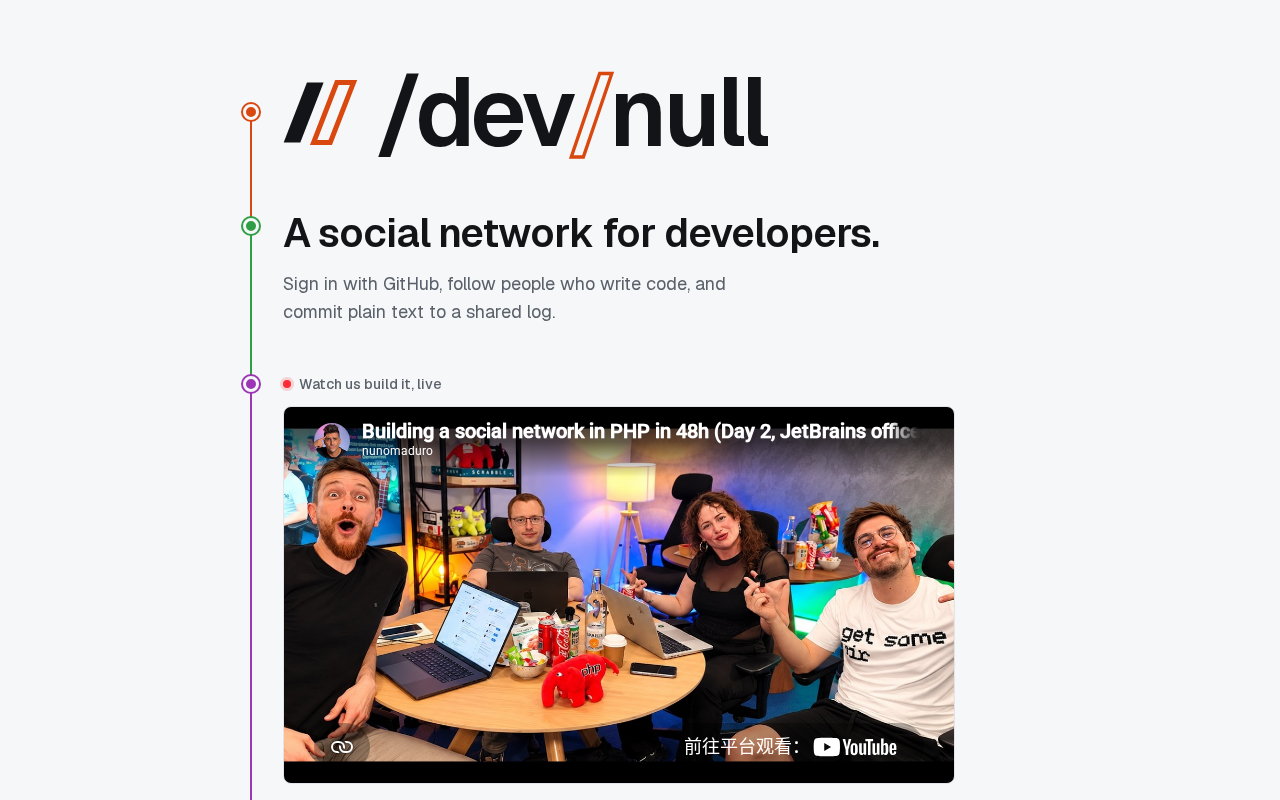
Recently, a project called /dev/null sparked discussion on Hacker News, positioning itself as a "social network for developers." In today's highly saturated social platform landscape, a new name appearing is nothing unusual, but the name /dev/null itself precisely hits the cultural nerve of the programmer community.
What /dev/null Actually Means
In Unix and Unix-like systems, /dev/null is a special device file, often called the "null device" or "black hole." Any data written to it is immediately discarded by the system, and reading from it immediately returns end-of-file (EOF). Programmers commonly use it to discard unwanted output — for example, command > /dev/null throws the command's standard output into the void.
So naming a developer social network /dev/null carries a strong sense of irony: a "social" product whose name points to "leaving nothing behind." This naming strategy is a classic form of dark humor in developer culture — using low-level system jokes to express an attitude, rather than conventional social buzzwords like "connect," "community," or "share."
This naming choice hints that the product may want to take a path opposite to mainstream social networks: not chasing infinite feed scrolling, not encouraging meaningless interaction, and possibly even emphasizing a minimalist philosophy of "burn after reading" or "no content storage."
Technical Details of /dev/null in Unix Systems
/dev/null is a special device file defined by the POSIX standard, typically located in the /dev directory, with major device number 1 and minor device number 3. It isn't associated with any physical hardware, and the kernel handles read/write operations specially: writes discard data and return success, while reads immediately return EOF. Permissions are usually crw-rw-rw-, allowing all users to read and write.
Beyond discarding standard output (command > /dev/null), it has several other common uses: command 2> /dev/null discards error output; command &> /dev/null discards all output; command > /dev/null 2>&1 is the older shell-compatible form. In scripts, if [ -e file ] > /dev/null can silently check whether a file exists. Additionally, /dev/null is often used as a placeholder — for example, to suppress email notifications in crontab.
This "data black hole" semantics makes it a classic symbol for programmers to express "ignore," "discard," or "don't care about the result." Naming a social network /dev/null borrows this metaphor of "all input is discarded," hinting that the product may refuse to store user data or adopt minimalist interaction.
The Real Needs of a Developer Social Network
Programmers have always had a conflicted relationship with social networks. On one hand, they're active on Hacker News, GitHub, Stack Overflow, Reddit subreddits, and various Discord servers; on the other hand, they're generally wary of the product logic of mainstream social platforms — algorithmic recommendations, addictive design, privacy erosion — all of which have long been criticized by developer communities.
A social network truly built for developers needs to solve not "how to make people stay longer" but "how to efficiently exchange valuable information." This includes: finding people who can solve specific technical problems, sharing ongoing projects, discussing technology choices, and making professional connections when necessary.
Existing platforms each cover part of these needs, but none completely. GitHub leans toward code collaboration, Stack Overflow toward Q&A, Hacker News toward news discussion, Twitter/X toward instant expression. An integrated developer social network that merely stitches these features together will struggle to achieve real differentiation.
Network Effects and the Cold Start Problem
Network effects refer to the phenomenon where the value of a product or service increases as the number of users grows. For social networks, Metcalfe's Law states that value is proportional to the square of the number of users. This means new platforms face a chicken-and-egg problem early on: without enough users, there's no valuable content or interaction; without value, it's hard to attract users.
This is especially true for developer social networks. Developers' time is precious, their tolerance for low-quality content is low, and mature tools like GitHub and Stack Overflow already satisfy core needs. To break the status quo, a new platform must offer unique value that existing platforms can't replace — for example, more precise matching, more efficient collaboration, or more open protocols.
Cold start strategies typically include: invitation-only (to ensure early quality), single-point breakthrough (serving one niche well first), or integration with existing tools (to reduce switching costs). But even after a successful launch, maintaining activity remains a long-term challenge, because user retention in social products depends heavily on continuous content supply and social relationship chains.
Why the Discussion on HN Is Worth Noticing
The fact that this project appeared on Hacker News itself shows it reached its target audience. HN's comment section is an excellent window into developers' real attitudes — it gathers a large number of senior engineers, open-source maintainers, and tech entrepreneurs who are both harsh and honest about new products.
Judging by the discussion's intensity, developers still have strong interest in "rethinking social networks." Behind this interest lies both dissatisfaction with existing platforms and expectation for new possibilities. However, there's still a big gap between interest and actual adoption. Historically, many products claiming to be "developer-exclusive social networks" ultimately failed to build active communities of sufficient scale.
The core difficulty of social products has never been technical implementation, but cold start and network effects. Although the developer community is highly receptive to new technology, it also has higher demands for product quality and privacy protection — which paradoxically makes customer acquisition even harder.
Common Challenges Facing Such Projects
Developer social networks are not a new concept. Over the years, there have been many attempts — some focused on code snippet sharing, some on technical Q&A, some trying to become the "LinkedIn for developers." Most of them faced the same few problems.
First is unclear differentiation. If the features are just a subset or simple combination of existing platforms, users have no reason to migrate. Second is content quality maintenance. Developer communities have extremely low tolerance for low-quality content; once the feed is flooded with noise, core users will leave. Third is the business model. Developers are usually willing to pay for tools, but less willing to pay for social products, and advertising models easily provoke resentment.
The name /dev/null might hint at an extreme answer: if the social network itself is a "null device," then perhaps it never intended to operate by traditional social product logic from the start. This could be an experiment, or it could be an expression of attitude.
The Business Model Dilemma of Developer Communities
Developers generally have low willingness to pay for social products, because they're already used to free platforms like GitHub and Stack Overflow, and these platforms are mostly sponsored by companies or use freemium models. Advertising models are especially sensitive in developer communities: developers typically use ad blockers and have zero tolerance for privacy violations, so forcibly inserting ads could lead to core user loss.
Common alternative models include: value-added services (such as private repositories, advanced search), enterprise editions (team collaboration and permission management), recruiting services (precisely matching developers with positions), and tipping or sponsorship. But each model has limitations. For example, recruiting services may distort the community's neutrality, and value-added services require a sufficiently large free user base.
Historically, some developer social networks shut down because they couldn't find a sustainable business model, such as the former Forrst, Pledgie, and others. Therefore, if /dev/null wants to operate long-term, it must innovate on its business model or clearly define its nonprofit/experimental nature.
Questions More Worth Pondering
Setting aside the success or failure of any single project, the discussion sparked by /dev/null points to a deeper question: what kind of social network do developers actually need?
Perhaps the answer isn't yet another platform, but better protocols, more open interoperability, or simply a return to "ancient" but effective tools like mailing lists and IRC. The form of social networks is changing, but people's need for high-quality technical exchange hasn't changed.
As for the project itself, it's still too early to draw conclusions. But its appearance and the discussion it sparked at least show that the developer community still has the willingness to reflect on "social." In an era dominated by algorithms and growth metrics, that reflection itself is worth noticing.
One-line Summary
Developer social network /dev/null borrows the Unix null device name, sparking reflection on developers' social needs.
Paragraph Summary
The article discusses the developer social network project /dev/null that appeared on Hacker News. Its name borrows the Unix null device concept, carrying an ironic tone and hinting that it may not follow mainstream social routes. The article analyzes developers' conflicted attitude toward social networks: active on multiple vertical platforms, yet wary of algorithmic recommendations and addictive design. The real need is efficient exchange of valuable information, not longer dwell time. Existing platforms each cover part of the need, and integrated products struggle to differentiate. The project faces common challenges: cold start, network effects, content quality, and business model. The discussion reflects developers' ongoing need for more open and efficient technical exchange, though a gap remains between interest and adoption.
Related articles

Amphibious Transforming Drone: Beyond 100x Power Savings, What Are the Real Needs?
Is the amphibious transforming drone just a gimmick? Starting from the 100x power difference of the M4 Morphobot, explore real application scenarios and thesis topic ideas, analyzing boundary conditions where pure drones and pure ground robots both fail.

Warhound Raises $200 Million: Genetically Engineered "War Dogs" Paired with Anduril Gear
Warhound raises $200M, backed by Ben Lamm and Palmer Luckey, to genetically engineer dogs for military and law enforcement use and equip them with Anduril gear. This article analyzes its technology direction, funding logic, and ethical controversy.

Claude API Comes to Google Cloud: IAM Integration and SDK Access Guide
Anthropic hosts the full Claude API on Google Cloud with IAM-controlled permissions and unified billing. This guide covers the Vertex AI and Anthropic-hosted entry points, IAM role configuration, and SDK access.