Developer Builds an AI Opponent for Sandtris, Free to Play in the Browser

A developer built an AI opponent for the sand-physics Tetris game Sandtris and turned it into a free browser game for players to test.
Out of personal interest, a developer built an AI opponent for the sandbox Tetris game Sandtris and packaged it as Sandtris Duel, a free browser game. Sandtris combines sand physics with Tetris: cleared lines cause sand to collapse and trigger chain reactions, making the state space far more complex than traditional Tetris and requiring stronger forward planning from the AI. The author says the bot is "decent" and promises to share the model's workings soon.
A developer has built an AI opponent for Sandtris, the sandbox Tetris game he loves, and turned it into a free browser game called Sandtris Duel that anyone can play. According to the original Reddit post, the project started as a personal hobby and the bot has now reached a "decent" level—the author is inviting more players to test it and share feedback.
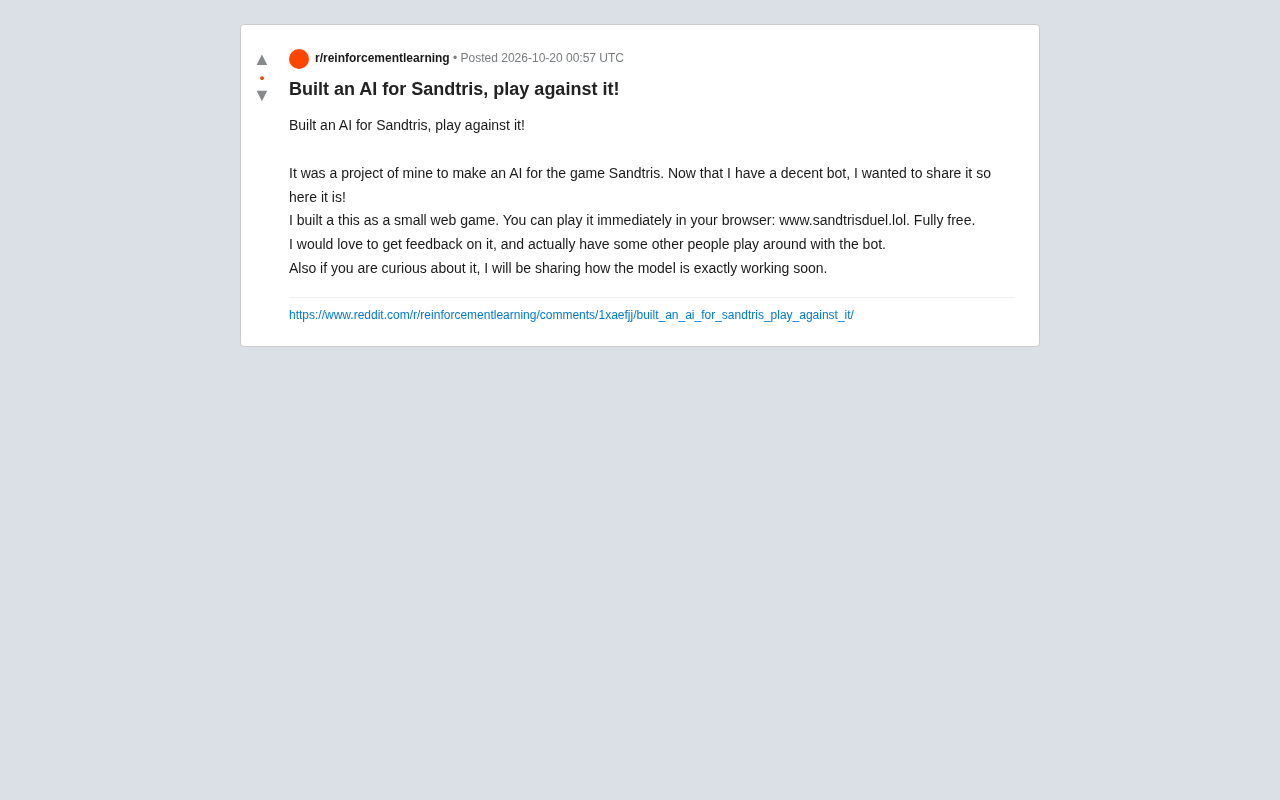
From Personal Project to Public Dueling Platform
Sandtris is a creative game that combines sand physics with Tetris mechanics: players control falling sand blocks, stack them, and clear lines. Designing AI for this kind of game is no easy task—the fluidity of the sand and its chain reactions make the state space far more complex than in traditional Tetris. The author hasn't disclosed algorithm details but explicitly says he'll "share how the model works soon," hinting that the AI may rely on search algorithms, heuristic evaluation, or machine learning.
Packaging the AI as a web game is a smart choice: zero installation, click-and-play, and maximum efficiency in collecting feedback. From a product experience standpoint, this lightweight deployment approach is worth borrowing for indie developers.
Why the Sandtris AI Is Worth Watching
Traditional Tetris AI has well-established solutions (such as evaluation functions based on the Pierre Dellacherie algorithm), but Sandtris's sand physics introduces uncertainty: after a line is cleared, the sand blocks above collapse, creating new chain opportunities or blockage risks. This means the AI needs stronger forward-planning capabilities rather than a simple immediate-stacking strategy.
The author says the bot currently performs "decently" but hasn't published win rates or match data. If technical details are shared later, this project could become an interesting case study for AI in uncertain grid games. For AI application developers, it also demonstrates how to quickly turn an experimental model into an interactive product.
The Pierre Dellacherie algorithm is one of the most representative evaluation-based approaches in traditional Tetris AI. It doesn't perform deep search; instead, it scores the board state after each placement using several heuristic features—such as landing height, lines cleared, number of holes, row transitions and column transitions, and well depth—then picks the placement with the highest total score. This "one-step evaluation plus weighted features" method has low computational cost and is simple to implement, yet it achieves clearing efficiency far beyond humans and has long served as a baseline for Tetris AI. Its limitation is that feature weights require manual tuning and it assumes the board is static immediately after a piece lands. Sandtris's sand collapse breaks this assumption, so Dellacherie-style evaluation can only be a starting point; it also needs re-evaluation after collapse or multi-step lookahead.
AI for uncertain grid games typically faces two kinds of uncertainty: randomness in the environment itself, such as the sequence of new pieces; and randomness in action outcomes, where the same move may lead to different states. Sand physics falls into the latter—the collapse path of sand blocks may be affected by subtle initial differences. Common countermeasures include Monte Carlo Tree Search (MCTS), which estimates action values through large numbers of random simulations and is naturally suited to scenarios with uncertain outcomes; and deep reinforcement learning, which lets a network learn expected returns rather than a single deterministic trajectory through interaction with the environment. By contrast, pure Alpha-Beta search requires a deterministic state-transition model and is more prone to failure in sand simulation due to branch explosion and outcome bias. This is precisely why the project's technical approach is worth watching.
What Players Can Expect
Sandtris Duel is currently completely free, and players can battle the AI directly in their browser. The author's core goal is to collect feedback from real players to further tune the bot's performance. If you're interested in sandbox puzzles or AI duels, give it a try—you can experience a novel gameplay style and contribute test data to this project that embodies the open-source spirit.
What's worth watching next is the model analysis the author has promised: will it use deep reinforcement learning or a classic search tree? Either way, it will provide a reference for AI design in similar games.
Deep reinforcement learning (DRL) and classic search trees represent two different technical paths. Search-tree methods (such as MCTS and beam search) rely on precise simulation of game rules; their advantages are interpretability and no need for training data, but each step must expand many branches, creating heavy real-time pressure. DRL, by contrast, uses neural networks to approximate a policy or value function, requiring only a single forward computation at inference time for fast responses, but it needs a large number of matches for training, and the training environment must efficiently simulate sand physics. For games like Sandtris where state transitions involve random collapse, hybrid approaches are also common: replacing random rollouts in search with a learned value network, or first using search to generate high-quality matches and then distilling them into a policy network. Which path the author ultimately chooses will directly affect the bot's play style and strength ceiling.
One-line Summary
A developer built an AI opponent for the sand-physics Tetris game Sandtris and turned it into a free browser game for players to test.
Paragraph Summary
Out of personal interest, a developer built an AI opponent for the sandbox Tetris game Sandtris and packaged it as Sandtris Duel, a free browser game playable directly in the browser. Sandtris combines sand physics with Tetris mechanics; after a line is cleared, sand blocks collapse and trigger chain reactions, making the state space far more complex than traditional Tetris. The AI therefore needs stronger forward-planning capabilities rather than a simple immediate-stacking strategy. The author says the bot has reached a "decent" level and hasn't yet published algorithm details or win rates, but promises to share how the model works soon. Deployed as a zero-install, click-and-play experience, the project's core purpose is to collect feedback from real players to tune the bot, while also demonstrating a path for quickly turning an experimental model into an interactive product.
Related articles

Amphibious Transforming Drone: Beyond 100x Power Savings, What Are the Real Needs?
Is the amphibious transforming drone just a gimmick? Starting from the 100x power difference of the M4 Morphobot, explore real application scenarios and thesis topic ideas, analyzing boundary conditions where pure drones and pure ground robots both fail.

Warhound Raises $200 Million: Genetically Engineered "War Dogs" Paired with Anduril Gear
Warhound raises $200M, backed by Ben Lamm and Palmer Luckey, to genetically engineer dogs for military and law enforcement use and equip them with Anduril gear. This article analyzes its technology direction, funding logic, and ethical controversy.

Claude API Comes to Google Cloud: IAM Integration and SDK Access Guide
Anthropic hosts the full Claude API on Google Cloud with IAM-controlled permissions and unified billing. This guide covers the Vertex AI and Anthropic-hosted entry points, IAM role configuration, and SDK access.