Jensen Huang and Nvidia: Elite Privilege Behind the Revolving Door of Business and Politics

An opinion piece uses "elite impunity" to satirize suspected political interference behind Jensen Huang's reappointment and probe the line between free markets and business-government ties.
An opinion piece titled "Welcome to Elite Impunity, Jensen Huang" pointedly suggests possible political intervention by Trump and Vance behind Huang's reappointment as Nvidia CEO, calling it "elite impunity"—business leaders transcending market rules and accountability. It asks how free-market believers should understand this close business-government interaction, and warns that fairness, innovation, and public trust in the AI industry could suffer.
Nvidia CEO Jensen Huang has once again become the focus of public discussion. An opinion piece titled "Welcome to Elite Impunity, Jensen Huang" pointedly notes that Huang's reappointment "surprised almost everyone except President Trump and Vice President Vance," hinting that political forces may have intervened behind the outcome. The article goes on to ask: how should those with a basic education in "free markets" understand this kind of close interaction between business and politics?
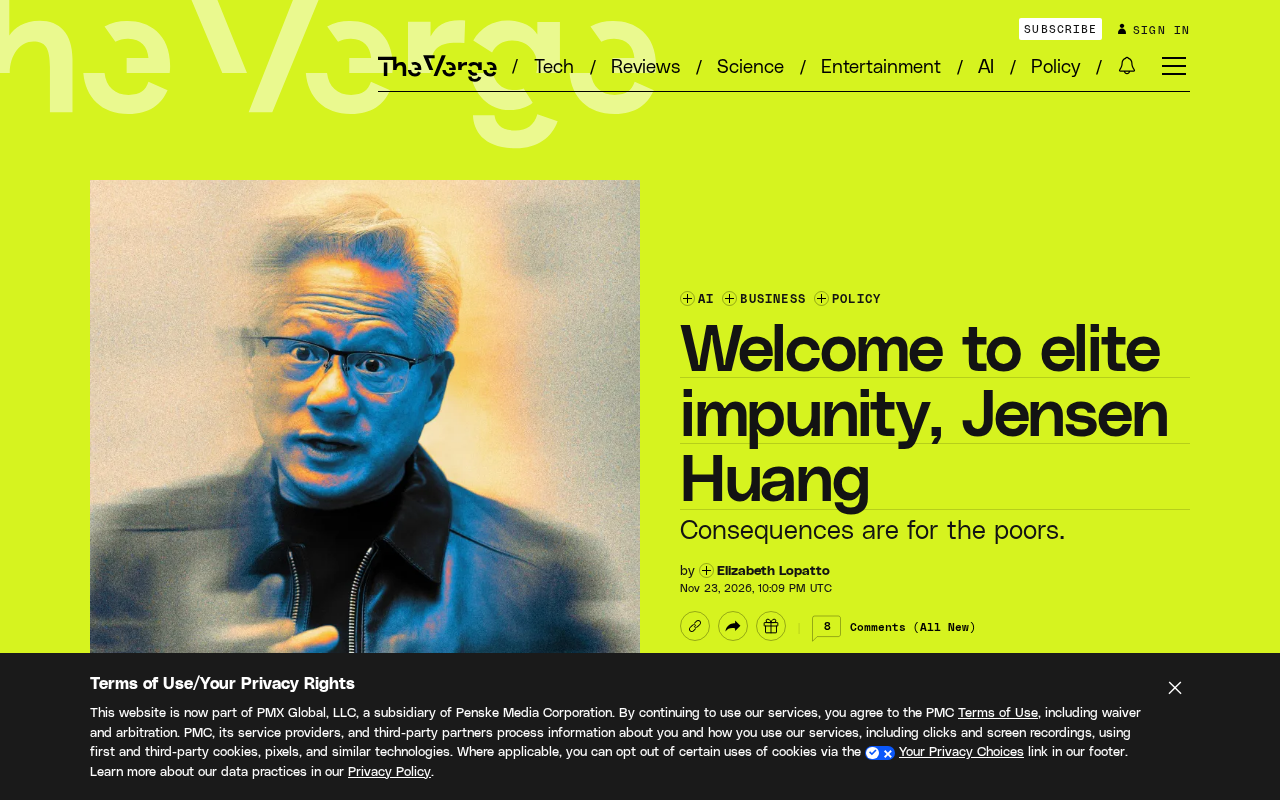
The Delicate Balance of Business-Government Relations
As the man at the helm of Nvidia, Huang's position should be a matter of corporate governance, yet the opinion piece directly ties it to Trump and Vance. This narrative places the fate of a corporate leader within a political spectrum, suggesting that in the current business environment, senior personnel changes may be influenced by non-market factors. Although the original text provides no specific details, the phrase "elite impunity" points directly at a phenomenon: certain business leaders seem able to transcend conventional market rules and accountability mechanisms.
For those who follow the tech industry, Nvidia's dominance in AI chips makes any move by its CEO symbolically significant. Huang's reappointment concerns not only one company's future but may also shape the direction of the entire AI hardware ecosystem. By choosing "impunity" as its entry point, the opinion piece is in fact asking: when commercial power and political power intertwine, how can the fairness of the free market be safeguarded?
"Elite impunity" is a critical concept with strong political-sociological overtones, literally meaning "the elite class being exempt from punishment." It describes a phenomenon in which groups at the top of wealth, power, or social status are often able to escape substantive consequences even when their actions violate the rules, laws, or market accountability mechanisms that apply to ordinary people. The concept is frequently associated with issues such as "impunity," "double standards," and "revolving doors," and is used to critique regulatory capture and class entrenchment. In a business context, it refers to certain corporate leaders who, by controlling key resources or being deeply tied to political power, gain special protection beyond the oversight of boards, shareholders, and the public. Understanding this term helps grasp the satirical edge of the original title—it is not immunity in the legal sense, but a structural privilege perceived by public opinion.
The Real-World Challenge to Free-Market Ideals
The article opens by mentioning "those with a basic education in free markets," clearly satirizing the gap between reality and theory. In an ideal free-market model, the replacement of corporate leaders should be decided by boards and shareholders based on performance, not by external political intervention. Yet the opinion piece suggests that Huang's reappointment is not a purely market choice but carries the color of political endorsement.
Such questioning is not an isolated voice. In recent years, the relationship between tech giants and governments has grown increasingly complex, from antitrust investigations to industrial policy support, and the role of corporate leaders has long exceeded the purely commercial realm. Huang's case has sparked discussion because it touches on a sensitive topic: in the context of white-hot AI competition, should the government intervene in a company's core decisions, and if so, how?
The free-market model is an idealized benchmark in economics: prices are determined by supply and demand, resources are allocated through competition, the replacement of corporate leaders is decided by boards and shareholders based on performance and fiduciary duty, and the government plays only the role of rule-maker and property-rights protector. In contrast are industrial policy and business-government coordination—in which the government directly intervenes in key industries through subsidies, procurement, export controls, or strategic dialogue. In fields such as AI chips, which are regarded as national strategic resources, a fully free market barely exists, and corporate decisions are often intertwined with national security, export controls, and industrial support. The confusion of "those with a basic education in free markets" mentioned in the original text stems precisely from the tension between the theoretical benchmark and actual practice: when political endorsement becomes an implicit variable in CEO stability, the boundary between shareholder accountability and market discipline becomes blurred.
The Metaphor of Elite Impunity
The title "elite impunity" carries a strong critical tone. It implies that certain elites can be exempt from conventional rules, whether at the legal, market, or public-opinion level. For Huang, this "impunity" may be reflected in the stability of his position—even amid external doubts, he can still secure the support of key political figures.
From a broader perspective, this discussion reflects public concern about the expanding power of tech giants. When a company's technology products become national strategic resources, its leader's status is no longer merely a commercial matter. Under Huang's leadership, Nvidia occupies a key position in the field of AI computing power, which makes his interactions with policymakers more frequent and more likely to evoke associations with "rent-seeking."
Rent-seeking refers to individuals or companies obtaining excess returns by influencing political and institutional arrangements rather than creating value through productive innovation. In the tech industry, this concept is often used to discuss how companies consolidate market positions through lobbying, policy relationships, or standard-setting power. Related to this is regulatory capture—in which regulators are swayed by the interests of the industry they oversee. By associating Huang's frequent interactions with policymakers with "rent-seeking," the original text is reminding readers: when a company's products become national strategic resources, the line between its commercial success and political relationships becomes blurred, and public trust in fair competition may be damaged as a result.
Potential Impact on the AI Industry
Regardless of whether the opinion piece's specific arguments are sufficient, the questions it raises deserve deep consideration by the AI industry. If the fate of corporate leaders is indeed influenced by political factors, then the fairness of industry competition, the vitality of innovation, and public trust may all be eroded. For AI developers and companies that rely on Nvidia chips, what they need to watch is not only product performance but also the governance structure behind the supply chain.
So far, Nvidia has not responded to the related commentary. But it is foreseeable that as AI technology penetrates ever deeper into all areas of the economy and society, the relationship between tech leaders and political power will remain a focus of public scrutiny. Huang's case may be just a microcosm, reminding us that while celebrating tech heroes, we should not neglect to question how power actually operates.
One-line Summary
An opinion piece uses "elite impunity" to satirize suspected political intervention behind Huang's reappointment, questioning the boundary between free markets and business-government entanglement.
Paragraph Summary
An opinion piece titled "Welcome to Elite Impunity, Jensen Huang" pointedly notes that political intervention by Trump and Vance may lie behind Huang's reappointment as Nvidia CEO, and sums it up as "elite impunity"—the phenomenon of business leaders transcending market rules and accountability mechanisms. The article thus asks: how should those educated in free markets understand this close business-government interaction? Nvidia's dominance in AI chips gives this personnel change industry-wide symbolic significance, involving tensions among corporate governance, political endorsement, and fair competition. The article argues that if the fate of corporate leaders is indeed influenced by political factors, the fairness of industry competition, innovation vitality, and public trust may all suffer, and the relationship between tech leaders and political power will remain a focus of public attention.
Related articles

Developer Naming Woes: The Technical Names That Drive Us Crazy
Why is technical naming so maddening? From Nginx and Vite to Qt and Sudo, a YouTube creator rants about the chaos of developer naming and pronunciation, revealing the tug-of-war between creators' intentions and community habits, and the cultural roots behind spelling traps like PyPI and GNOME.

Figma Workplace Scandal: Employee Sues CEO for Forcing Confrontation with Harasser
Figma and its CEO are sued by a current employee alleging sexual harassment and discrimination, and forcing the victim to confront her harasser. This article outlines the background, potential impact, and industry reflection.
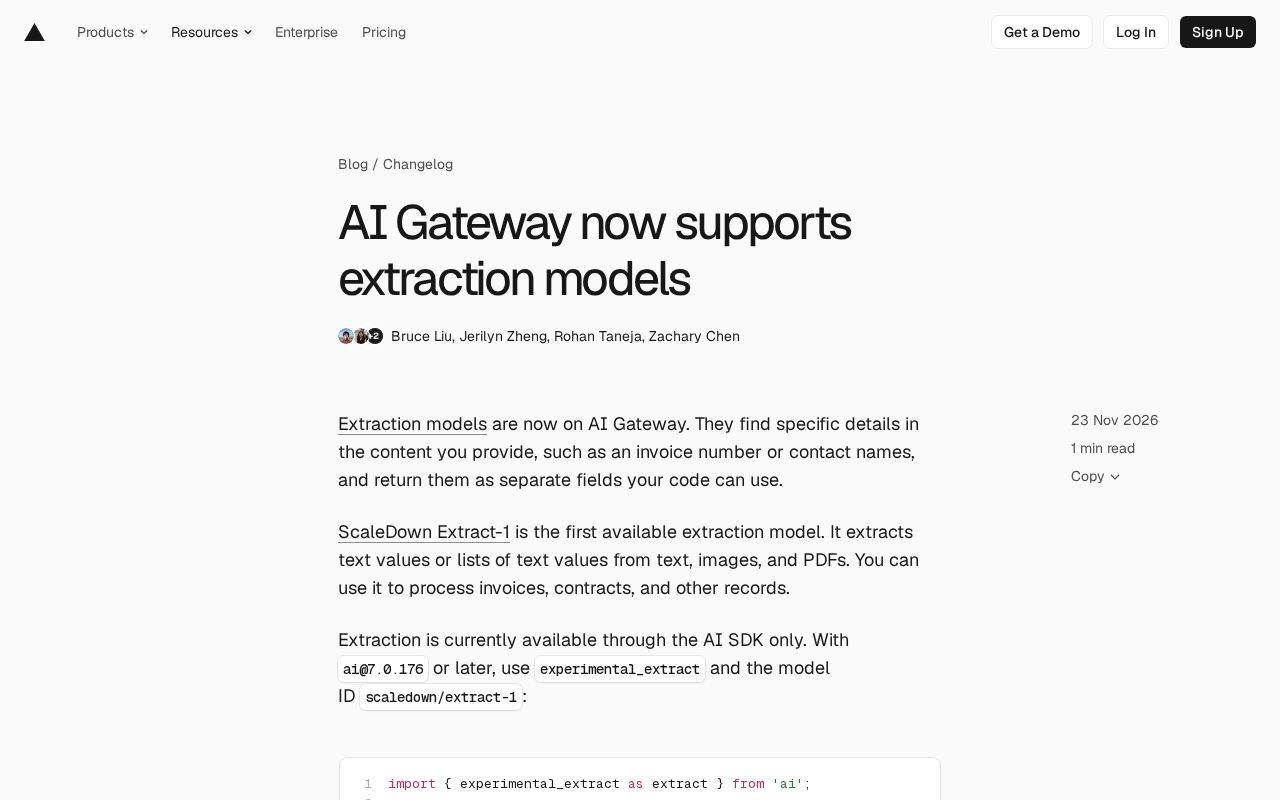
AI Gateway Launches Extraction Models: Precisely Pull Structured Fields from Invoices and Contracts
AI Gateway adds extraction models, debuting with ScaleDown Extract-1, which pulls fields like invoice numbers and contacts from text, images, and PDFs, returning confidence scores and character offsets via AI SDK's experimental_extract.