Devin Integrates Gemini 4 Argon: Coding Agent Benchmarks Surpass GPT-6

Gemini 4 Argon lands on both Devin platforms with a 60.5% FrontierCode 1.1 score and a limited-time 25% discount.
Gemini 4 Argon is now available on both Devin Desktop and Devin CLI, covering graphical and command-line workflows with no migration cost. It scored 60.5% on the FrontierCode 1.1 coding benchmark, surpassing GPT-6.1 Sol and matching GPT-6 Sol — the highest for any Gemini model. A 25% discount applies until October 27, 2026. The article recommends validating the switch through multi-file refactoring, constrained code generation, and debugging tasks rather than relying solely on benchmark scores.
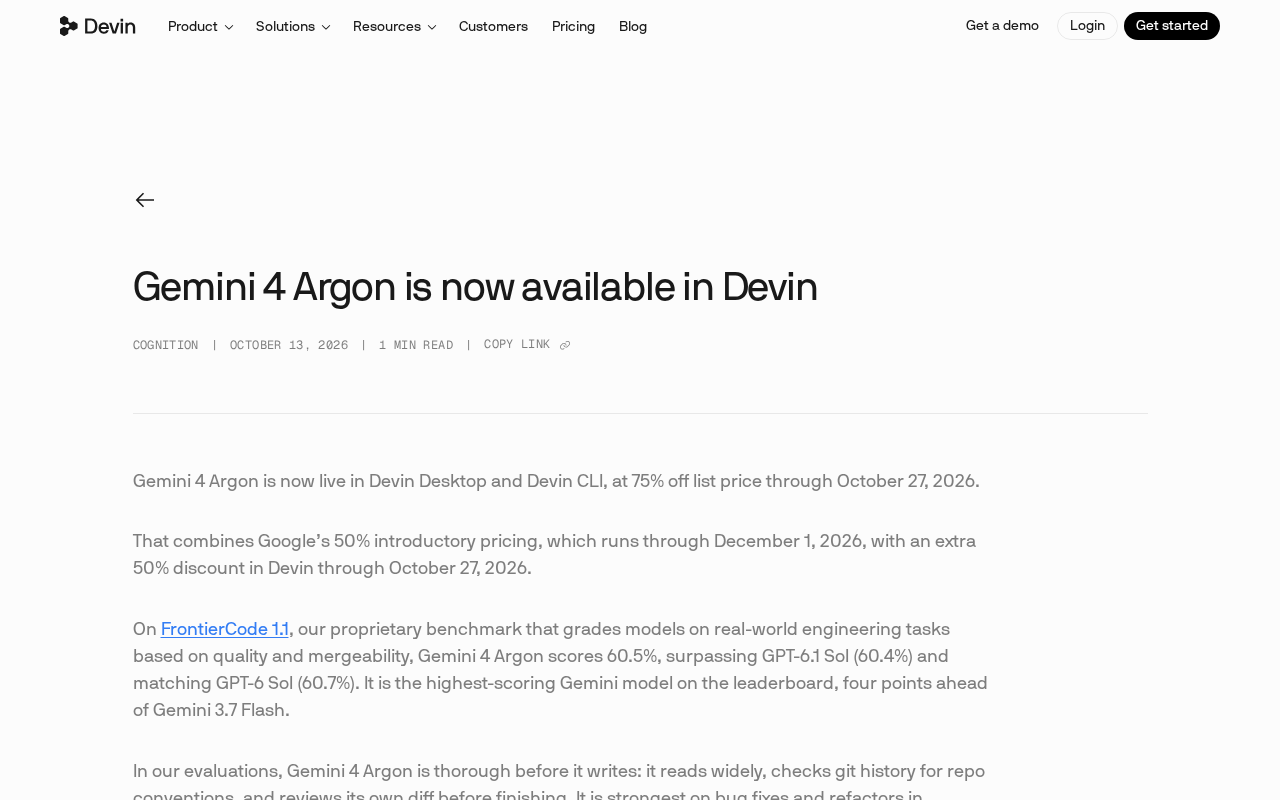
AI coding agent platform Devin has announced that Gemini 4 Argon is now available across both Devin Desktop and Devin CLI. What makes this news notable isn't just the model's arrival — it's the 60.5% score it achieved on the coding arena benchmark FrontierCode 1.1, surpassing GPT-6.1 Sol, matching GPT-6 Sol, and becoming the strongest Gemini model on that leaderboard.
How a Model Lands on Two Product Lines in Two Days
Gemini 4 Argon's integration covers both Devin Desktop and Devin CLI simultaneously. This means whether users work through a graphical interface or a command-line workflow, they can directly invoke this model. Devin's product form has always leaned toward "autonomously executing coding tasks," and bringing stronger new models on board at the earliest opportunity is a fundamental move to maintain its competitiveness.
For developers who use Devin daily, this update carries no migration cost: there's simply one more option in the model list and one more, stronger candidate in terms of behavior. What truly needs judgment is which task types warrant switching away from the model you've been using.
What 60.5% on FrontierCode 1.1 Means
FrontierCode 1.1 is an evaluation benchmark targeting code generation and engineering tasks, with scores typically used to compare different models' capabilities in real-world programming scenarios. Gemini 4 Argon's 60.5% has several reference points within this framework:
- It exceeds GPT-6.1 Sol's score;
- It matches GPT-6 Sol;
- It is the highest score any Gemini-series model has achieved on FrontierCode 1.1.
It's worth noting that the absolute figure of 60.5% isn't particularly close to a perfect score, indicating that FrontierCode 1.1's problems still pose a substantial challenge to all current models. Competition in the 50% to 60% range often isn't about who's more reliable on easy problems, but who makes fewer mistakes on complex, multi-step tasks.
How Coding Arena Benchmarks Work
Coding benchmarks like FrontierCode 1.1 typically consist of a set of programming problems with hidden test cases, covering different difficulty tiers such as algorithms, refactoring, debugging, and multi-file modifications. Models generate code or patches after receiving task descriptions, and automated tests then determine whether they pass. Final scores are generally weighted pass rates, so the difficulty distribution of problems significantly affects absolute numbers. This is also why the same model can rank very differently across benchmarks: some benchmarks lean toward competitive algorithm problems, others toward real engineering tasks, and the two impose different capability requirements on models. When referencing score thresholds, what's more worth attention is a model's pass rate on complex multi-step tasks rather than the total score itself.
The 75% Pricing Window
Devin's pricing terms are: Gemini 4 Argon is billed at 75% of list price until October 27, 2026 — in other words, a 25% discount. For teams that invoke models at high frequency, such discount windows directly impact cost accounting — the billing difference between choosing the right model and the wrong one for the same month's usage could be considerable.
How prices will adjust after the discount expires can only be confirmed by official follow-up announcements. If your workflow includes tasks suitable for batch processing with this type of model, scheduling heavier invocations within the window period is the more cost-effective approach.
The Economics of Token-Based Billing and Discount Windows
Agent platforms calling large models typically bill by token, with different unit prices for input and output tokens — output generally being more expensive. In autonomous task execution scenarios like Devin, a single programming task often involves multiple rounds of model calls — reading files, generating patches, running tests, modifying based on errors — and the actual token consumption may be several times or even dozens of times that of a single-round Q&A. Therefore, changes in model unit price get amplified by the number of task rounds: a 25% discount on unit price means high-frequency teams' monthly bills may also drop by roughly a quarter. The discount window is especially suitable for batch tasks, such as large-scale refactoring of legacy codebases or test generation, where invocation volume is concentrated and can be planned in advance.
How to Decide Whether to Switch
High benchmark scores don't necessarily mean better usability in your project, especially when the codebase contains numerous private conventions and legacy patterns. A more pragmatic approach is to run comparative tests on three task types:
- Multi-file refactoring: See whether the model can produce compilable changes while understanding cross-file dependencies;
- Constrained code generation: Give it explicit interface signatures, style requirements, and boundary conditions, and observe compliance;
- Debugging and localization: Give it an error message and context, and check the accuracy of root cause identification rather than accepting a patch that runs but only treats symptoms.
FrontierCode 1.1 scores can serve as an initial screening signal, but they cannot replace your own regression tests. The gaps on leaderboards are a few percentage points, but in a specific project they could mean the difference between "passing in one shot" and "three rounds of back-and-forth" — or the reverse.
Why High Benchmark Scores Don't Equal Better Project Usability
Benchmark problems typically have clear task descriptions and clean initial code, whereas real projects are full of implicit conventions: naming habits, directory structures, internal library usage, historical workarounds. A model that performs strongly only on public problems may not infer these rules that aren't written in documentation. Additionally, benchmarks judge by test pass/fail, while projects also need to consider whether changes are maintainable and whether they introduce security or performance risks. Therefore, treating benchmark scores as an initial screening signal is reasonable, but before switching models it's best to conduct small-scale comparative experiments on your own codebase, comprehensively judging by real-task success rates, rework rounds, and manual review costs.
An Observation on the Competitive Landscape
Gemini 4 Argon tying with GPT-6 Sol on FrontierCode 1.1 while edging out GPT-6.1 Sol itself demonstrates that the gap in coding capability among current top models has narrowed to a very small range. For developers, this is actually good news: models are becoming more interchangeable, and the choice shifts back to "which platform's workflow is more convenient" and "which model is more stable in your scenario," rather than being forced to commit to a single model.
Devin's speed in model integration is also one of the core selling points of agent products like it. The faster models iterate, the more platform integration pace resembles a continuous arms race.
One-line Summary
Gemini 4 Argon launches on both Devin platforms with a FrontierCode 1.1 score of 60.5%, plus a limited-time 25% discount.
Paragraph Summary
Gemini 4 Argon is now available simultaneously on Devin Desktop and Devin CLI, covering both graphical and command-line usage paths, with no migration cost for developers to select it from the multi-model list. It achieved a 60.5% score on the coding arena benchmark FrontierCode 1.1, surpassing GPT-6.1 Sol, matching GPT-6 Sol, and marking the highest score for a Gemini-series model on that leaderboard. On pricing, it's billed at 75% of list price until October 27, 2026, offering cost appeal for high-frequency teams. The article advises against switching models based solely on benchmark scores, recommending instead comparative validation through three task types — multi-file refactoring, constrained code generation, and debugging localization — on your own codebase, since gaps remain between benchmark results and real-project performance.
Related articles

Random Pruning of the DPO Computation Graph: 1.4x Training Speedup and Lower Peak Memory
DPO training too slow and memory-hungry? This paper proposes a random pruning framework for the DPO computation graph, sampling independently across position, sequence, and branch dimensions; branch pruning achieves a 1.426x step-time speedup and cuts training time by about 30%, with in-depth attribution of memory and time gains.

Why Does JEPA Underperform MLM in Longitudinal EHR Representation Learning?
New study compares JEPA and MLM for longitudinal EHR representation learning on MIMIC-IV: three JEPA variants train stably without collapse but underperform MLM; target size, not heterogeneity, drives prediction error.

Transfer Learning + Visible Light Communication: A New Approach to Energy-Efficient Indoor Positioning
A study proposes a transfer learning-based visible light communication indoor positioning method, achieving 47% accuracy improvement on the BOSCH factory dataset, 67.5% model efficiency under high noise, and introducing the ME composite metric for energy-efficient positioning in energy-constrained industrial IoT scenarios.