DevPrep: Practice Technical Interviews with AI Voice Simulation, Speak Up and Get Instant Feedback

DevPrep uses AI voice interviews to get developers speaking and receiving instant feedback, with flashcards and a dashboard forming a practice loop.
DevPrep is a free developer interview practice tool that shifts prep from reading answers to actually speaking them out loud. It features AI voice interviews with real-time transcription and scoring, smart flashcards that auto-queue mistakes into spaced repetition review, and a dashboard tracking scores, streaks, and trends. It's currently in early stages, free for the first few sessions, with room to improve scoring accuracy and speech recognition.
Grinding problems, memorizing interview experiences, watching video explanations — most technical interview prep stays at the "input" level. But when you actually get to the interview, you find you can't articulate your thoughts. That's exactly the problem DevPrep aims to solve: get you to speak your answers out loud to an AI, instead of silently reading them.
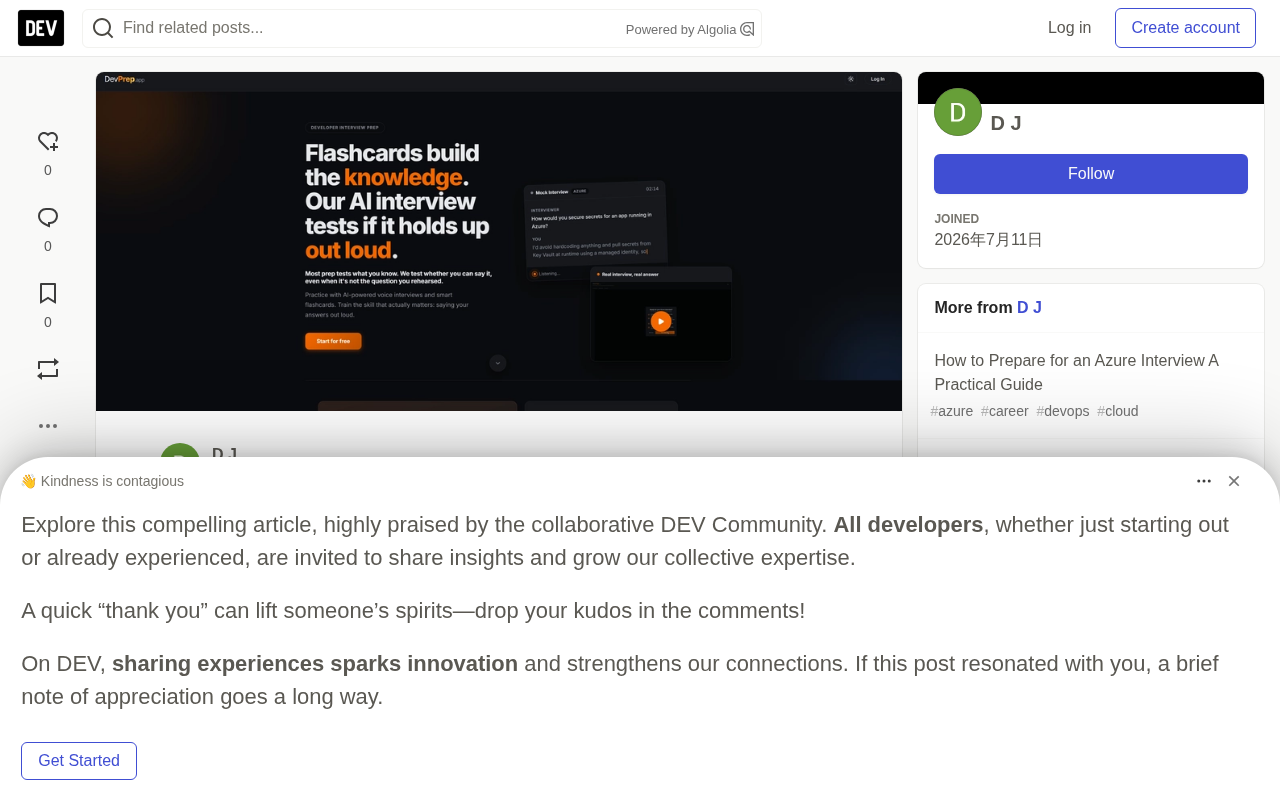
DevPrep in One Sentence
DevPrep is a free tool with the goal of shifting developer interview practice from "reading answers" to "actually practicing." It was released by its developer in the community and is still in its early stages — the author explicitly asks users to try it and share feedback on what features are missing or what experiences feel rough.
Structurally, it revolves around three modules: AI voice interviews, smart flashcards, and a data dashboard. Together they form a closed loop — practice, correct, track.
Core Features Breakdown
AI Voice Interview: You Only Really Know It When You Can Say It
This is DevPrep's most differentiated feature. It throws real interview questions at you, requires you to answer by voice, transcribes your response in real time, and gives you a score the moment you finish.
The value of this design lies in recreating the pressure of an actual interview. The hard part of a technical interview is often not "not knowing" — it's "knowing but not being able to explain it well." Being able to organize an answer in your head and being able to articulate it clearly out loud are two different skills. Many candidates are excellent at written tests but freeze up the moment they have to explain at a whiteboard or in a behavioral interview — the root cause is a lack of opportunities to practice speaking. DevPrep moves this step earlier in the process.
Instant scoring provides feedback speed. One of the biggest efficiency drains in interview prep is "practicing without knowing how well you're doing," and AI scoring at least gives you an iterable baseline.
Speech-to-Text (STT) is the technology that converts speech signals into text. Modern STT systems are mostly based on end-to-end deep learning architectures such as Whisper and Conformer, and their accuracy in quiet environments is already quite high. But technical interview scenarios still pose challenges: domain-specific terms (like Kubernetes, Dijkstra), English abbreviations, accents, and speech rate variations can all cause recognition errors.
Transcription quality directly determines the reliability of subsequent scoring — if transcription mishears "hash table" as something else, the scoring model may misjudge. Therefore, such tools typically need vocabulary enhancement or fine-tuning for vertical domains. Understanding this layer helps users judge in practice: is a low score due to the answer content, or noise from the transcription step? This is also one of the technical areas early products need to focus on refining.
Smart Flashcards: Wrong Answers Automatically Enter the Review Queue
The flashcard module's design logic is straightforward: you honestly rate your own mastery level, and anything marked as wrong or uncertain is automatically queued into a dedicated review deck.
This mechanism borrows from spaced repetition but is more closely tailored to interview scenarios — the forgetting curve for interview knowledge points is steep, especially for rote-material content that you never use in daily work and only encounter in interviews. Self-assessment relies on subjective honesty, but for self-disciplined developers, it saves the hassle of manually organizing a wrong-answer notebook.
Spaced Repetition is a learning technique based on the forgetting curve. Its core assumption is that memory decays over time, but if you review at the critical point just before forgetting, retention improves significantly. Typical algorithms (such as SM-2, from the SuperMemo family) adjust the next review interval based on the quality of feedback from each review — the more fluently you answer, the longer the interval; if you answer incorrectly or hesitate, the interval shortens. Tools like Anki and SuperMemo are all based on this principle.
In interview scenarios, spaced repetition works because rote knowledge points often go unused for long periods and are forgotten very quickly. Traditional wrong-answer notebooks rely on manual organization, are easy to miss things in, and update slowly; an automated spaced repetition system can delegate the decision of "which question should I review again in a few days" to an algorithm, and users only need to honestly report their mastery level. DevPrep's self-assessment is precisely the input signal for the spaced repetition system, and its accuracy directly determines the quality of the review queue.
Data Dashboard: Make Your Prep Progress Visible
Every practice session is recorded, gradually forming a progress profile that includes scores, consecutive practice days, and trend changes. More practically, it generates a "pre-exam cheat sheet" summarizing what you still need to focus on reviewing.
For candidates with longer prep cycles, this kind of visual tracking effectively combats the anxiety of "feeling like I've been preparing all along but not knowing how much progress I've made." The consecutive practice streak provides positive behavioral reinforcement.
Why "Speaking Out Loud" Deserves Its Own Tool
The technical interview prep space already has plenty of products: problem-grinding platforms, mock interview services, AI resume optimizers. But the vast majority of tools design the practice path around reading or coding, and conversational practice has long been neglected because its feedback cost is too high — finding someone to do a mock interview requires coordinating schedules and is hard to scale.
The maturity of speech recognition and AI scoring has changed this cost structure. DevPrep is hitting exactly this window: automating the experience of "having someone listen to you speak and give you an evaluation," making speaking practice something you can do anytime, without appointments, with instant feedback.
Cost and Current Stage
According to the author, the first few interview practice sessions are free, with no credit card required. The tool is currently in early development, with features still rapidly iterating based on feedback.
This means two things: on one hand, there's almost no barrier to trying it now, making it suitable to incorporate into your daily practice routine; on the other hand, as an early product, scoring accuracy, question bank coverage, and speech recognition stability all likely have room for improvement. The author's proactive stance in soliciting feedback also indicates the product form is not yet finalized.
For developers currently preparing for technical interviews, DevPrep offers a new dimension beyond traditional problem grinding — actually saying your answers out loud. Even just as a starting point for speaking practice, the act itself has value.
One-line Summary
DevPrep uses AI voice interviews to get developers speaking and receiving instant feedback, with flashcards and a dashboard forming a practice loop.
Paragraph Summary
DevPrep is a free developer interview practice tool positioned to shift interview prep from "reading answers" to "actually practicing out loud." It has three modules: AI voice interviews that pose real questions, require spoken answers, and provide real-time transcription and scoring; smart flashcards that automatically queue wrong answers into a spaced repetition review deck based on self-assessment; and a data dashboard that tracks scores, consecutive practice days, and trends, plus generates a pre-exam cheat sheet. The product targets the long-neglected pain point of "being able to think it through but not explain it well," leveraging mature speech recognition and AI scoring to automate the experience of "having someone listen and evaluate." It's currently in early stages, free for the first few sessions with no credit card required, and the author is soliciting feedback. Scoring accuracy, question bank coverage, and recognition stability still have room for improvement.
Related articles

Random Pruning of the DPO Computation Graph: 1.4x Training Speedup and Lower Peak Memory
DPO training too slow and memory-hungry? This paper proposes a random pruning framework for the DPO computation graph, sampling independently across position, sequence, and branch dimensions; branch pruning achieves a 1.426x step-time speedup and cuts training time by about 30%, with in-depth attribution of memory and time gains.

Why Does JEPA Underperform MLM in Longitudinal EHR Representation Learning?
New study compares JEPA and MLM for longitudinal EHR representation learning on MIMIC-IV: three JEPA variants train stably without collapse but underperform MLM; target size, not heterogeneity, drives prediction error.

Transfer Learning + Visible Light Communication: A New Approach to Energy-Efficient Indoor Positioning
A study proposes a transfer learning-based visible light communication indoor positioning method, achieving 47% accuracy improvement on the BOSCH factory dataset, 67.5% model efficiency under high noise, and introducing the ME composite metric for energy-efficient positioning in energy-constrained industrial IoT scenarios.