Dialogue-Augmented Bayesian Framework: Dynamic Task Allocation Under Partial Observability
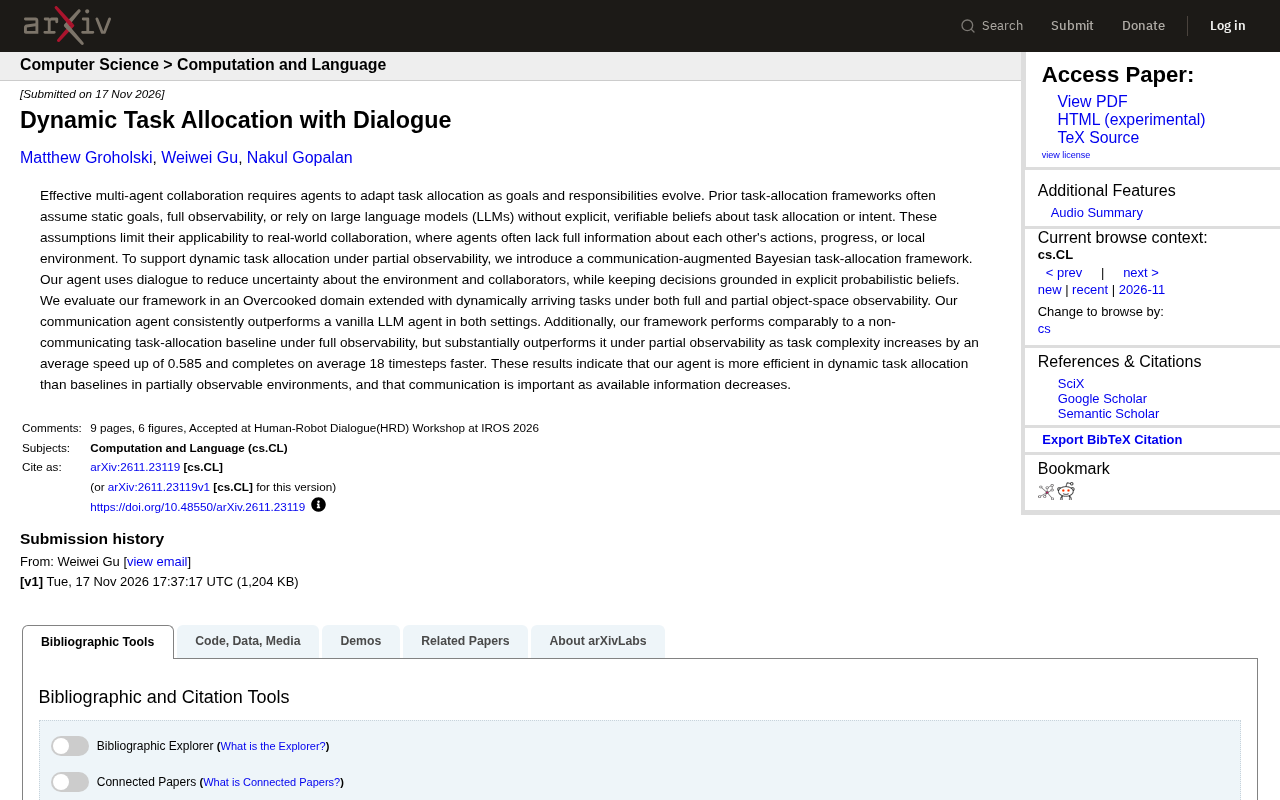
A communication-enhanced Bayesian task allocation framework that uses dialogue to fill information gaps under partial observability.
To address the limitations of static task allocation assumptions in multi-agent collaboration, this study proposes a communication-enhanced Bayesian task allocation framework. It uses dialogue to reduce uncertainty about the environment and teammates and grounds decisions in explicit probabilistic beliefs, making allocation dynamically adjustable and traceable. In Overcooked with dynamic tasks, communicating agents outperform ordinary LLM agents under both full and partial observability; under partial observability, they achieve an average speedup of 0.585 and complete tasks 18 time steps earlier on average versus a non-communicating baseline, with the advantage growing as task complexity increases. The results show that the value of communication is positively correlated with information scarcity, and that explicit beliefs plus communication is a pragmatic path to improving dynamic adaptability.
In multi-agent collaboration, task allocation is often simplified into a static optimization problem: fixed goals, omniscient environment, and transparent information among agents. But real-world collaborative scenarios rarely satisfy these conditions—what teammates are doing, how much progress has been made, and what has happened in the local environment are usually only a tip of the iceberg to an agent. A recent study from arXiv (rss source) proposes a communication-enhanced Bayesian task allocation framework that attempts to fill information gaps through dialogue, enabling agents to dynamically adjust their division of labor even under partial observability.
The Limits of Static Assumptions and the Challenges of Dynamic Allocation
Existing task allocation frameworks are usually built on three strong assumptions: goals are static, the environment is fully observable, or they directly rely on large language models (LLMs) for decision-making without maintaining explicit verifiable beliefs. These assumptions easily fail in real collaboration. When tasks arrive dynamically, teammates' behaviors are invisible, and local environment information is incomplete, methods based on static assumptions degrade rapidly.
More critically, many LLM-driven approaches, while flexible, lack explicit belief representations of task allocation intent. Agents "feel" what they should do, but cannot explain why the allocation is made that way, nor can they make traceable corrections when information updates. This leads to the core question of the study: how can task allocation decisions be both dynamic and trustworthy under partial observability?
Reducing Uncertainty Through Dialogue: Framework Design
The core mechanism of the framework is to use dialogue to reduce uncertainty about the environment and collaborators, while grounding decisions in explicit probabilistic beliefs. Agents exchange information about teammates' progress, intentions, and local observations through communication, incorporate this information into the Bayesian belief update process, and then make task allocation decisions based on the updated beliefs.
The ingenuity of this design lies in the fact that dialogue does not replace decision-making but serves it. LLMs can generate or understand dialogue content, but the final allocation action is driven by probabilistic beliefs, maintaining verifiability. Compared with pure LLM agents, this framework establishes a clearer connection between "what to say" and "what to do."
Bayesian belief updating is the core mechanism throughout the framework. In partially observable environments, agents cannot directly know the true state of the world (e.g., what a teammate is currently doing, whether a certain ingredient has been processed); they can only maintain a probability distribution over possible states, i.e., a belief. When an agent obtains new information—whether from its own local observation or from dialogue content from teammates—it combines the prior belief with the observation likelihood through Bayes' rule to obtain the posterior belief:
$$P(s \mid o) \propto P(o \mid s) , P(s)$$
where $s$ is the world state and $o$ is the new observation or communication information. The key advantage of this process is traceability: every belief change has a clear probabilistic basis, and decisions are no longer a black box but naturally derived results after information updates. In contrast, pure LLM agents often implicitly "remember" context and act on intuition, unable to explain why a certain allocation changed. Explicit Bayesian beliefs allow multi-agent systems to quantify uncertainty when information is insufficient and to precisely revise the division of labor after communication brings information gain.
Overcooked Experiments: Full vs. Partial Observability
The research team extended dynamically arriving tasks in the Overcooked domain and evaluated them under two settings: fully observable object space and partially observable object space. Overcooked is a classic test environment for multi-person collaborative cooking; after extending it with dynamic tasks, it better reflects the constantly changing task flow in real scenarios.
The experimental results show a clear divergence. Communicating agents consistently outperform ordinary LLM agents under both settings. When compared with a non-communicating task allocation baseline, the two perform comparably under full observability, but once partial observability is introduced, the advantage of the communication framework expands significantly as task complexity increases—with an average speedup of 0.585 and completing tasks on average 18 time steps earlier.
This set of data conveys a clear signal: the value of communication is positively correlated with the degree of information scarcity. The less agents know about the environment and teammates, the greater the information gain from dialogue.
Overcooked is a multi-person collaborative cooking environment proposed by Carroll et al., originally used to study implicit coordination between humans and AI (such as joint cooking in the Overcooked! game). In this environment, multiple agents share a kitchen and must divide tasks such as fetching ingredients, chopping, cooking, and serving to complete orders. Its core challenges are credit assignment and coordination: agents must infer teammates' intentions and avoid action conflicts, while the environment usually provides only partial observability. The original Overcooked uses a fixed order sequence; this study extends it to dynamically arriving tasks—orders appear randomly during runtime, forcing agents to continuously renegotiate the division of labor, thereby better reflecting the constantly changing task flow in real scenarios. This extension transforms Overcooked from a static collaboration benchmark into an ideal platform for testing dynamic task allocation and the value of communication.
Why Communication Matters More When Information Is Scarce
Under full observability, agents can directly see everything, so the marginal benefit of communication is naturally limited, consistent with the "comparable performance" result in the experiments. But under partial observability, each agent holds fragments of private information; without communication, each makes decisions based on incomplete information, leading to increased conflicts and duplicated work.
As task complexity increases, the cost of this information fragmentation is amplified. Communicating agents exchange key states through dialogue, reducing belief uncertainty, and thus re-coordinate the division of labor more quickly when dynamic tasks arrive. The gap of completing tasks on average 18 time steps earlier reflects differences in coordination efficiency, not differences in individual agent capabilities.
Partial observability is a core concept in multi-agent systems theory, referring to the fact that a single agent cannot obtain the complete state of the environment and can only observe local information relevant to itself. Under the "partially observable object space" setting in Overcooked, each agent can only see nearby objects and part of teammates' actions; the state of other areas of the kitchen (such as whether an ingredient has been taken or whether a pot is cooking) is invisible to it. This contrasts with full observability: under full observability, all agents share a complete state view, and the marginal information gain from communication approaches zero. Partial observability is precisely the source of communication value—each agent holds fragments of private information, and only by exchanging them through dialogue can they piece together a near-complete global picture, thereby reducing belief divergence and coordination conflicts. This concept also explains why communication benefits expand with task complexity: the more complex the task, the higher the cost of information fragmentation.
Implications for Multi-Agent System Design
The value of this work lies not only in the experimental results but also in pointing out a design direction: the combination of explicit beliefs + communication may be more effective at solving information problems in collaboration than simply scaling up model capabilities. For practical systems requiring multi-agent collaboration—whether robotic collaboration, automated workflows, or game AI—when the environment cannot be fully observed, having agents "speak clearly" and "record beliefs explicitly" is a pragmatic path to improving dynamic adaptability.
The study also leaves open questions: how to compress dialogue content to reduce communication overhead, how to extend belief representations to more complex task structures, and the scalability of the method in larger agent teams all warrant further exploration.
One-line Summary
A communication-enhanced Bayesian task allocation framework that uses dialogue to fill information gaps under partial observability.
Paragraph Summary
To address the limitations of static task allocation assumptions in multi-agent collaboration, this study proposes a communication-enhanced Bayesian task allocation framework. The framework uses dialogue to reduce uncertainty about the environment and teammates, and grounds decisions in explicit probabilistic beliefs, making allocation both dynamically adjustable and traceable. In an Overcooked environment extended with dynamic tasks, communicating agents outperform ordinary LLM agents under both full and partial observability; under partial observability, compared with a non-communicating baseline, they achieve an average speedup of 0.585 and complete tasks 18 time steps earlier on average, with the advantage expanding as task complexity increases. The results show that the value of communication is positively correlated with information scarcity, and that explicit beliefs plus communication is a pragmatic path to improving dynamic adaptability.
Related articles
GLM-5.4 Loop Transformer: 75B Parameters Deliver Trillion-Scale Reasoning
GLM-5.4 turns a 750B pretrained model into a Loop Transformer—28 layers looped twice, zero new parameters, AIME 25 up 11.3, outputs 14% shorter, reasoning moves into implicit depth.

Landlord's Comeback: Terminal Liver Cancer Survivor Relies on Tenant Wish System to Stay Alive
A Bilibili short drama follows Wu Youfu, who after transmigrating is diagnosed with terminal liver cancer and binds a Wish System, fulfilling three female tenants' wishes to earn lifespan rewards and unlock mind-reading, invisibility, and other skills as his condition improves from terminal to mid-stage.

Viral Griddle-Cake Stand Sparks Rent Doubling: Who Really Owns the Traffic?
In a viral Bilibili video, griddle-cake vendor Lao Bai makes a whole street famous, then the landlord doubles rent to 200,000. This article examines the dispute over offline traffic ownership: where is the boundary between property rights and individual creativity?