DiDi Open-Sources X-Helix: Making AI Coding Tools Truly Understand Enterprise Java Microservices

DiDi open-sources X-Helix, filling in the missing engineering context AI coding tools need for legacy enterprise projects.
Starting from developers repeatedly hitting walls with Claude Code and Codex on legacy enterprise projects, the article attributes the root cause to missing context from private wrappers, internal standards, and complex dependencies—not model capability. DiDi's X-Helix adds an engineering layer on top of AI Agents, covering requirements through archiving and accumulating knowledge for team reuse. Hands-on testing on a complex Java microservice project with a local small model showed significant improvements in compilation failures and internal method invocation. The project is early-stage (370 stars) and best suited for enterprise projects with private frameworks and complex dependencies.
Why Do AI Coding Tools Keep Failing on Legacy Enterprise Projects?
Many developers have had a similar experience: writing new projects with Claude Code and Codex feels effortless, but the moment you plug them into an old internal company project, everything falls apart. Bilibili creator Kuanpeng Talk shared his own pain points in a video—attempting AI coding on a complex legacy Java framework containing over a dozen microservices, only to end up with compilation failures, mismatched code style, and AI that had no idea it should call the enterprise's internally wrapped methods.
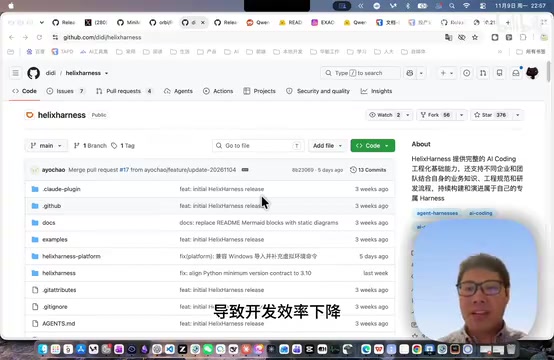
The root cause isn't model capability—it's missing context. Enterprises typically have a large number of privately wrapped frameworks, custom code standards, and review processes that never appear in public documentation. AI Agents can't access this information, so naturally they can't write code that meets the team's engineering standards. For relatively lightweight new projects in Python, Node, or Go, this problem isn't obvious. But when facing complex Java projects with private package dependencies, AI coding efficiency drops dramatically.
Context Window and Retrieval-Augmented Generation (RAG): AI coding tools perform well on new projects because new projects typically have less code, fewer dependencies, and lighter documentation that fit entirely within the model's context window. The context window refers to the maximum number of tokens a model can process in a single pass; beyond that, the model cannot "see" all the information. Legacy enterprise projects often have hundreds of thousands of lines of code, multiple layers of private dependencies, and internal documentation that far exceed the window capacity. RAG uses vector retrieval to recall relevant snippets from a knowledge base and feed them to the model, but this requires that the private content has already been indexed. X-Helix's knowledge accumulation mechanism is essentially building a retrievable engineering context for legacy projects, compensating for the model's inability to understand the full picture at once.
What Is X-Helix: Adding an Engineering Capability Layer on Top of AI Agents
DiDi's open-source X-Helix was born precisely to solve this pain point. According to the creator's understanding, it essentially establishes a layer of AI Coding engineering capability on top of Codex or Claude Code, bringing business knowledge and engineering standards into the Agent's workflow.
The entire process covers the full chain from requirements analysis, implementation, testing, and review to archiving. The key design is this: after each development cycle, the archived content is accumulated into the project's knowledge base, which can be directly reused for the next requirement—no need to repeatedly emphasize the project architecture to the AI, and no need to manually specify which documents to read each time.
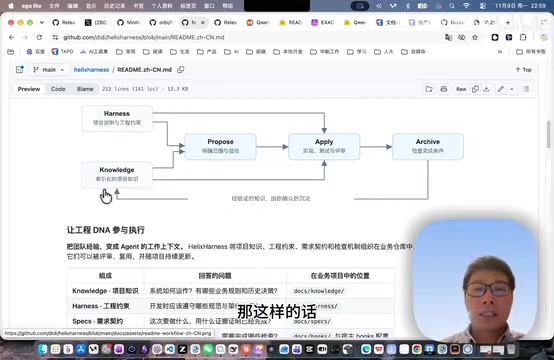
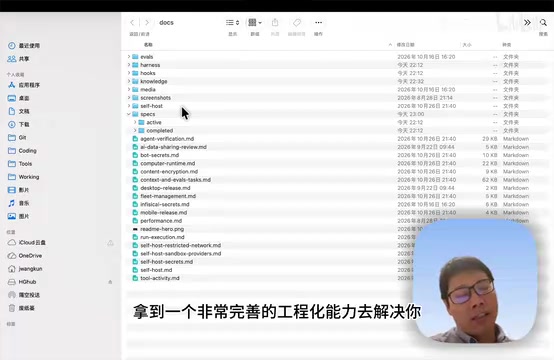
In terms of project structure, X-Helix generates two folders under the Docs directory: Helix and Knowledge. Knowledge serves as the knowledge base, while Helix contains requirement decomposition, coding conventions, and Hooks configuration—Hooks define which nodes trigger reviews and which steps require human review. During the creator's testing, the project hadn't been fully scanned yet, but the skeleton of this engineering framework was already visible.
AI Agent and Hooks Mechanism: An AI Agent refers to a model system that can autonomously plan, invoke tools, and execute multi-step tasks—Claude Code and Codex both fall into this category. Hooks are event triggers within the Agent workflow that allow automatic invocation of external scripts or review processes at specific nodes (such as after code generation or before submission). X-Helix uses Hooks to embed enterprise quality gates, code standard checks, and human reviews into the Agent's execution pipeline, ensuring that AI output is subject to engineering constraints before entering the codebase. This design shifts "post-hoc manual correction" to "in-process automatic interception," which is the key difference from using a bare Agent.
Hands-On Experience: Adaptation Results on a Complex Java Microservice Project
The creator validated this with a Personal Agent project, installing the Claude Code version and running it with a local free model (an 8B-level model from Qwen 3). The installation process is simple—Codex and Claude Code each have two corresponding commands. After execution, you run initialization once, and the tool automatically scans the legacy project and accumulates the content into the knowledge base.
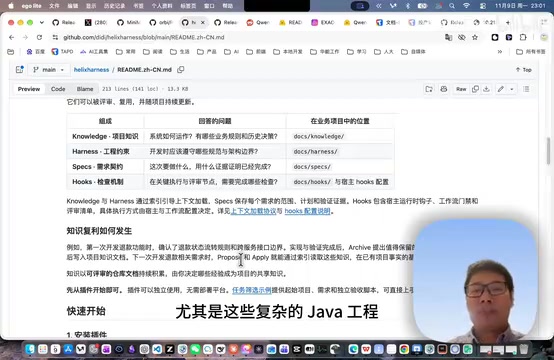
In hands-on testing, the previously encountered issues—compilation failures and failure to call internally wrapped methods—were significantly improved. The creator specifically noted that for large private production projects where you wouldn't dare let AI touch directly, this engineering capability provides a viable integration approach. On the coding conventions side, X-Helix comes with a built-in SPAC specification, and users can also import conventions they've accumulated in Cursor, OpenSPAC, or Claude SPAC to further enhance the engineering capability.
SPAC Specification: SPAC is a specification description system for AI coding, designed to provide code style, naming conventions, architectural constraints, and other engineering rules to models in structured text form. Since large models cannot automatically know an enterprise's internal coding habits, SPAC specifications serve as "executable specification manuals." X-Helix's built-in SPAC specification and support for importing existing specification files from Cursor, Claude, and other tools means teams can migrate long-accumulated engineering conventions, reducing repetitive configuration and minimizing the gap between AI output and team standards.
Closed-Loop Design for Knowledge Accumulation and Team Reuse
The most thoughtful part of X-Helix is its knowledge accumulation mechanism. After AI completes development, data is reported through logs, passes through quality gates, human review, and evolution confirmation, and is ultimately accumulated into the knowledge base. Individually accumulated knowledge can be shared with the team, forming organization-level engineering assets.
The tool also provides an observability dashboard where you can view project status, token consumption, usage data, and more, with support for custom configuration. However, the creator noted that he doesn't currently find the dashboard useful and is more focused on the knowledge base accumulation as the main thread.
It's worth noting objectively that this project currently has only 370 stars and is at a very early stage, with many capabilities still being refined. The creator's own project also has quite a bit of content that hasn't been accumulated yet. But from an architectural design perspective, it hits a real gap in enterprise-level AI coding—not making AI smarter, but making AI better understand your engineering system.
Who Is It For?
If you're mainly writing new projects in Python, Go, or Rust, X-Helix offers limited marginal benefit—using Claude Code or Codex directly is sufficient. But if you're dealing with enterprise-level projects that have private wrappers, internal standards, and complex dependency relationships—especially Java microservice architectures—this tool is worth trying. The installation barrier is low, and the creator ran it with a small local model and found it already covers daily development needs. If you're interested, keep an eye on the project's future iterations.
One-line Summary
DiDi open-sources X-Helix, filling in the missing engineering context that AI coding tools need for legacy enterprise projects.
Paragraph Summary
Starting from the phenomenon of developers repeatedly hitting walls with Claude Code and Codex on legacy enterprise projects, the article points out that the root cause lies in missing context due to private wrappers, internal standards, and complex dependencies—not insufficient model capability. DiDi's open-source X-Helix adds a layer of engineering capability on top of AI Agents, covering the full chain from requirements analysis, implementation, testing, and review to archiving, and uses the Knowledge base to accumulate each development experience for team reuse. The author tested it on a complex Java microservice project with a local small model and found that compilation failures and inability to call internal methods were significantly improved. The article also objectively notes that the project has only 370 stars and is at an early stage—suitable for enterprise projects with private frameworks and complex dependencies, with limited marginal benefit for new projects.
Related articles

From Vibe Coding to Enterprise-Grade: A Practical Guide to Engineering with Claude Code + Codex
A Bilibili hands-on tutorial: using Claude Code and Codex to go from Vibe Coding and Plan Mode to engineering enterprise e-commerce projects with Super Power, plus tool selection and model comparison.

LLM Interview Focus Shifts to Agents: Harness Engineering and Langfuse Tracing Become Must-Know Topics
2026 LLM application interviews now focus on AI agents: multi-agent systems, Harness engineering, Langfuse tracing/evaluation, and security mechanisms are must-know topics. This article covers interview trends and resume tips.

Claude Code Advanced Guide: 10 Tips to Stop Approving Manually
Based on The Benmore Brief's Claude Code tutorial, 10 practical tips: from Auto mode, effort levels, and side chats to phone remote control and scheduled tasks—stop approving every step.